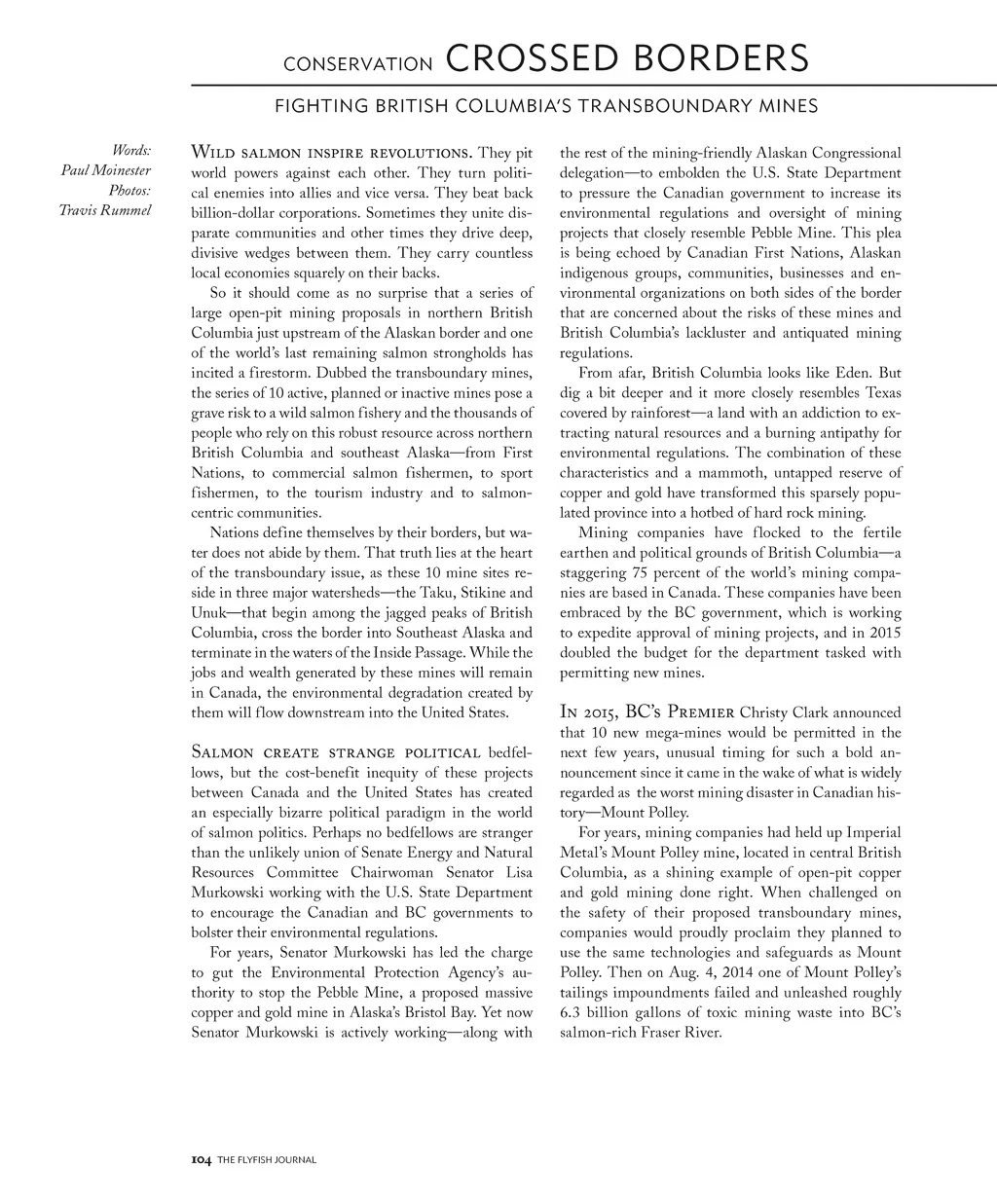
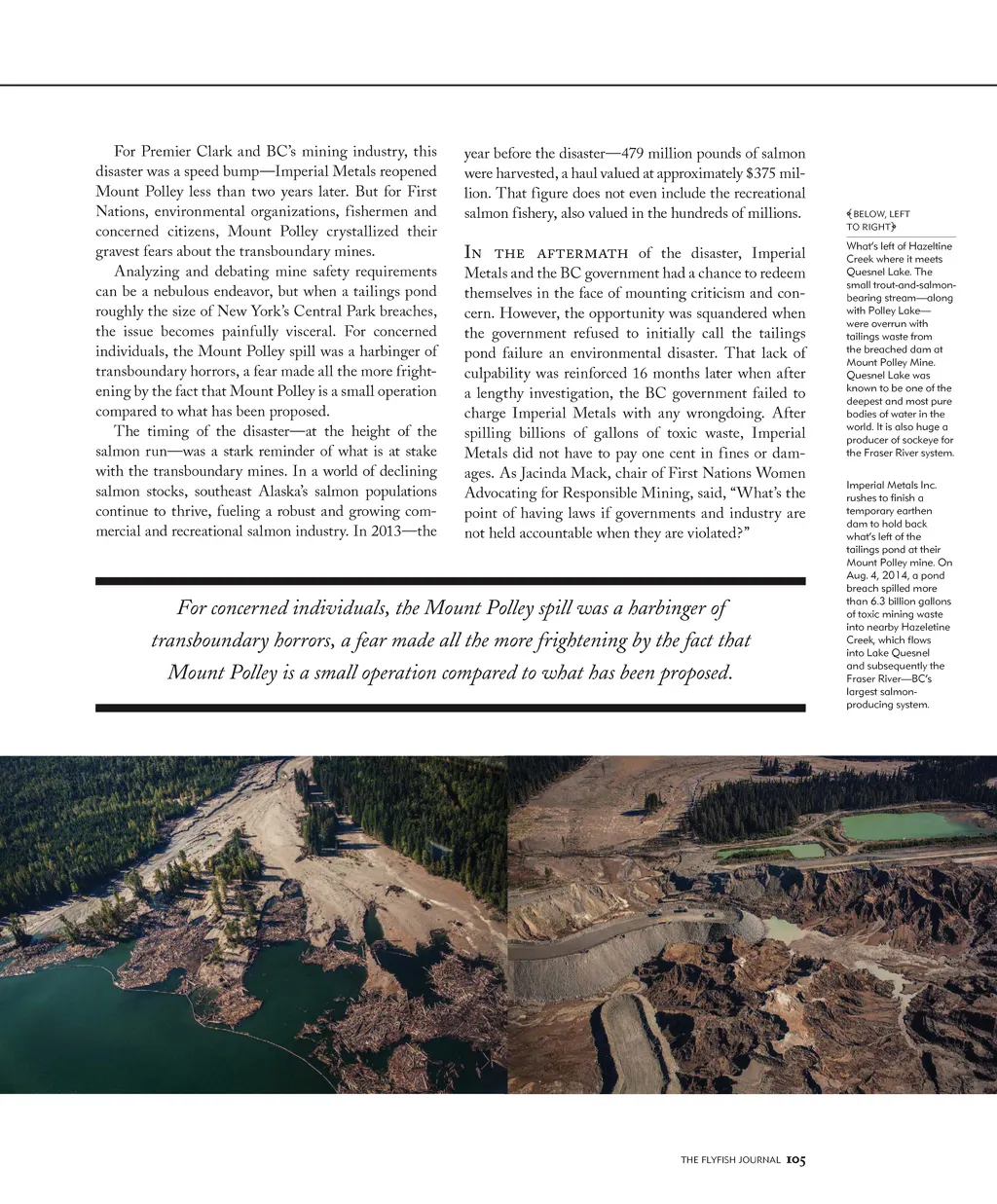
For Premier Clark and BC’s mining industry, this disaster was a speed bump—Imperial Metals reopened Mount Polley less than two years later. But for First Nations, environmental organizations, fishermen and concerned citizens, Mount Polley crystallized their gravest fears about the transboundary mines. Analyzing and debating mine safety requirements can be a nebulous endeavor, but when a tailings pond roughly the size of New York’s Central Park breaches, the issue becomes painfully visceral. For concerned individuals, the Mount Polley spill was a harbinger of transboundary horrors, a fear made all the more fright-ening by the fact that Mount Polley is a small operation compared to what has been proposed. The timing of the disaster—at the height of the salmon run—was a stark reminder of what is at stake with the transboundary mines. In a world of declining salmon stocks, southeast Alaska’s salmon populations continue to thrive, fueling a robust and growing com-mercial and recreational salmon industry. In 2013—the year before the disaster—479 million pounds of salmon were harvested, a haul valued at approximately $375 mil-lion. That figure does not even include the recreational salmon fishery, also valued in the hundreds of millions. BELOW, LEFT TO RIGHT In the aftermath of the disaster, Imperial Metals and the BC government had a chance to redeem themselves in the face of mounting criticism and con-cern. However, the opportunity was squandered when the government refused to initially call the tailings pond failure an environmental disaster. That lack of culpability was reinforced 16 months later when after a lengthy investigation, the BC government failed to charge Imperial Metals with any wrongdoing. After spilling billions of gallons of toxic waste, Imperial Metals did not have to pay one cent in fines or dam-ages. As Jacinda Mack, chair of First Nations Women Advocating for Responsible Mining, said, “What’s the point of having laws if governments and industry are not held accountable when they are violated?” What’s left of Hazeltine Creek where it meets Quesnel Lake. The small trout-and-salmon-bearing stream—along with Polley Lake— were overrun with tailings waste from the breached dam at Mount Polley Mine. Quesnel Lake was known to be one of the deepest and most pure bodies of water in the world. It is also huge a producer of sockeye for the Fraser River system. Imperial Metals Inc. rushes to finish a temporary earthen dam to hold back what’s left of the tailings pond at their Mount Polley mine. On Aug. 4, 2014, a pond breach spilled more than 6.3 billion gallons of toxic mining waste into nearby Hazeletine Creek, which flows into Lake Quesnel and subsequently the Fraser River—BC’s largest salmon-producing system. For concerned individuals, the Mount Polley spill was a harbinger of transboundary horrors, a fear made all the more frightening by the fact that Mount Polley is a small operation compared to what has been proposed. THE FLYFISH JOURNAL 105
The Flyfish Journal Volume Eight, Issue Two: Page 105