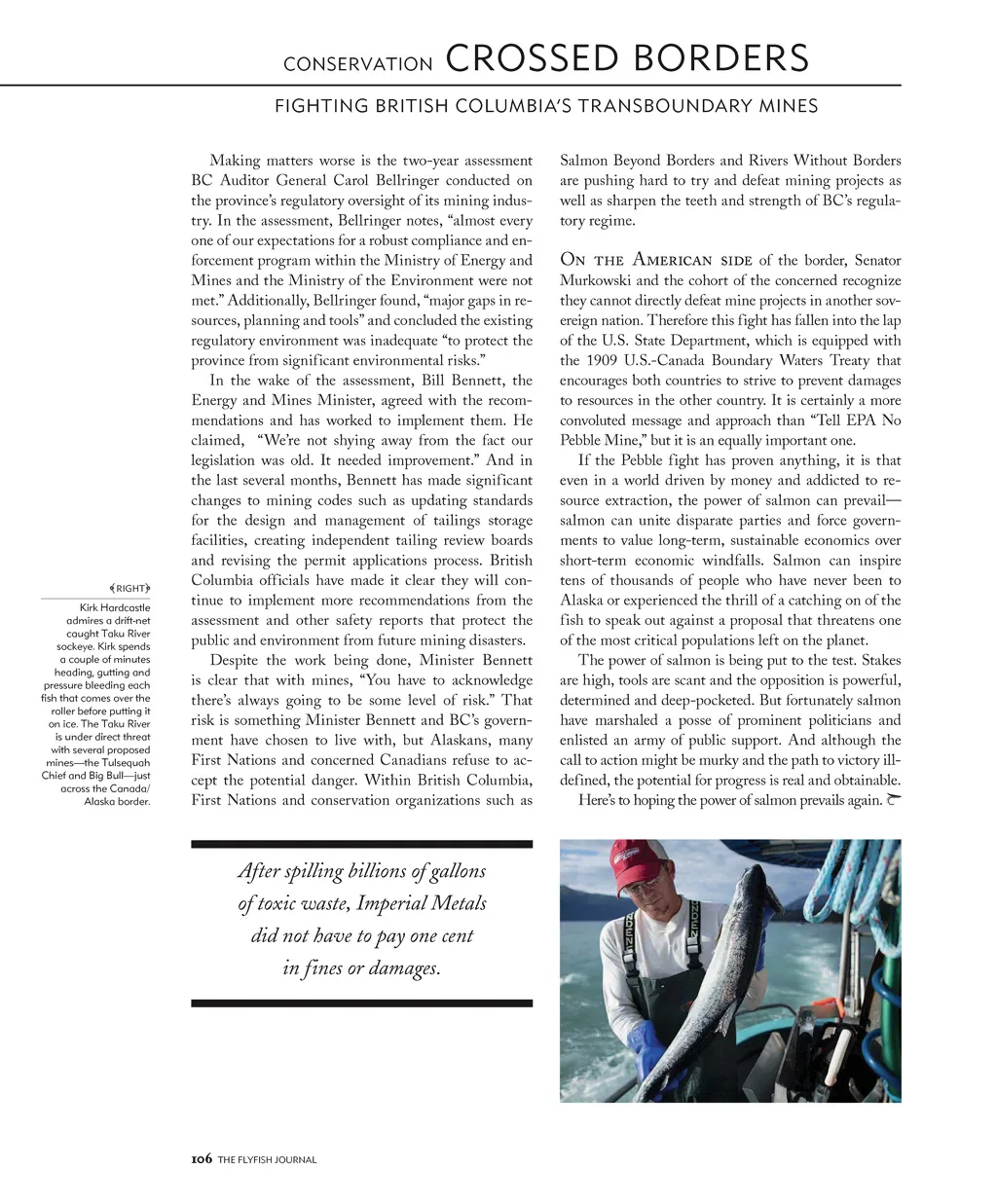
CONSERVATION CROSSED BORDERS Salmon Beyond Borders and Rivers Without Borders are pushing hard to try and defeat mining projects as well as sharpen the teeth and strength of BC’s regula-tory regime. FIGHTING BRITISH COLUMBIA’S TR ANSBOUNDARY MINES Making matters worse is the two-year assessment BC Auditor General Carol Bellringer conducted on the province’s regulatory oversight of its mining indus-try. In the assessment, Bellringer notes, “almost every one of our expectations for a robust compliance and en-forcement program within the Ministry of Energy and Mines and the Ministry of the Environment were not met.” Additionally, Bellringer found, “major gaps in re-sources, planning and tools” and concluded the existing regulatory environment was inadequate “to protect the province from significant environmental risks.” In the wake of the assessment, Bill Bennett, the Energy and Mines Minister, agreed with the recom-mendations and has worked to implement them. He claimed, “We’re not shying away from the fact our legislation was old. It needed improvement.” And in the last several months, Bennett has made significant changes to mining codes such as updating standards for the design and management of tailings storage facilities, creating independent tailing review boards and revising the permit applications process. British Columbia officials have made it clear they will con-tinue to implement more recommendations from the assessment and other safety reports that protect the public and environment from future mining disasters. Despite the work being done, Minister Bennett is clear that with mines, “You have to acknowledge there’s always going to be some level of risk.” That risk is something Minister Bennett and BC’s govern-ment have chosen to live with, but Alaskans, many First Nations and concerned Canadians refuse to ac-cept the potential danger. Within British Columbia, First Nations and conservation organizations such as RIGHT Kirk Hardcastle admires a drift-net caught Taku River sockeye. Kirk spends a couple of minutes heading, gutting and pressure bleeding each fish that comes over the roller before putting it on ice. The Taku River is under direct threat with several proposed mines—the Tulsequah Chief and Big Bull—just across the Canada/ Alaska border. On the American side of the border, Senator Murkowski and the cohort of the concerned recognize they cannot directly defeat mine projects in another sov-ereign nation. Therefore this fight has fallen into the lap of the U.S. State Department, which is equipped with the 1909 U.S.-Canada Boundary Waters Treaty that encourages both countries to strive to prevent damages to resources in the other country. It is certainly a more convoluted message and approach than “Tell EPA No Pebble Mine,” but it is an equally important one. If the Pebble fight has proven anything, it is that even in a world driven by money and addicted to re-source extraction, the power of salmon can prevail— salmon can unite disparate parties and force govern-ments to value long-term, sustainable economics over short-term economic windfalls. Salmon can inspire tens of thousands of people who have never been to Alaska or experienced the thrill of a catching on of the fish to speak out against a proposal that threatens one of the most critical populations left on the planet. The power of salmon is being put to the test. Stakes are high, tools are scant and the opposition is powerful, determined and deep-pocketed. But fortunately salmon have marshaled a posse of prominent politicians and enlisted an army of public support. And although the call to action might be murky and the path to victory ill-defined, the potential for progress is real and obtainable. Here’s to hoping the power of salmon prevails again. After spilling billions of gallons of toxic waste, Imperial Metals did not have to pay one cent in fines or damages. 106 THE FLYFISH JOURNAL
The Flyfish Journal Volume Eight, Issue Two: Page 106