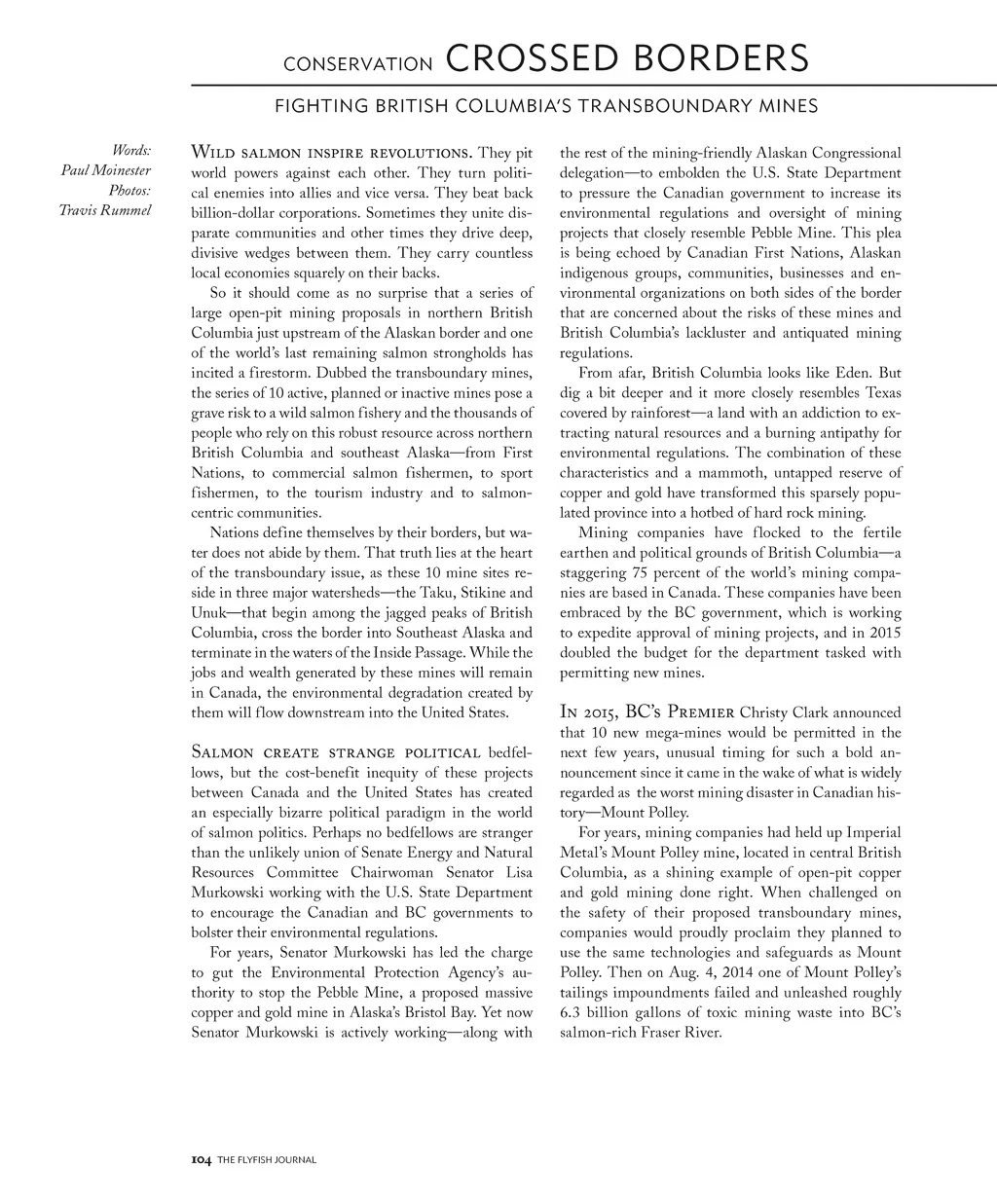
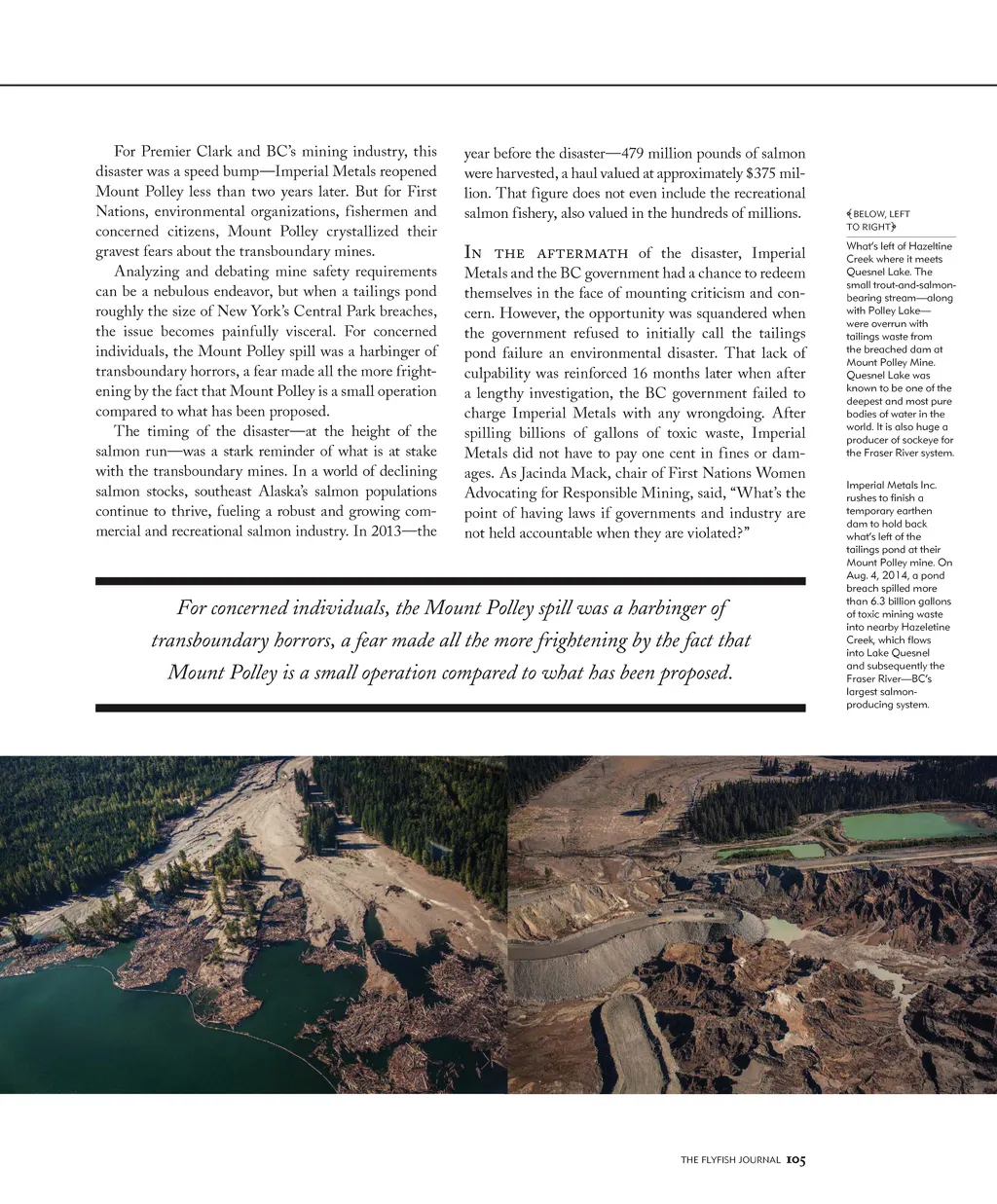
CONSERVATION CROSSED BORDERS the rest of the mining-friendly Alaskan Congressional delegation—to embolden the U.S. State Department to pressure the Canadian government to increase its environmental regulations and oversight of mining projects that closely resemble Pebble Mine. This plea is being echoed by Canadian First Nations, Alaskan indigenous groups, communities, businesses and en-vironmental organizations on both sides of the border that are concerned about the risks of these mines and British Columbia’s lackluster and antiquated mining regulations. From afar, British Columbia looks like Eden. But dig a bit deeper and it more closely resembles Texas covered by rainforest—a land with an addiction to ex-tracting natural resources and a burning antipathy for environmental regulations. The combination of these characteristics and a mammoth, untapped reserve of copper and gold have transformed this sparsely popu-lated province into a hotbed of hard rock mining. Mining companies have flocked to the fertile earthen and political grounds of British Columbia—a staggering 75 percent of the world’s mining compa-nies are based in Canada. These companies have been embraced by the BC government, which is working to expedite approval of mining projects, and in 2015 doubled the budget for the department tasked with permitting new mines. FIGHTING BRITISH COLUMBIA’S TR ANSBOUNDARY MINES Words: Paul Moinester Photos: Travis Rummel Wild salmon inspire revolutions. They pit world powers against each other. They turn politi-cal enemies into allies and vice versa. They beat back billion-dollar corporations. Sometimes they unite dis-parate communities and other times they drive deep, divisive wedges between them. They carry countless local economies squarely on their backs. So it should come as no surprise that a series of large open-pit mining proposals in northern British Columbia just upstream of the Alaskan border and one of the world’s last remaining salmon strongholds has incited a firestorm. Dubbed the transboundary mines, the series of 10 active, planned or inactive mines pose a grave risk to a wild salmon fishery and the thousands of people who rely on this robust resource across northern British Columbia and southeast Alaska—from First Nations, to commercial salmon fishermen, to sport fishermen, to the tourism industry and to salmon-centric communities. Nations define themselves by their borders, but wa-ter does not abide by them. That truth lies at the heart of the transboundary issue, as these 10 mine sites re-side in three major watersheds—the Taku, Stikine and Unuk—that begin among the jagged peaks of British Columbia, cross the border into Southeast Alaska and terminate in the waters of the Inside Passage. While the jobs and wealth generated by these mines will remain in Canada, the environmental degradation created by them will flow downstream into the United States. Salmon create strange political bedfel-lows, but the cost-benefit inequity of these projects between Canada and the United States has created an especially bizarre political paradigm in the world of salmon politics. Perhaps no bedfellows are stranger than the unlikely union of Senate Energy and Natural Resources Committee Chairwoman Senator Lisa Murkowski working with the U.S. State Department to encourage the Canadian and BC governments to bolster their environmental regulations. For years, Senator Murkowski has led the charge to gut the Environmental Protection Agency’s au-thority to stop the Pebble Mine, a proposed massive copper and gold mine in Alaska’s Bristol Bay. Yet now Senator Murkowski is actively working—along with In 2015, BC’s Premier Christy Clark announced that 10 new mega-mines would be permitted in the next few years, unusual timing for such a bold an-nouncement since it came in the wake of what is widely regarded as the worst mining disaster in Canadian his-tory—Mount Polley. For years, mining companies had held up Imperial Metal’s Mount Polley mine, located in central British Columbia, as a shining example of open-pit copper and gold mining done right. When challenged on the safety of their proposed transboundary mines, companies would proudly proclaim they planned to use the same technologies and safeguards as Mount Polley. Then on Aug. 4, 2014 one of Mount Polley’s tailings impoundments failed and unleashed roughly 6.3 billion gallons of toxic mining waste into BC’s salmon-rich Fraser River. 104 THE FLYFISH JOURNAL
The Flyfish Journal Volume Eight, Issue Two: Page 104