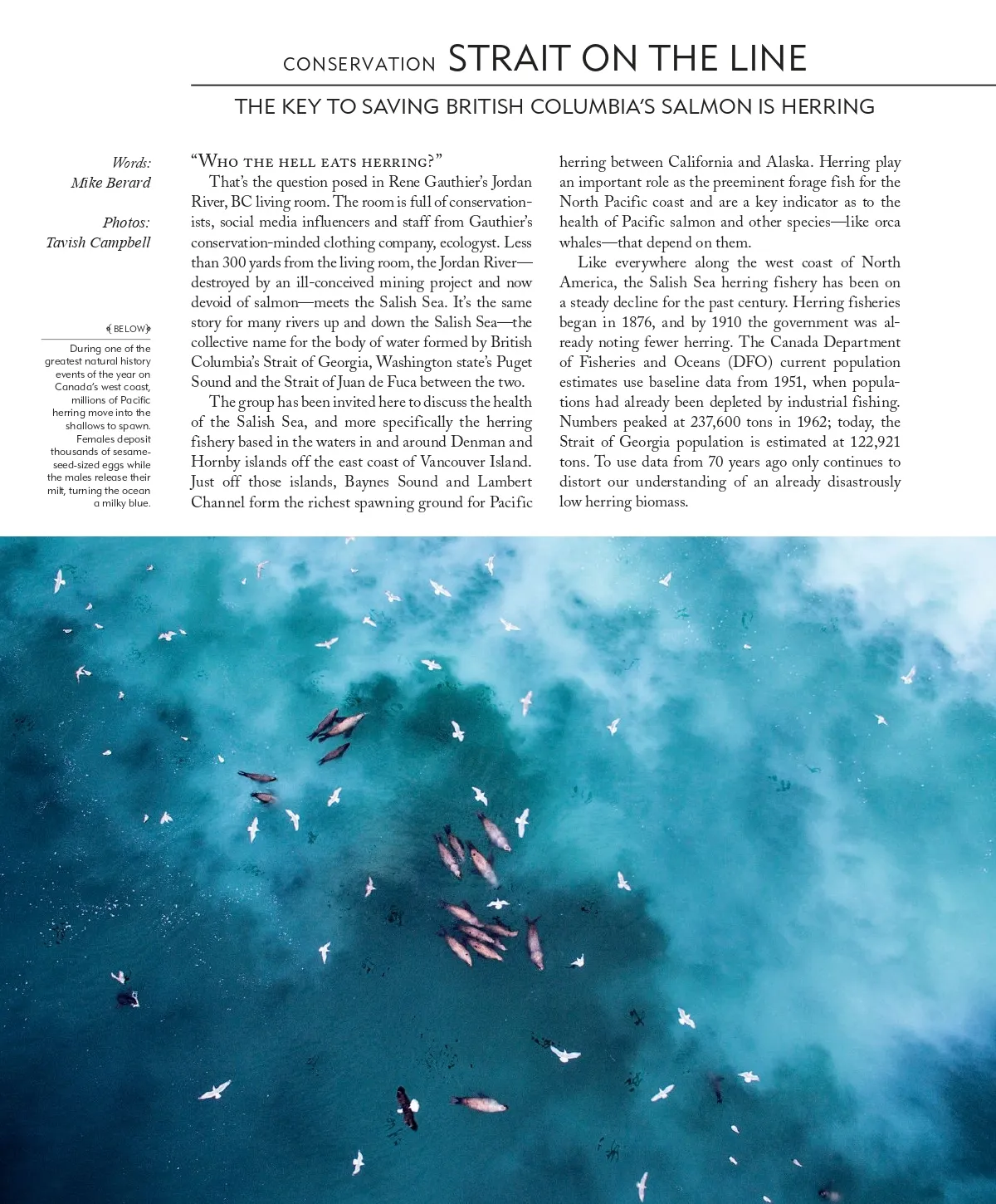
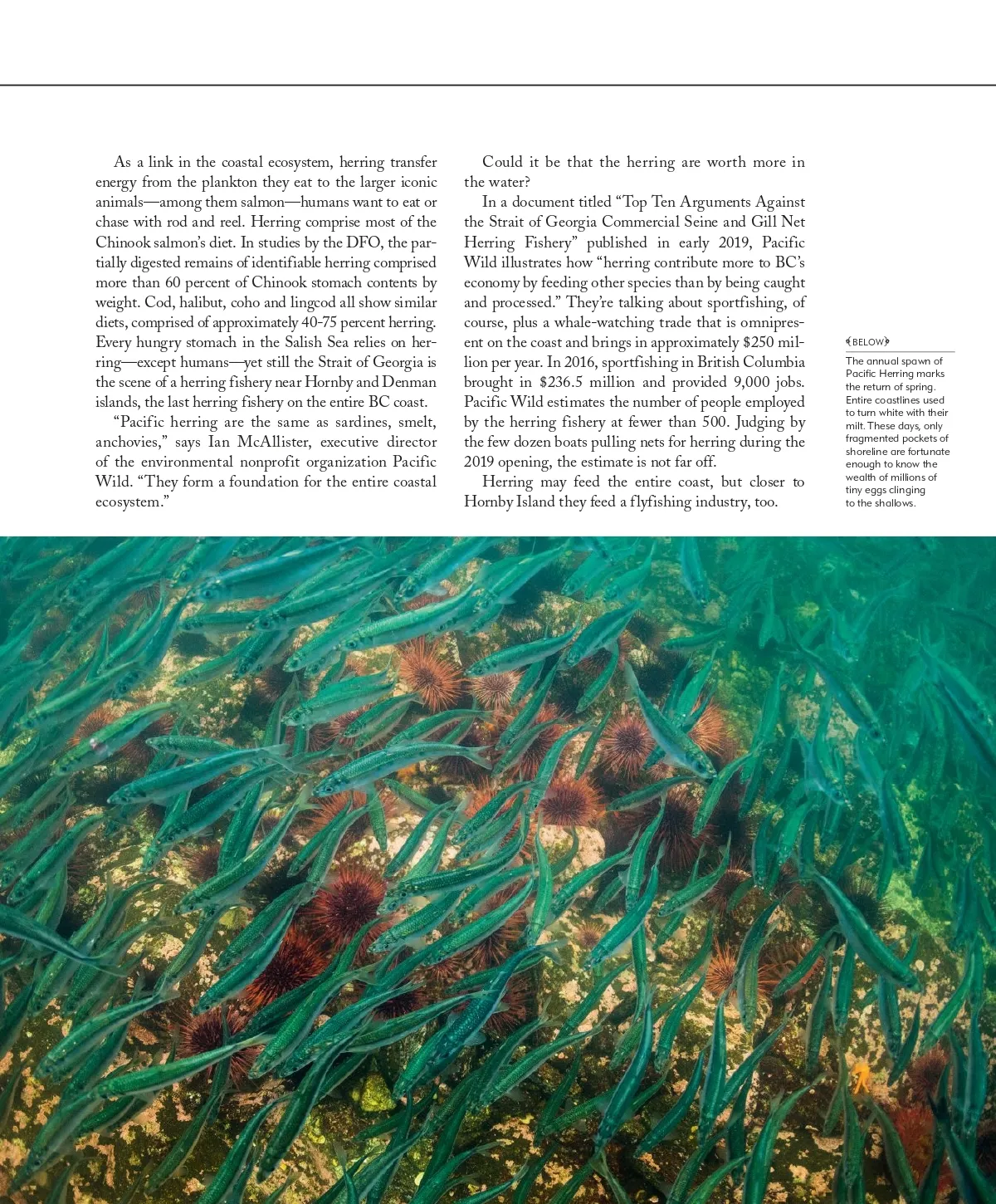
As a link in the coastal ecosystem, herring transfer energy from the plankton they eat to the larger iconic animals—among them salmon—humans want to eat or chase with rod and reel. Herring comprise most of the Chinook salmon’s diet. In studies by the DFO, the par-tially digested remains of identifiable herring comprised more than 60 percent of Chinook stomach contents by weight. Cod, halibut, coho and lingcod all show similar diets, comprised of approximately 40-75 percent herring. Every hungry stomach in the Salish Sea relies on her-ring—except humans—yet still the Strait of Georgia is the scene of a herring fishery near Hornby and Denman islands, the last herring fishery on the entire BC coast. “Pacific herring are the same as sardines, smelt, anchovies,” says Ian McAllister, executive director of the environmental nonprofit organization Pacific Wild. “They form a foundation for the entire coastal ecosystem.” Could it be that the herring are worth more in the water? In a document titled “Top Ten Arguments Against the Strait of Georgia Commercial Seine and Gill Net Herring Fishery” published in early 2019, Pacific Wild illustrates how “herring contribute more to BC’s economy by feeding other species than by being caught and processed.” They’re talking about sportfishing, of course, plus a whale-watching trade that is omnipres-ent on the coast and brings in approximately $250 mil-lion per year. In 2016, sportfishing in British Columbia brought in $236.5 million and provided 9,000 jobs. Pacific Wild estimates the number of people employed by the herring fishery at fewer than 500. Judging by the few dozen boats pulling nets for herring during the 2019 opening, the estimate is not far off. Herring may feed the entire coast, but closer to Hornby Island they feed a flyfishing industry, too. BELOW The annual spawn of Pacific Herring marks the return of spring. Entire coastlines used to turn white with their milt. These days, only fragmented pockets of shoreline are fortunate enough to know the wealth of millions of tiny eggs clinging to the shallows.
The Flyfish Journal Volume 11, Issue 1: Page 107