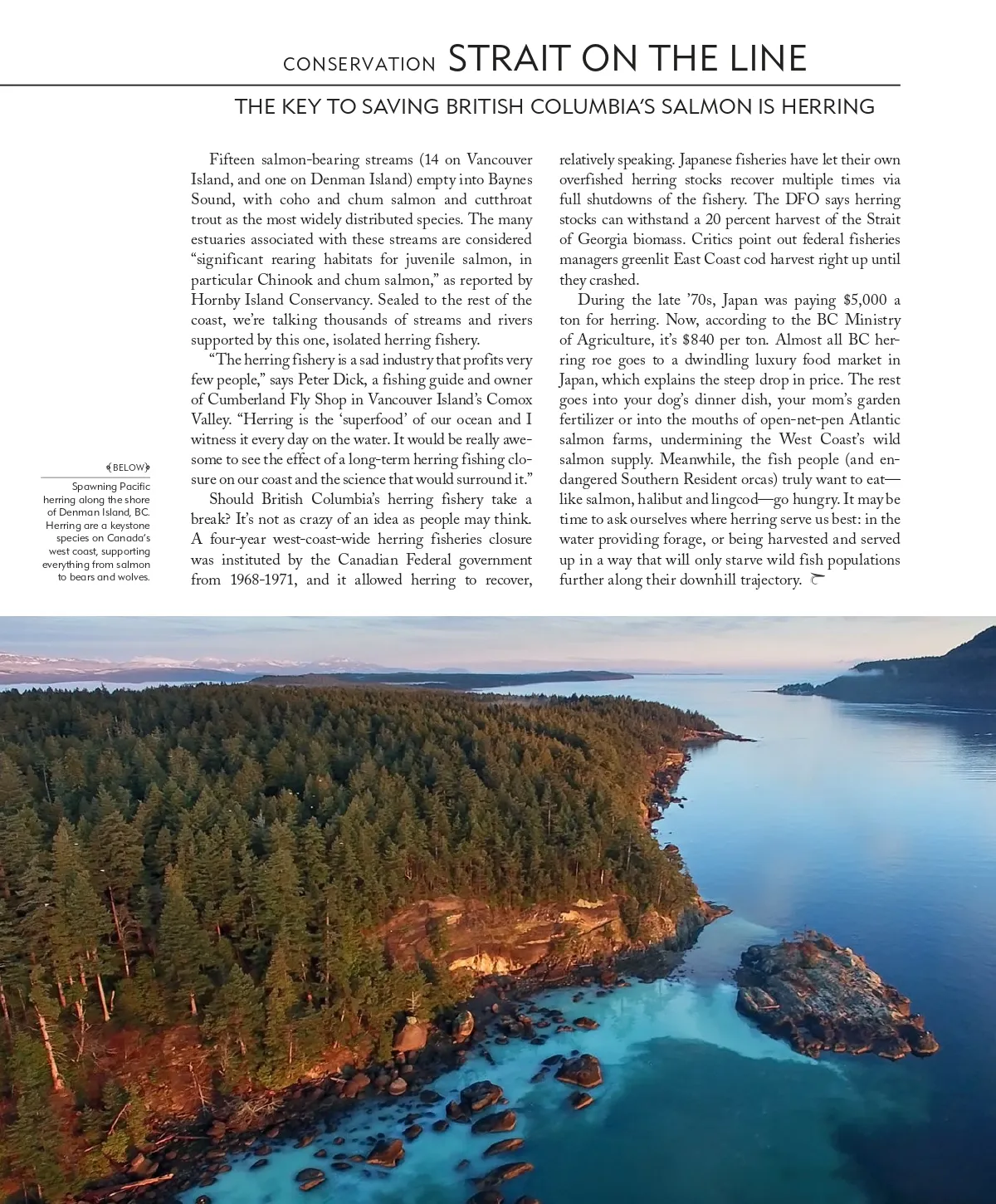
CONSERVATION STRAIT ON THE LINE relatively speaking. Japanese fisheries have let their own overfished herring stocks recover multiple times via full shutdowns of the fishery. The DFO says herring stocks can withstand a 20 percent harvest of the Strait of Georgia biomass. Critics point out federal fisheries managers greenlit East Coast cod harvest right up until they crashed. During the late ’70s, Japan was paying $5,000 a ton for herring. Now, according to the BC Ministry of Agriculture, it’s $840 per ton. Almost all BC her-ring roe goes to a dwindling luxury food market in Japan, which explains the steep drop in price. The rest goes into your dog’s dinner dish, your mom’s garden fertilizer or into the mouths of open-net-pen Atlantic salmon farms, undermining the West Coast’s wild salmon supply. Meanwhile, the fish people (and en-dangered Southern Resident orcas) truly want to eat— like salmon, halibut and lingcod—go hungry. It may be time to ask ourselves where herring serve us best: in the water providing forage, or being harvested and served up in a way that will only starve wild fish populations further along their downhill trajectory. THE KEY TO SAVING BRITISH COLUMBIA’S SALMON IS HERRING Fifteen salmon-bearing streams (14 on Vancouver Island, and one on Denman Island) empty into Baynes Sound, with coho and chum salmon and cutthroat trout as the most widely distributed species. The many estuaries associated with these streams are considered “significant rearing habitats for juvenile salmon, in particular Chinook and chum salmon,” as reported by Hornby Island Conservancy. Sealed to the rest of the coast, we’re talking thousands of streams and rivers supported by this one, isolated herring fishery. “The herring fishery is a sad industry that profits very few people,” says Peter Dick, a fishing guide and owner of Cumberland Fly Shop in Vancouver Island’s Comox Valley. “Herring is the ‘superfood’ of our ocean and I witness it every day on the water. It would be really awe-some to see the effect of a long-term herring fishing clo-sure on our coast and the science that would surround it.” Should British Columbia’s herring fishery take a break? It’s not as crazy of an idea as people may think. A four-year west-coast-wide herring fisheries closure was instituted by the Canadian Federal government from 1968-1971, and it allowed herring to recover, BELOW Spawning Pacific herring along the shore of Denman Island, BC. Herring are a keystone species on Canada’s west coast, supporting everything from salmon to bears and wolves.
The Flyfish Journal Volume 11, Issue 1: Page 108