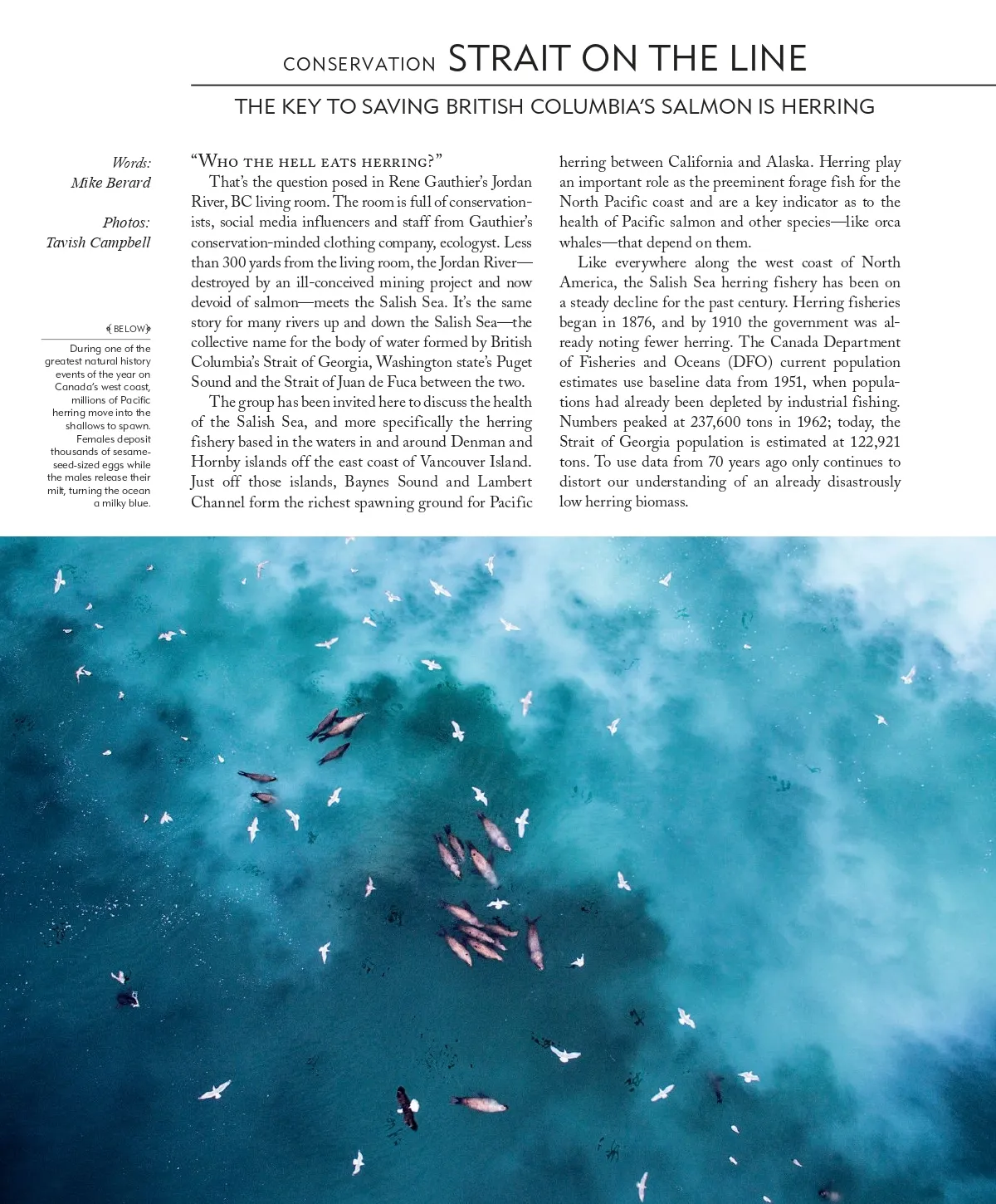
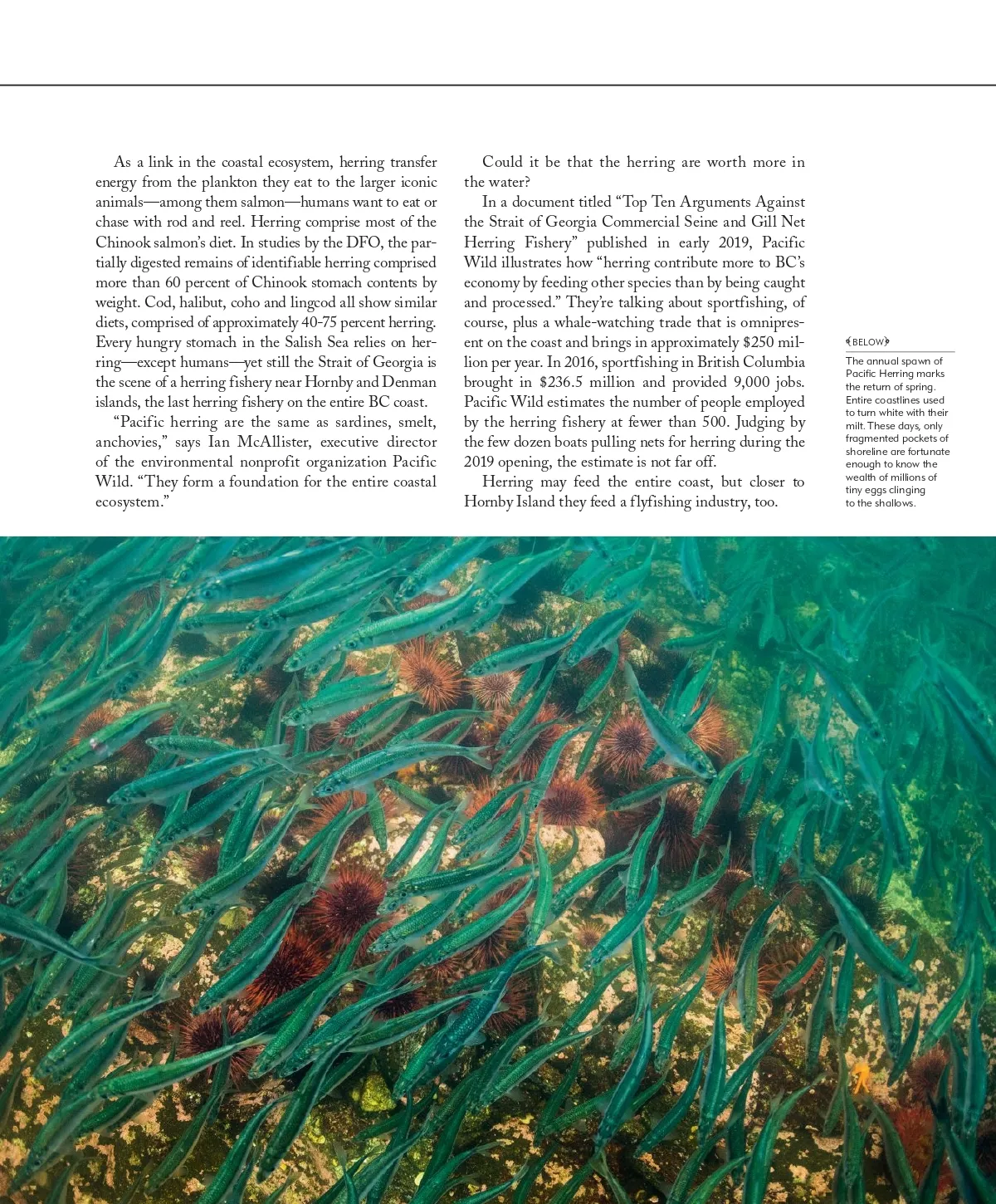
CONSERVATION STRAIT ON THE LINE herring between California and Alaska. Herring play an important role as the preeminent forage fish for the North Pacific coast and are a key indicator as to the health of Pacific salmon and other species—like orca whales—that depend on them. Like everywhere along the west coast of North America, the Salish Sea herring fishery has been on a steady decline for the past century. Herring fisheries began in 1876, and by 1910 the government was al-ready noting fewer herring. The Canada Department of Fisheries and Oceans (DFO) current population estimates use baseline data from 1951, when popula-tions had already been depleted by industrial fishing. Numbers peaked at 237,600 tons in 1962; today, the Strait of Georgia population is estimated at 122,921 tons. To use data from 70 years ago only continues to distort our understanding of an already disastrously low herring biomass. THE KEY TO SAVING BRITISH COLUMBIA’S SALMON IS HERRING Words: Mike Berard Photos: Tavish Campbell “Who the hell eats herring?” That’s the question posed in Rene Gauthier’s Jordan River, BC living room. The room is full of conservation-ists, social media influencers and staff from Gauthier’s conservation-minded clothing company, ecologyst. Less than 300 yards from the living room, the Jordan River— destroyed by an ill-conceived mining project and now devoid of salmon—meets the Salish Sea. It’s the same story for many rivers up and down the Salish Sea—the collective name for the body of water formed by British Columbia’s Strait of Georgia, Washington state’s Puget Sound and the Strait of Juan de Fuca between the two. The group has been invited here to discuss the health of the Salish Sea, and more specifically the herring fishery based in the waters in and around Denman and Hornby islands off the east coast of Vancouver Island. Just off those islands, Baynes Sound and Lambert Channel form the richest spawning ground for Pacific BELOW During one of the greatest natural history events of the year on Canada’s west coast, millions of Pacific herring move into the shallows to spawn. Females deposit thousands of sesame-seed-sized eggs while the males release their milt, turning the ocean a milky blue.
The Flyfish Journal Volume 11, Issue 1: Page 106