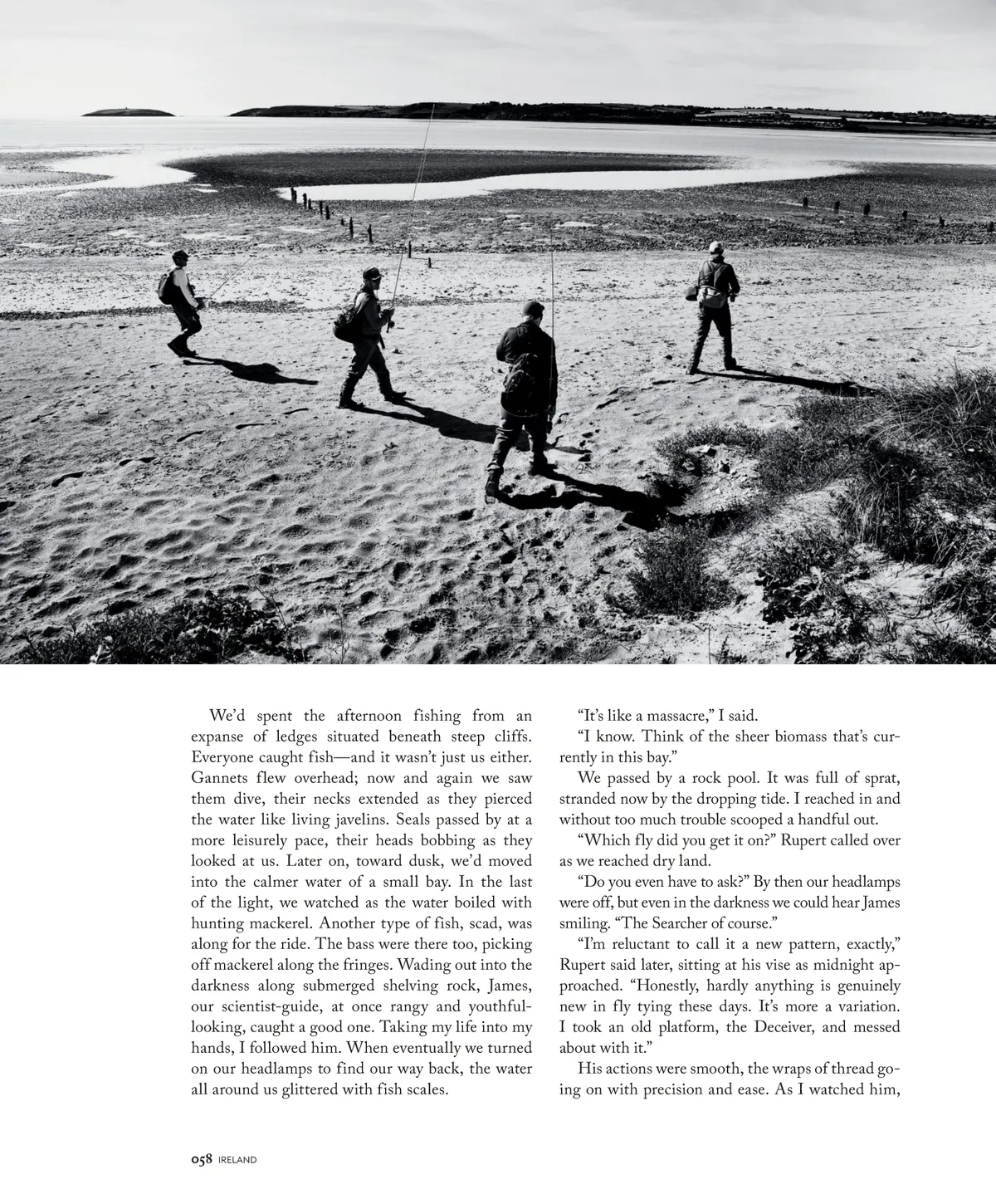
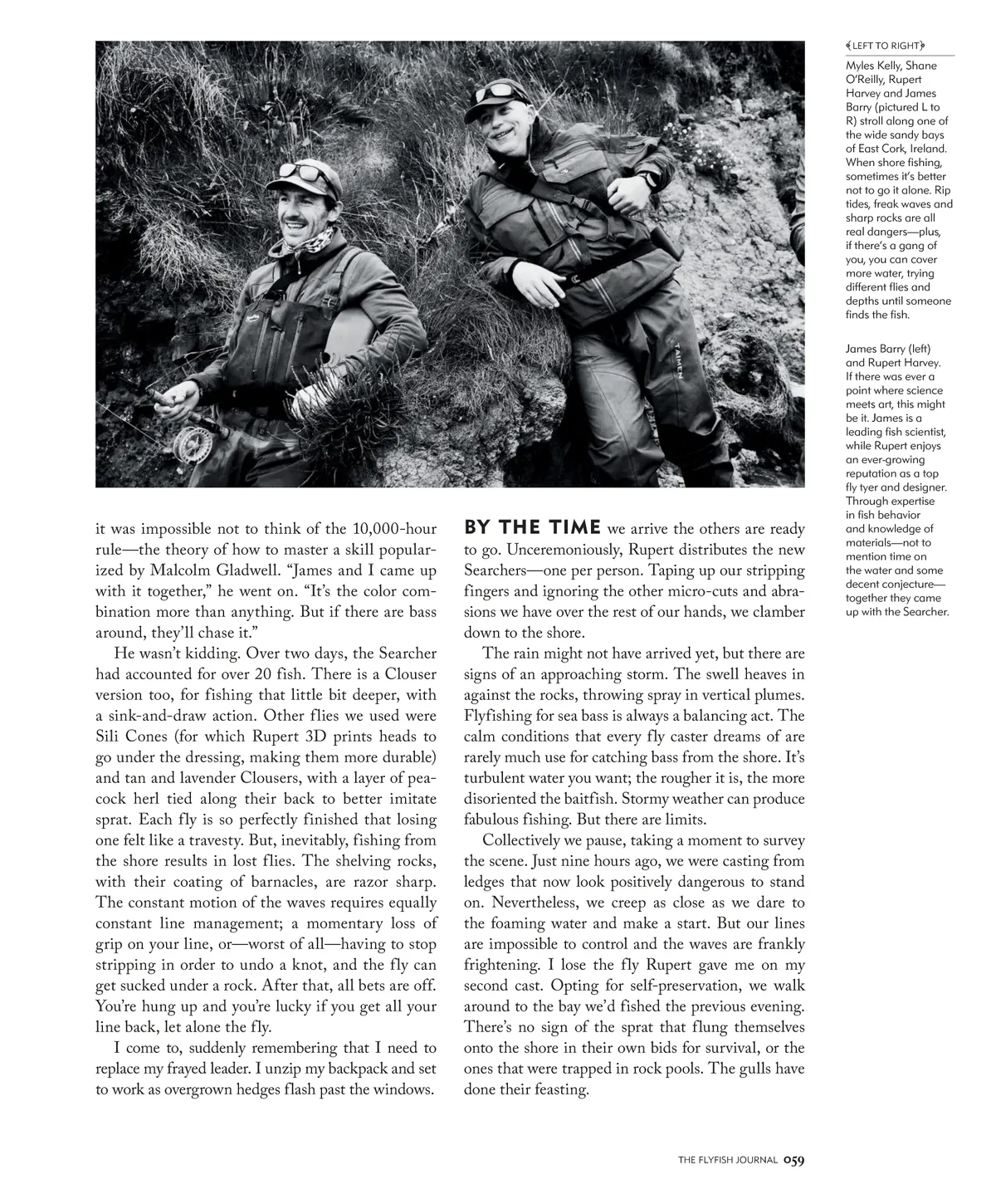
• LEFT TO RIGHT • Myles Kelly, Shane O’Reilly, Rupert Harvey and James Barry (pictured L to R) stroll along one of the wide sandy bays of East Cork, Ireland. When shore fishing, sometimes it’s better not to go it alone. Rip tides, freak waves and sharp rocks are all real dangers—plus, if there’s a gang of you, you can cover more water, trying different flies and depths until someone finds the fish. James Barry (left) and Rupert Harvey. If there was ever a point where science meets art, this might be it. James is a leading fish scientist, while Rupert enjoys an ever-growing reputation as a top fly tyer and designer. Through expertise in fish behavior and knowledge of materials—not to mention time on the water and some decent conjecture— together they came up with the Searcher. it was impossible not to think of the 10,000-hour rule—the theory of how to master a skill popular-ized by Malcolm Gladwell. “James and I came up with it together,” he went on. “It’s the color com-bination more than anything. But if there are bass around, they’ll chase it.” He wasn’t kidding. Over two days, the Searcher had accounted for over 20 fish. There is a Clouser version too, for fishing that little bit deeper, with a sink-and-draw action. Other flies we used were Sili Cones (for which Rupert 3D prints heads to go under the dressing, making them more durable) and tan and lavender Clousers, with a layer of pea-cock herl tied along their back to better imitate sprat. Each fly is so perfectly finished that losing one felt like a travesty. But, inevitably, fishing from the shore results in lost flies. The shelving rocks, with their coating of barnacles, are razor sharp. The constant motion of the waves requires equally constant line management; a momentary loss of grip on your line, or—worst of all—having to stop stripping in order to undo a knot, and the fly can get sucked under a rock. After that, all bets are off. You’re hung up and you’re lucky if you get all your line back, let alone the fly. I come to, suddenly remembering that I need to replace my frayed leader. I unzip my backpack and set to work as overgrown hedges flash past the windows. BY THE TIME we arrive the others are ready to go. Unceremoniously, Rupert distributes the new Searchers—one per person. Taping up our stripping fingers and ignoring the other micro-cuts and abra-sions we have over the rest of our hands, we clamber down to the shore. The rain might not have arrived yet, but there are signs of an approaching storm. The swell heaves in against the rocks, throwing spray in vertical plumes. Flyfishing for sea bass is always a balancing act. The calm conditions that every fly caster dreams of are rarely much use for catching bass from the shore. It’s turbulent water you want; the rougher it is, the more disoriented the baitfish. Stormy weather can produce fabulous fishing. But there are limits. Collectively we pause, taking a moment to survey the scene. Just nine hours ago, we were casting from ledges that now look positively dangerous to stand on. Nevertheless, we creep as close as we dare to the foaming water and make a start. But our lines are impossible to control and the waves are frankly frightening. I lose the fly Rupert gave me on my second cast. Opting for self-preservation, we walk around to the bay we’d fished the previous evening. There’s no sign of the sprat that flung themselves onto the shore in their own bids for survival, or the ones that were trapped in rock pools. The gulls have done their feasting. THE FLYFISH JOURNAL 059
The Flyfish Journal The Flyfish Journal 15.4: Page 57