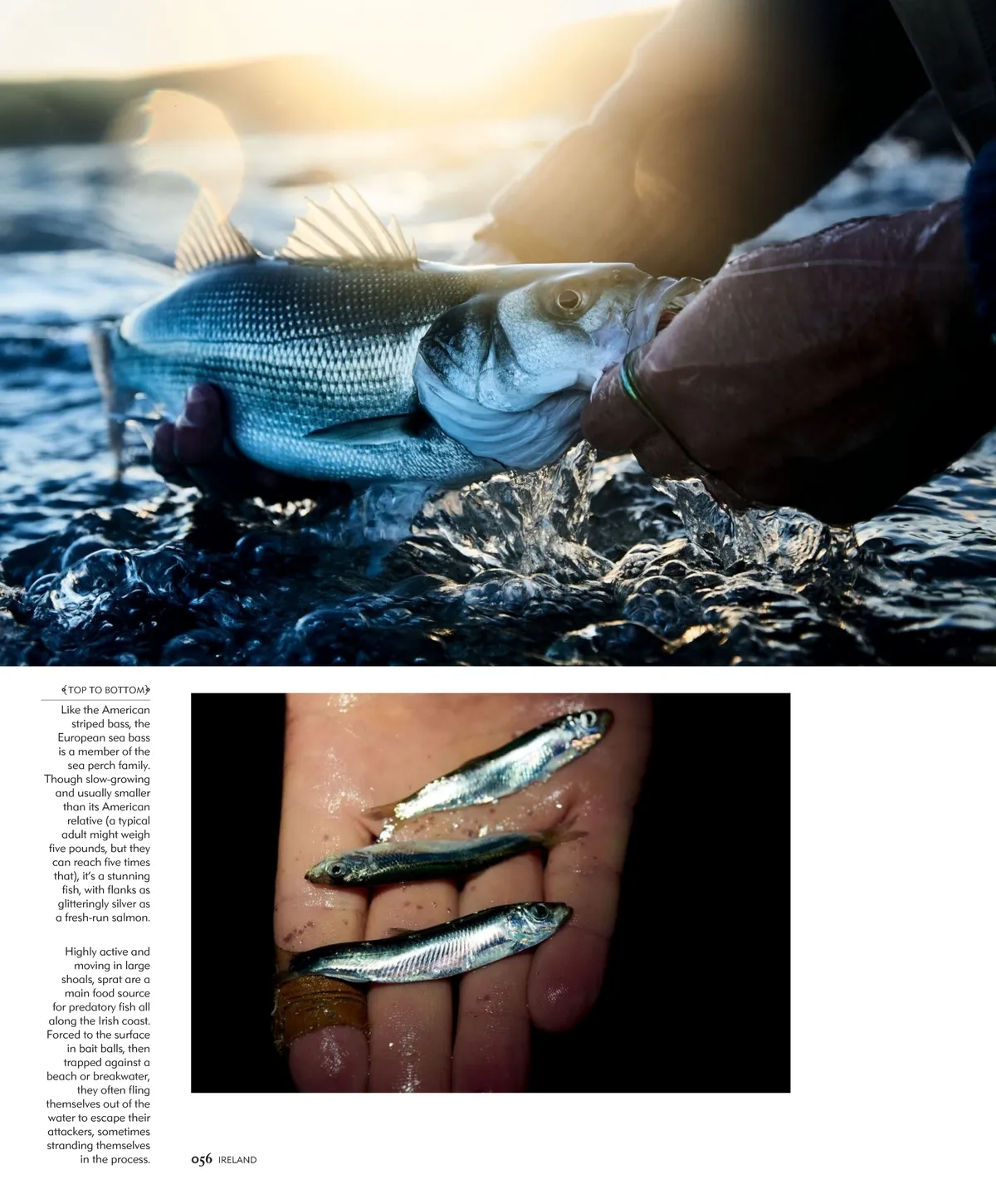
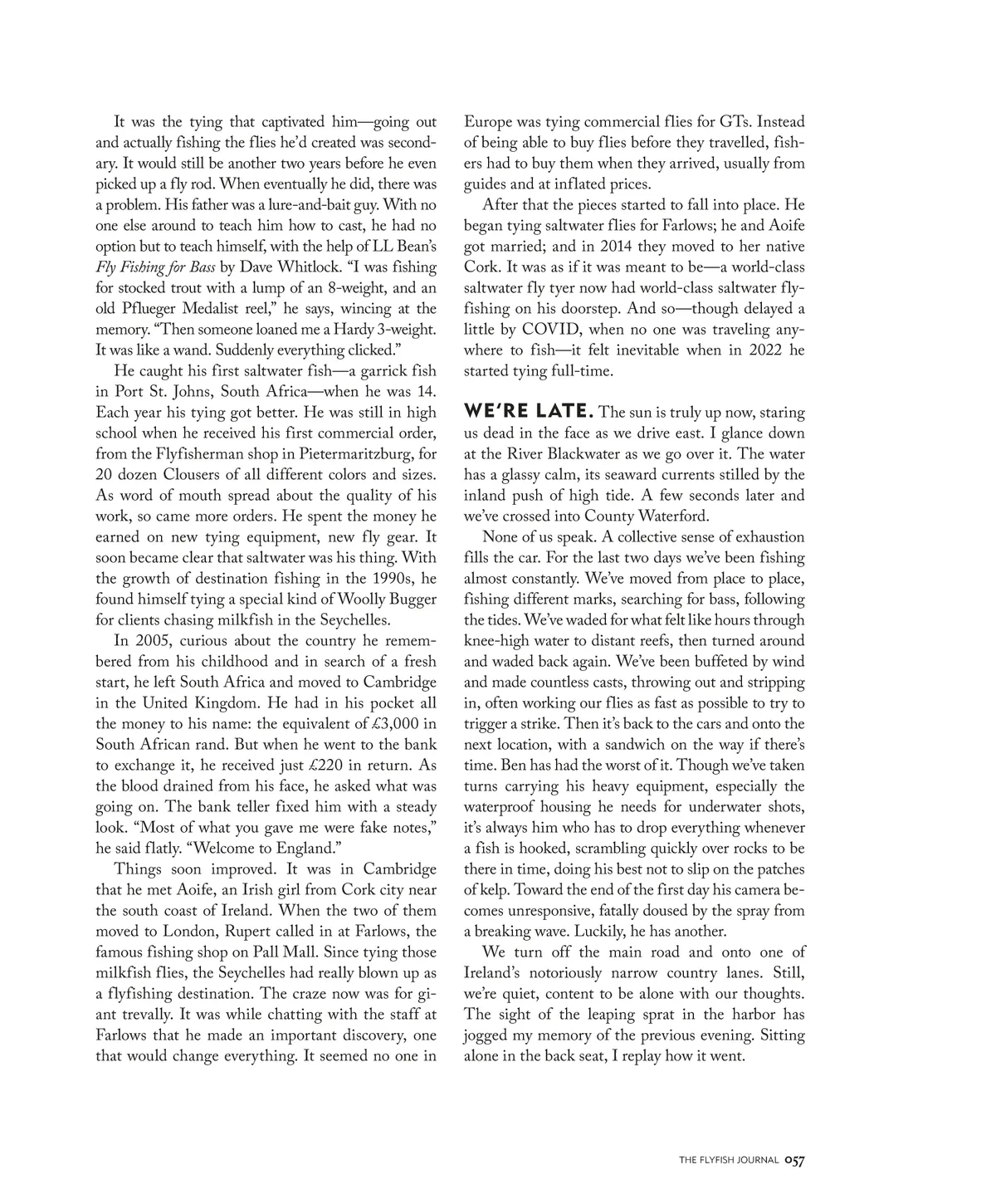
It was the tying that captivated him—going out and actually fishing the flies he’d created was second-ary. It would still be another two years before he even picked up a fly rod. When eventually he did, there was a problem. His father was a lure-and-bait guy. With no one else around to teach him how to cast, he had no option but to teach himself, with the help of LL Bean’s Fly Fishing for Bass by Dave Whitlock. “I was fishing for stocked trout with a lump of an 8-weight, and an old Pflueger Medalist reel,” he says, wincing at the memory. “Then someone loaned me a Hardy 3-weight. It was like a wand. Suddenly everything clicked.” He caught his first saltwater fish—a garrick fish in Port St. Johns, South Africa—when he was 14. Each year his tying got better. He was still in high school when he received his first commercial order, from the Flyfisherman shop in Pietermaritzburg, for 20 dozen Clousers of all different colors and sizes. As word of mouth spread about the quality of his work, so came more orders. He spent the money he earned on new tying equipment, new fly gear. It soon became clear that saltwater was his thing. With the growth of destination fishing in the 1990s, he found himself tying a special kind of Woolly Bugger for clients chasing milkfish in the Seychelles. In 2005, curious about the country he remem-bered from his childhood and in search of a fresh start, he left South Africa and moved to Cambridge in the United Kingdom. He had in his pocket all the money to his name: the equivalent of £3,000 in South African rand. But when he went to the bank to exchange it, he received just £220 in return. As the blood drained from his face, he asked what was going on. The bank teller fixed him with a steady look. “Most of what you gave me were fake notes,” he said flatly. “Welcome to England.” Things soon improved. It was in Cambridge that he met Aoife, an Irish girl from Cork city near the south coast of Ireland. When the two of them moved to London, Rupert called in at Farlows, the famous fishing shop on Pall Mall. Since tying those milkfish flies, the Seychelles had really blown up as a flyfishing destination. The craze now was for gi-ant trevally. It was while chatting with the staff at Farlows that he made an important discovery, one that would change everything. It seemed no one in Europe was tying commercial flies for GTs. Instead of being able to buy flies before they travelled, fish-ers had to buy them when they arrived, usually from guides and at inflated prices. After that the pieces started to fall into place. He began tying saltwater flies for Farlows; he and Aoife got married; and in 2014 they moved to her native Cork. It was as if it was meant to be—a world-class saltwater fly tyer now had world-class saltwater fly-fishing on his doorstep. And so—though delayed a little by COVID, when no one was traveling any-where to fish—it felt inevitable when in 2022 he started tying full-time. WE’RE LATE. The sun is truly up now, staring us dead in the face as we drive east. I glance down at the River Blackwater as we go over it. The water has a glassy calm, its seaward currents stilled by the inland push of high tide. A few seconds later and we’ve crossed into County Waterford. None of us speak. A collective sense of exhaustion fills the car. For the last two days we’ve been fishing almost constantly. We’ve moved from place to place, fishing different marks, searching for bass, following the tides. We’ve waded for what felt like hours through knee-high water to distant reefs, then turned around and waded back again. We’ve been buffeted by wind and made countless casts, throwing out and stripping in, often working our flies as fast as possible to try to trigger a strike. Then it’s back to the cars and onto the next location, with a sandwich on the way if there’s time. Ben has had the worst of it. Though we’ve taken turns carrying his heavy equipment, especially the waterproof housing he needs for underwater shots, it’s always him who has to drop everything whenever a fish is hooked, scrambling quickly over rocks to be there in time, doing his best not to slip on the patches of kelp. Toward the end of the first day his camera be-comes unresponsive, fatally doused by the spray from a breaking wave. Luckily, he has another. We turn off the main road and onto one of Ireland’s notoriously narrow country lanes. Still, we’re quiet, content to be alone with our thoughts. The sight of the leaping sprat in the harbor has jogged my memory of the previous evening. Sitting alone in the back seat, I replay how it went. THE FLYFISH JOURNAL 057
The Flyfish Journal The Flyfish Journal 15.4: Page 55