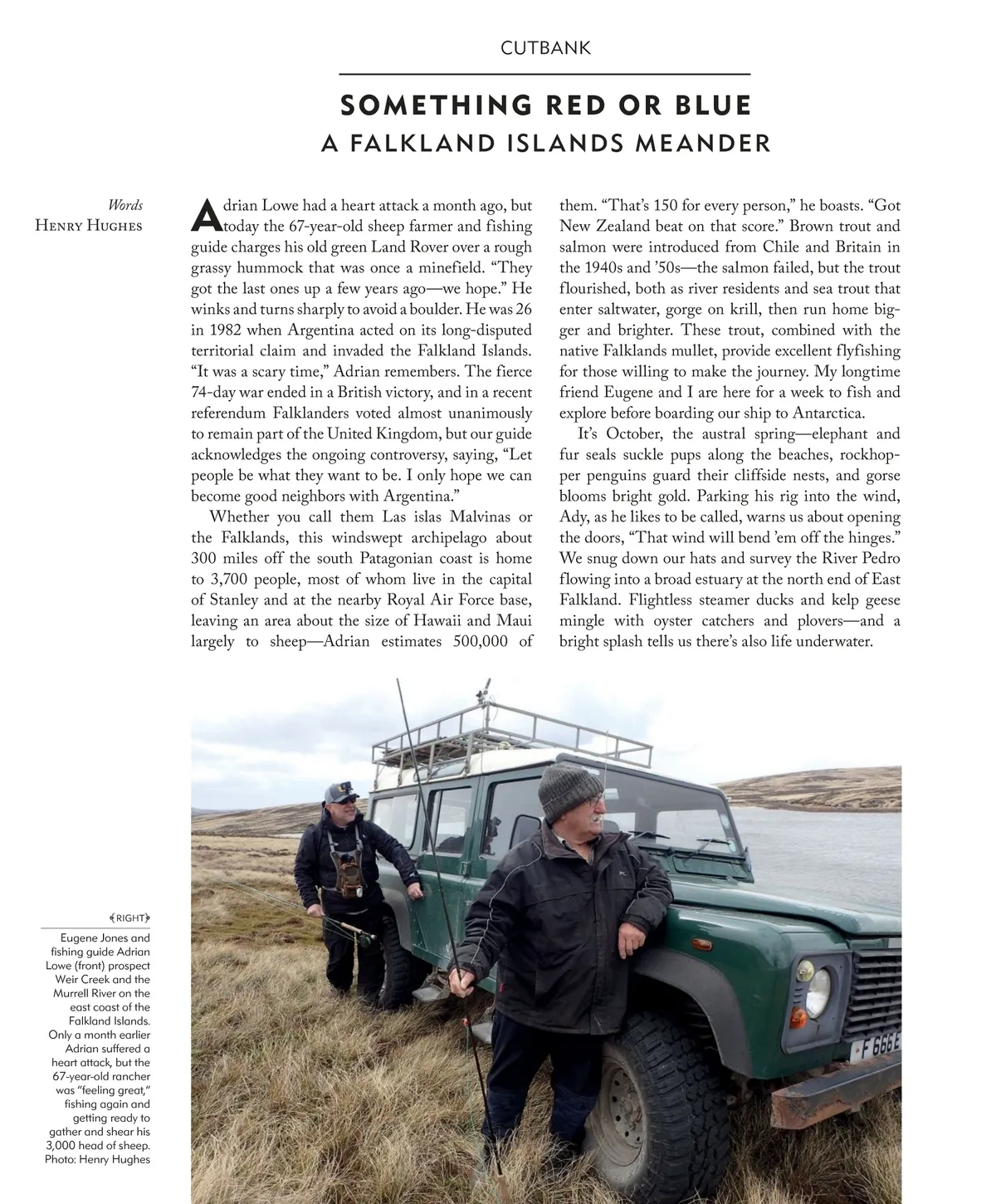
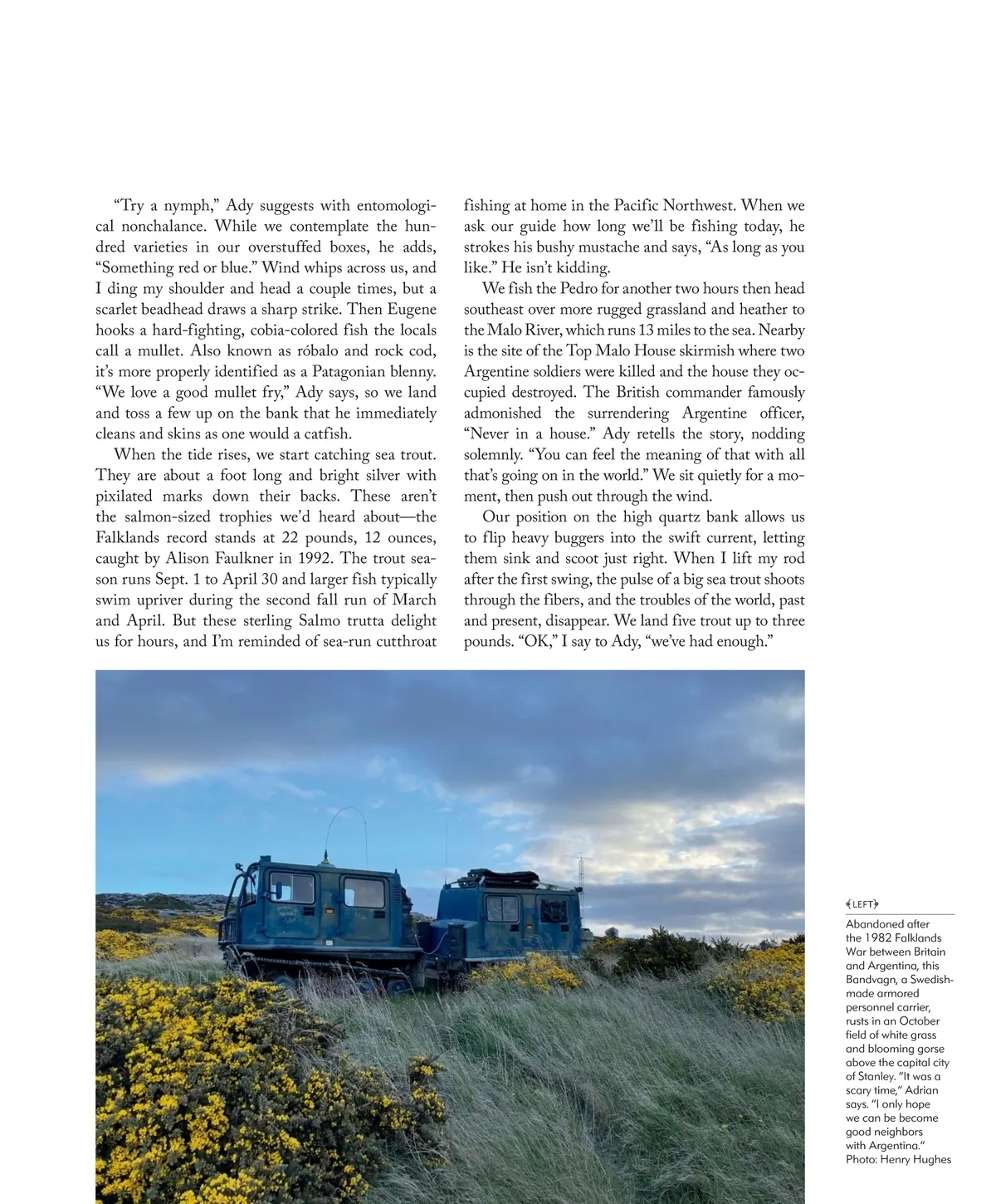
“Try a nymph,” Ady suggests with entomologi-cal nonchalance. While we contemplate the hun-dred varieties in our overstuffed boxes, he adds, “Something red or blue.” Wind whips across us, and I ding my shoulder and head a couple times, but a scarlet beadhead draws a sharp strike. Then Eugene hooks a hard-fighting, cobia-colored fish the locals call a mullet. Also known as róbalo and rock cod, it’s more properly identified as a Patagonian blenny. “We love a good mullet fry,” Ady says, so we land and toss a few up on the bank that he immediately cleans and skins as one would a catfish. When the tide rises, we start catching sea trout. They are about a foot long and bright silver with pixilated marks down their backs. These aren’t the salmon-sized trophies we’d heard about—the Falklands record stands at 22 pounds, 12 ounces, caught by Alison Faulkner in 1992. The trout sea-son runs Sept. 1 to April 30 and larger fish typically swim upriver during the second fall run of March and April. But these sterling Salmo trutta delight us for hours, and I’m reminded of sea-run cutthroat fishing at home in the Pacific Northwest. When we ask our guide how long we’ll be fishing today, he strokes his bushy mustache and says, “As long as you like.” He isn’t kidding. We fish the Pedro for another two hours then head southeast over more rugged grassland and heather to the Malo River, which runs 13 miles to the sea. Nearby is the site of the Top Malo House skirmish where two Argentine soldiers were killed and the house they oc-cupied destroyed. The British commander famously admonished the surrendering Argentine officer, “Never in a house.” Ady retells the story, nodding solemnly. “You can feel the meaning of that with all that’s going on in the world.” We sit quietly for a mo-ment, then push out through the wind. Our position on the high quartz bank allows us to flip heavy buggers into the swift current, letting them sink and scoot just right. When I lift my rod after the first swing, the pulse of a big sea trout shoots through the fibers, and the troubles of the world, past and present, disappear. We land five trout up to three pounds. “OK,” I say to Ady, “we’ve had enough.” • LEFT • Abandoned after the 1982 Falklands War between Britain and Argentina, this Bandvagn, a Swedish-made armored personnel carrier, rusts in an October field of white grass and blooming gorse above the capital city of Stanley. “It was a scary time,” Adrian says. “I only hope we can be become good neighbors with Argentina.” Photo: Henry Hughes
The Flyfish Journal The Flyfish Journal 15.4: Page 101