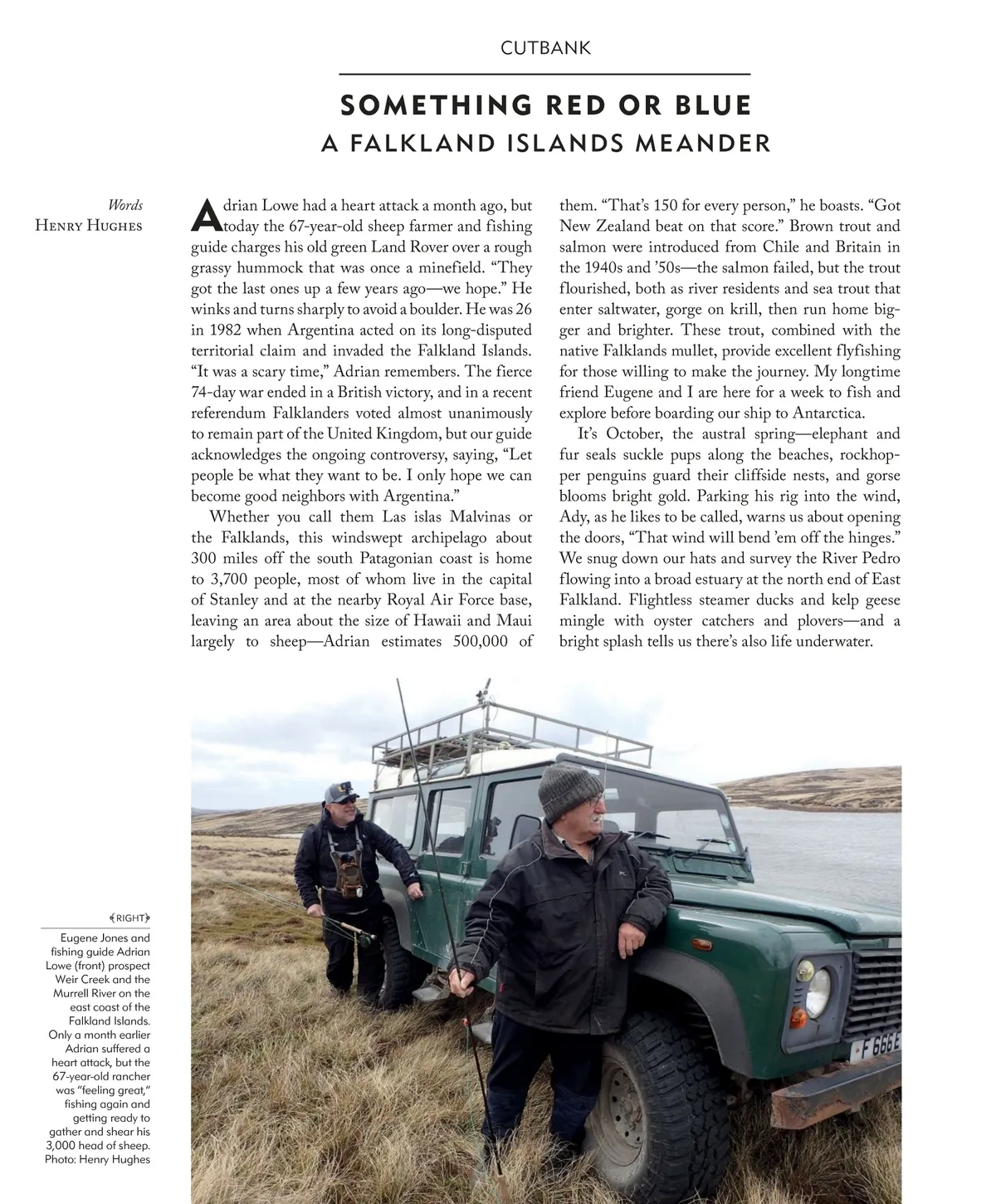
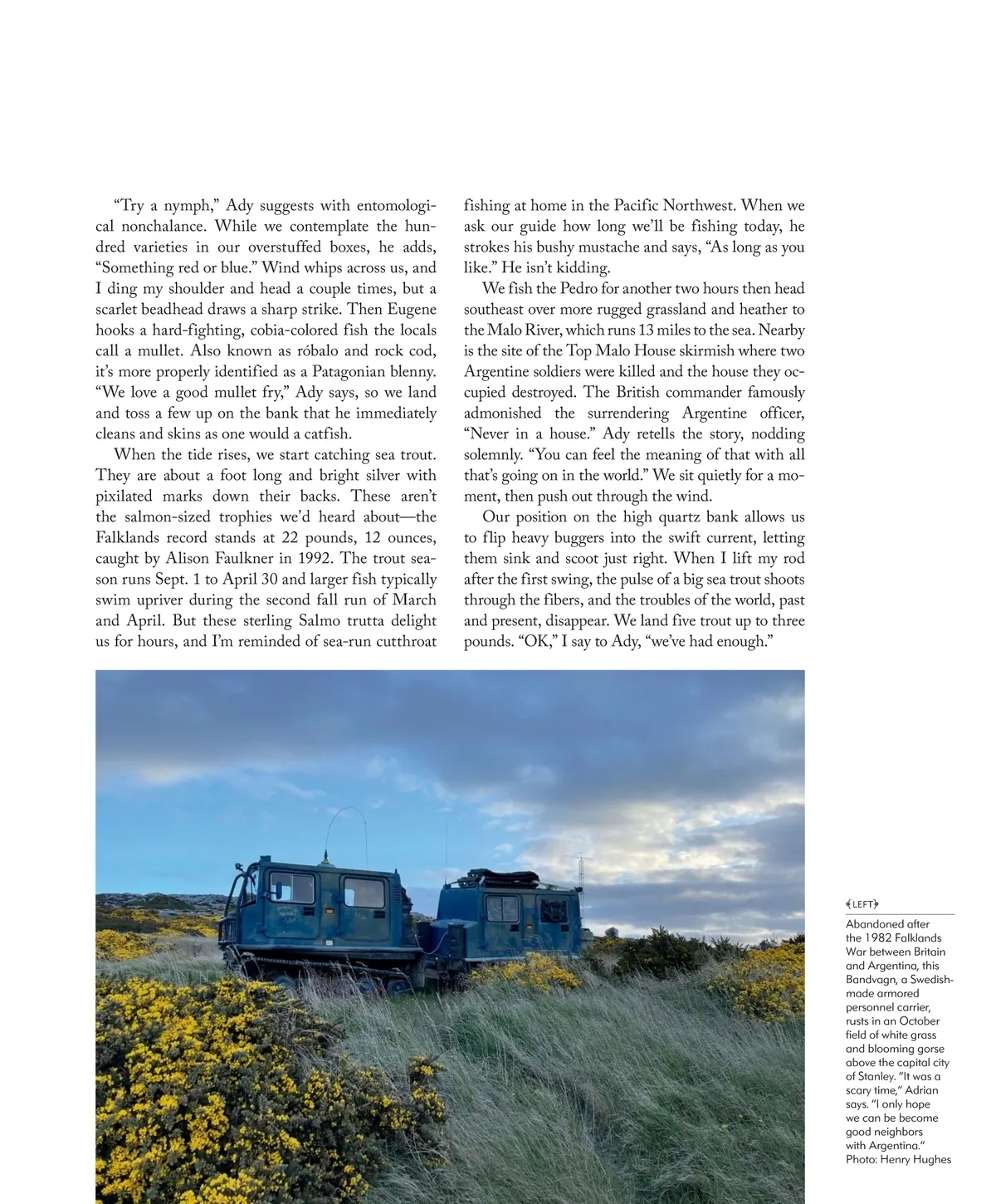
CUTBANK SOMETHING RED OR BLUE A FALKLAND ISLANDS MEANDER Words Henry Hughes drian Lowe had a heart attack a month ago, but today the 67-year-old sheep farmer and fishing guide charges his old green Land Rover over a rough grassy hummock that was once a minefield. “They got the last ones up a few years ago—we hope.” He winks and turns sharply to avoid a boulder. He was 26 in 1982 when Argentina acted on its long-disputed territorial claim and invaded the Falkland Islands. “It was a scary time,” Adrian remembers. The fierce 74-day war ended in a British victory, and in a recent referendum Falklanders voted almost unanimously to remain part of the United Kingdom, but our guide acknowledges the ongoing controversy, saying, “Let people be what they want to be. I only hope we can become good neighbors with Argentina.” Whether you call them Las islas Malvinas or the Falklands, this windswept archipelago about 300 miles off the south Patagonian coast is home to 3,700 people, most of whom live in the capital of Stanley and at the nearby Royal Air Force base, leaving an area about the size of Hawaii and Maui largely to sheep—Adrian estimates 500,000 of A them. “That’s 150 for every person,” he boasts. “Got New Zealand beat on that score.” Brown trout and salmon were introduced from Chile and Britain in the 1940s and ’50s—the salmon failed, but the trout flourished, both as river residents and sea trout that enter saltwater, gorge on krill, then run home big-ger and brighter. These trout, combined with the native Falklands mullet, provide excellent flyfishing for those willing to make the journey. My longtime friend Eugene and I are here for a week to fish and explore before boarding our ship to Antarctica. It’s October, the austral spring—elephant and fur seals suckle pups along the beaches, rockhop-per penguins guard their cliffside nests, and gorse blooms bright gold. Parking his rig into the wind, Ady, as he likes to be called, warns us about opening the doors, “That wind will bend ’em off the hinges.” We snug down our hats and survey the River Pedro flowing into a broad estuary at the north end of East Falkland. Flightless steamer ducks and kelp geese mingle with oyster catchers and plovers—and a bright splash tells us there’s also life underwater. • RIGHT • Eugene Jones and fishing guide Adrian Lowe (front) prospect Weir Creek and the Murrell River on the east coast of the Falkland Islands. Only a month earlier Adrian suffered a heart attack, but the 67-year-old rancher was “feeling great,” fishing again and getting ready to gather and shear his 3,000 head of sheep. Photo: Henry Hughes
The Flyfish Journal The Flyfish Journal 15.4: Page 100