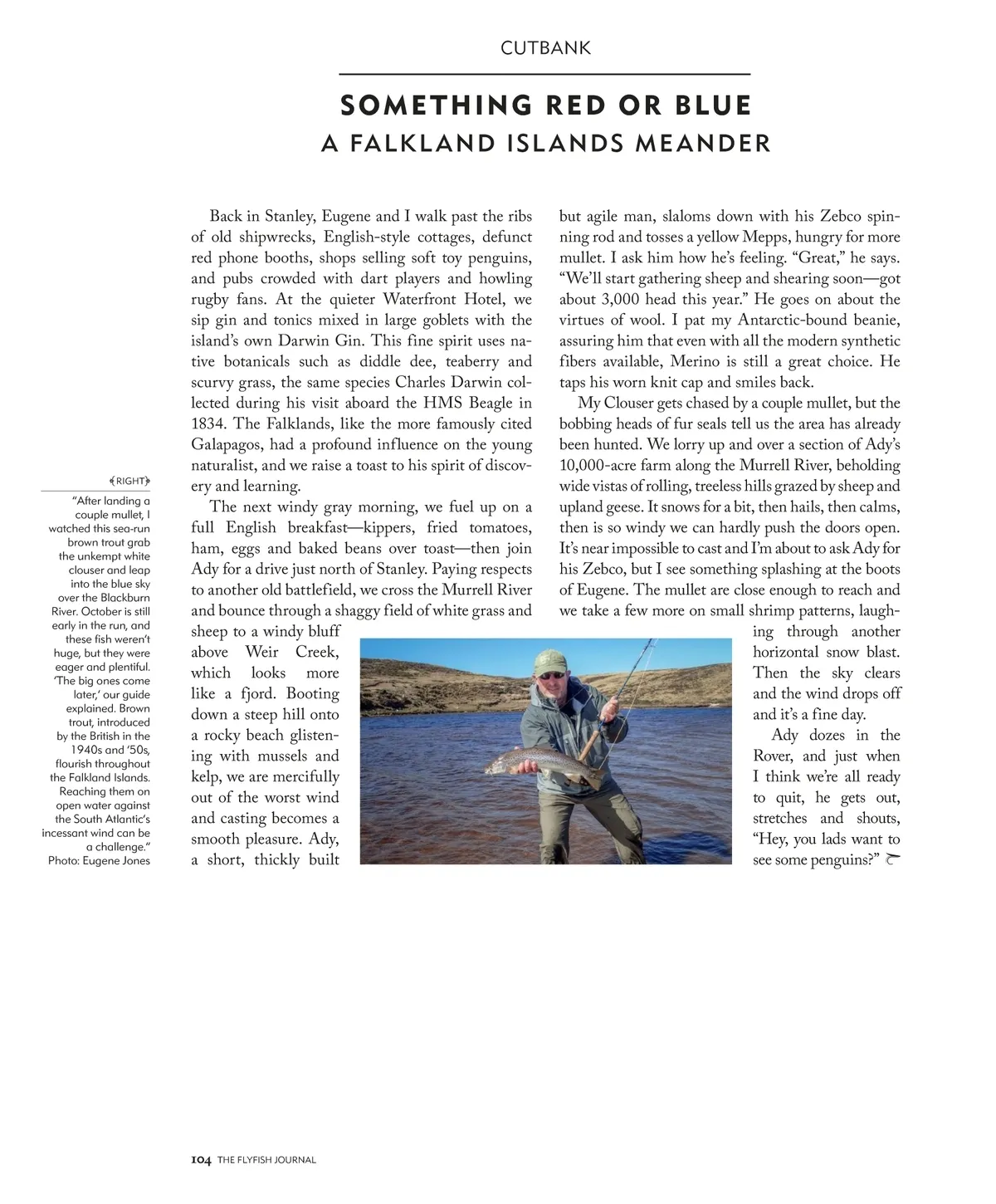
CUTBANK SOMETHING RED OR BLUE A FALKLAND ISLANDS MEANDER Back in Stanley, Eugene and I walk past the ribs of old shipwrecks, English-style cottages, defunct red phone booths, shops selling soft toy penguins, and pubs crowded with dart players and howling rugby fans. At the quieter Waterfront Hotel, we sip gin and tonics mixed in large goblets with the island’s own Darwin Gin. This fine spirit uses na-tive botanica ls such as diddle dee, teaberr y and scurvy grass, the same species Charles Darwin col-lected during his visit aboard the HMS Beagle in 1834. The Falklands, like the more famously cited Galapagos, had a profound influence on the young naturalist, and we raise a toast to his spirit of discov-ery and learning. The next windy gray morning, we fuel up on a full English breakfast—kippers, fried tomatoes, ham, eggs and baked beans over toast—then join Ady for a drive just north of Stanley. Paying respects to another old battlefield, we cross the Murrell River and bounce through a shaggy field of white grass and sheep to a windy bluff above Weir Creek, which looks more like a fjord. Booting down a steep hill onto a rocky beach glisten-ing with mussels and kelp, we are mercifully out of the worst wind and casting becomes a smooth pleasure. Ady, a short, thickly built but agile man, slaloms down with his Zebco spin-ning rod and tosses a yellow Mepps, hungry for more mullet. I ask him how he’s feeling. “Great,” he says. “We’ll start gathering sheep and shearing soon—got about 3,000 head this year.” He goes on about the virtues of wool. I pat my Antarctic-bound beanie, assuring him that even with all the modern synthetic fibers available, Merino is still a great choice. He taps his worn knit cap and smiles back. My Clouser gets chased by a couple mullet, but the bobbing heads of fur seals tell us the area has already been hunted. We lorry up and over a section of Ady’s 10,000-acre farm along the Murrell River, beholding wide vistas of rolling, treeless hills grazed by sheep and upland geese. It snows for a bit, then hails, then calms, then is so windy we can hardly push the doors open. It’s near impossible to cast and I’m about to ask Ady for his Zebco, but I see something splashing at the boots of Eugene. The mullet are close enough to reach and we take a few more on small shrimp patterns, laugh-ing through another horizontal snow blast. Then the sky clears and the wind drops off and it’s a fine day. Ady dozes in the Rover, and just when I think we’re all ready to quit, he gets out, stretches and shouts, “Hey, you lads want to see some penguins?” • RIGHT • “After landing a couple mullet, I watched this sea-run brown trout grab the unkempt white clouser and leap into the blue sky over the Blackburn River. October is still early in the run, and these fish weren’t huge, but they were eager and plentiful. ‘The big ones come later,’ our guide explained. Brown trout, introduced by the British in the 1940s and ’50s, flourish throughout the Falkland Islands. Reaching them on open water against the South Atlantic’s incessant wind can be a challenge.” Photo: Eugene Jones 104 THE FLYFISH JOURNAL
The Flyfish Journal The Flyfish Journal 15.4: Page 102