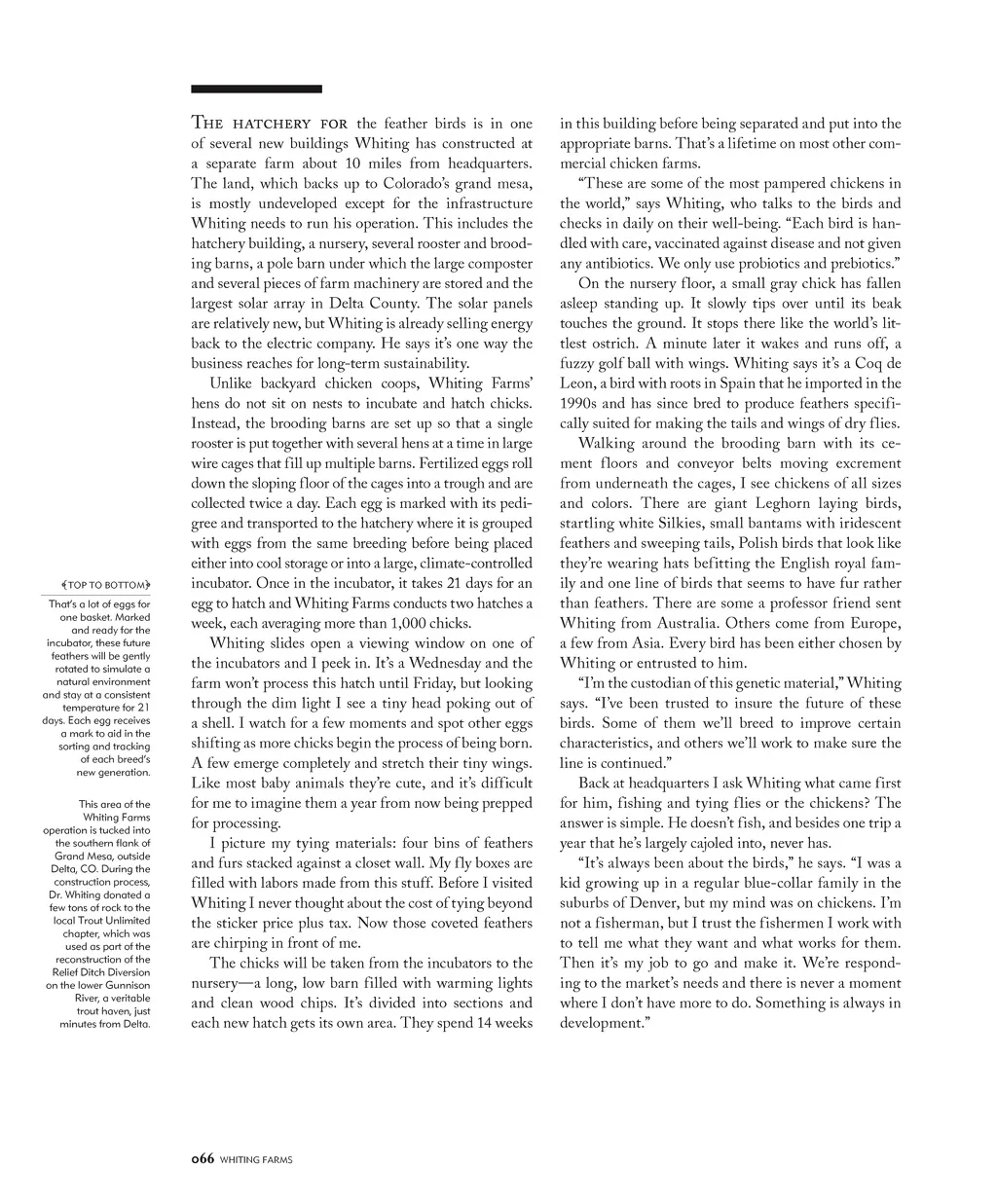
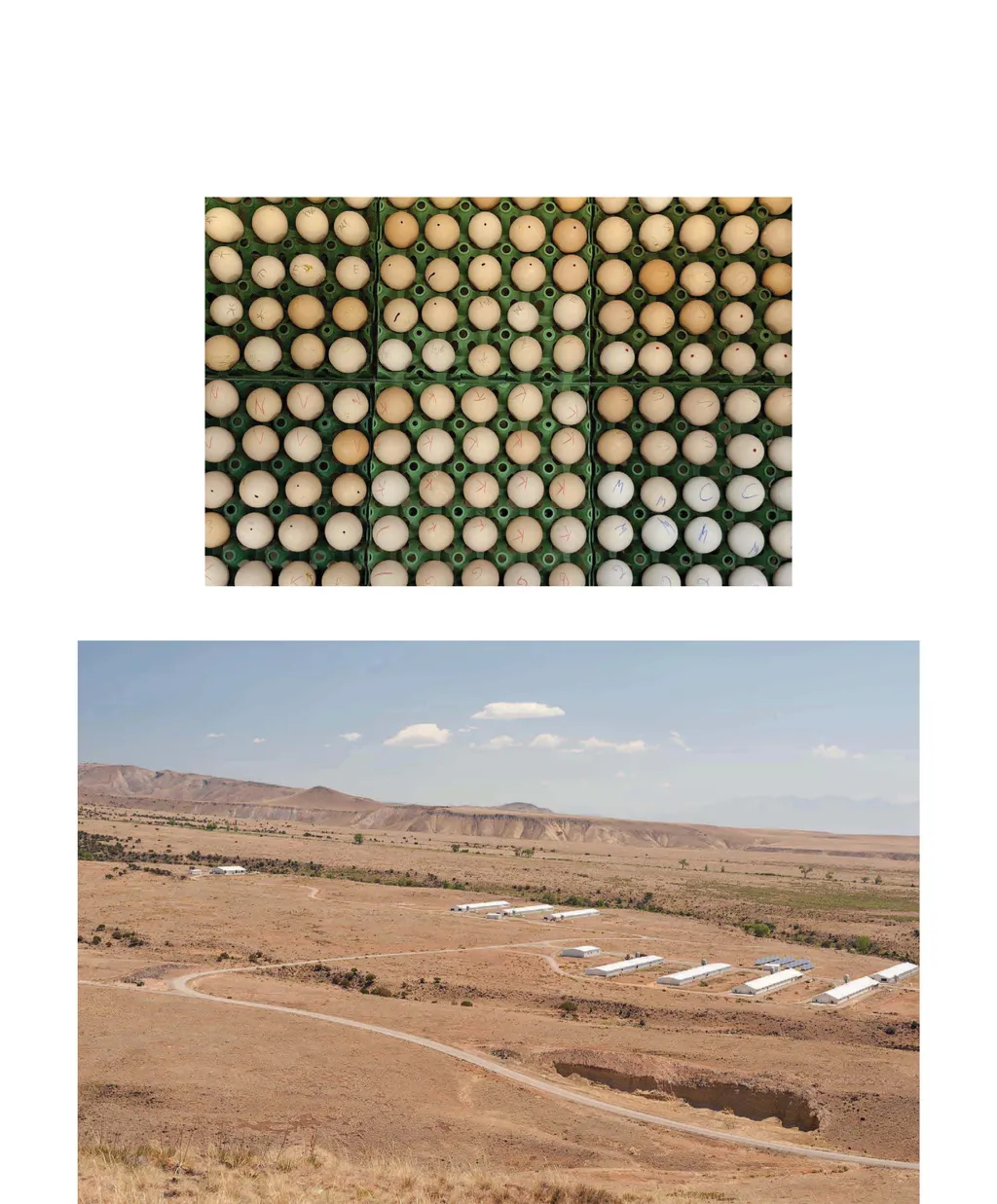
The hatchery for the feather birds is in one of several new buildings Whiting has constructed at a separate farm about 10 miles from headquarters. The land, which backs up to Colorado’s grand mesa, is mostly undeveloped except for the infrastructure Whiting needs to run his operation. This includes the hatchery building, a nursery, several rooster and brood-ing barns, a pole barn under which the large composter and several pieces of farm machinery are stored and the largest solar array in Delta County. The solar panels are relatively new, but Whiting is already selling energy back to the electric company. He says it’s one way the business reaches for long-term sustainability. Unlike backyard chicken coops, Whiting Farms’ hens do not sit on nests to incubate and hatch chicks. Instead, the brooding barns are set up so that a single rooster is put together with several hens at a time in large wire cages that fill up multiple barns. Fertilized eggs roll down the sloping floor of the cages into a trough and are collected twice a day. Each egg is marked with its pedi-gree and transported to the hatchery where it is grouped with eggs from the same breeding before being placed either into cool storage or into a large, climate-controlled incubator. Once in the incubator, it takes 21 days for an egg to hatch and Whiting Farms conducts two hatches a week, each averaging more than 1,000 chicks. Whiting slides open a viewing window on one of the incubators and I peek in. It’s a Wednesday and the farm won’t process this hatch until Friday, but looking through the dim light I see a tiny head poking out of a shell. I watch for a few moments and spot other eggs shifting as more chicks begin the process of being born. A few emerge completely and stretch their tiny wings. Like most baby animals they’re cute, and it’s difficult for me to imagine them a year from now being prepped for processing. I picture my tying materials: four bins of feathers and furs stacked against a closet wall. My fly boxes are filled with labors made from this stuff. Before I visited Whiting I never thought about the cost of tying beyond the sticker price plus tax. Now those coveted feathers are chirping in front of me. The chicks will be taken from the incubators to the nursery—a long, low barn filled with warming lights and clean wood chips. It’s divided into sections and each new hatch gets its own area. They spend 14 weeks TOP TO BOTTOM That’s a lot of eggs for one basket. Marked and ready for the incubator, these future feathers will be gently rotated to simulate a natural environment and stay at a consistent temperature for 21 days. Each egg receives a mark to aid in the sorting and tracking of each breed’s new generation. This area of the Whiting Farms operation is tucked into the southern flank of Grand Mesa, outside Delta, CO. During the construction process, Dr. Whiting donated a few tons of rock to the local Trout Unlimited chapter, which was used as part of the reconstruction of the Relief Ditch Diversion on the lower Gunnison River, a veritable trout haven, just minutes from Delta. in this building before being separated and put into the appropriate barns. That’s a lifetime on most other com-mercial chicken farms. “These are some of the most pampered chickens in the world,” says Whiting, who talks to the birds and checks in daily on their well-being. “Each bird is han-dled with care, vaccinated against disease and not given any antibiotics. We only use probiotics and prebiotics.” On the nursery floor, a small gray chick has fallen asleep standing up. It slowly tips over until its beak touches the ground. It stops there like the world’s lit-tlest ostrich. A minute later it wakes and runs off, a fuzzy golf ball with wings. Whiting says it’s a Coq de Leon, a bird with roots in Spain that he imported in the 1990s and has since bred to produce feathers specifi-cally suited for making the tails and wings of dry flies. Walking around the brooding barn with its ce-ment f loors and conveyor belts moving excrement from underneath the cages, I see chickens of all sizes and colors. There are giant Leghorn laying birds, startling white Silkies, small bantams with iridescent feathers and sweeping tails, Polish birds that look like they’re wearing hats befitting the English royal fam-ily and one line of birds that seems to have fur rather than feathers. There are some a professor friend sent Whiting from Australia. Others come from Europe, a few from Asia. Every bird has been either chosen by Whiting or entrusted to him. “I’m the custodian of this genetic material,” Whiting says. “I’ve been trusted to insure the future of these birds. Some of them we’ll breed to improve certain characteristics, and others we’ll work to make sure the line is continued.” Back at headquarters I ask Whiting what came first for him, fishing and tying flies or the chickens? The answer is simple. He doesn’t fish, and besides one trip a year that he’s largely cajoled into, never has. “It’s always been about the birds,” he says. “I was a kid growing up in a regular blue-collar family in the suburbs of Denver, but my mind was on chickens. I’m not a fisherman, but I trust the fishermen I work with to tell me what they want and what works for them. Then it’s my job to go and make it. We’re respond-ing to the market’s needs and there is never a moment where I don’t have more to do. Something is always in development.” 066 WHITING FARMS
The Flyfish Journal Volume Eight, Issue Two: Page 66