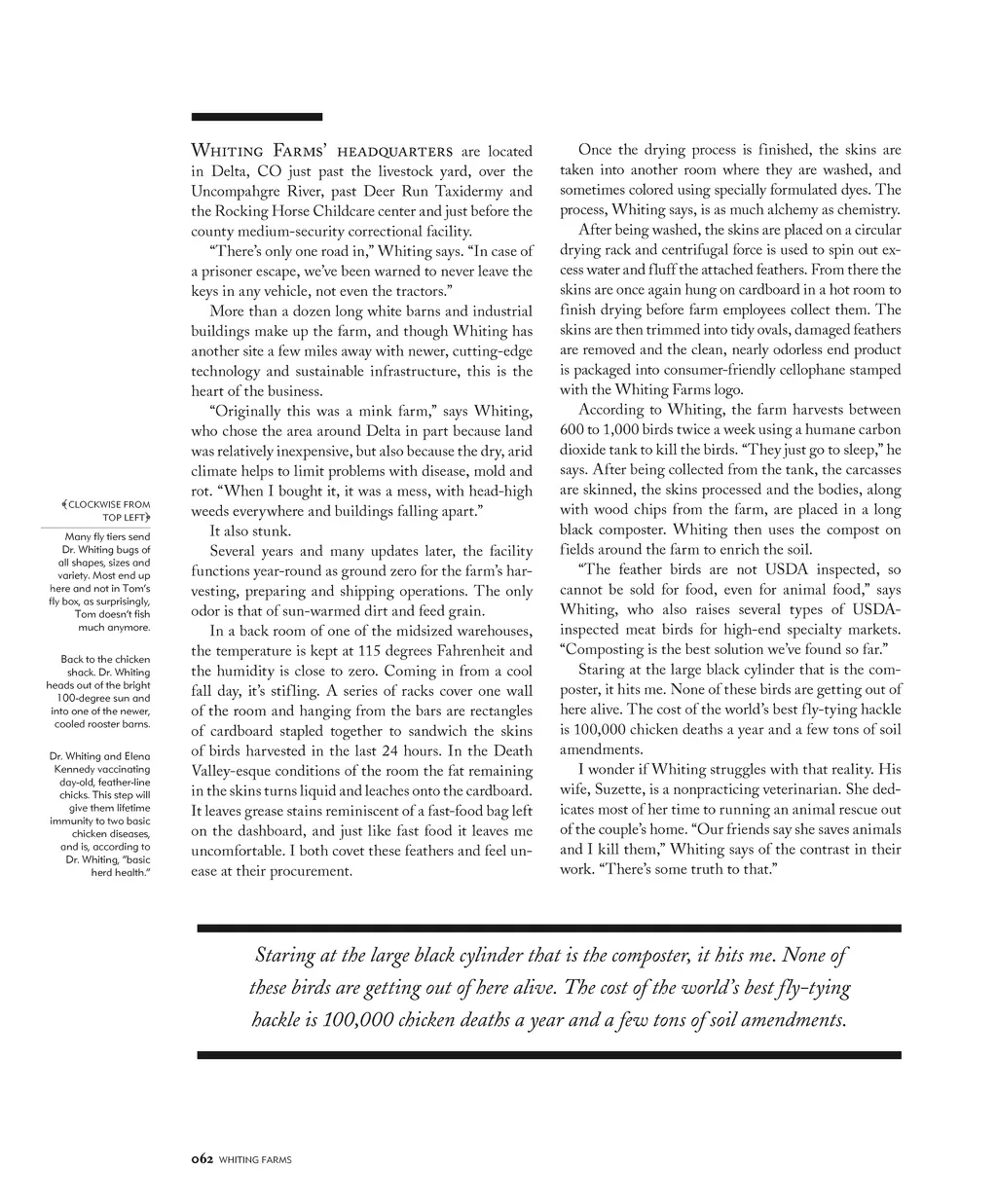
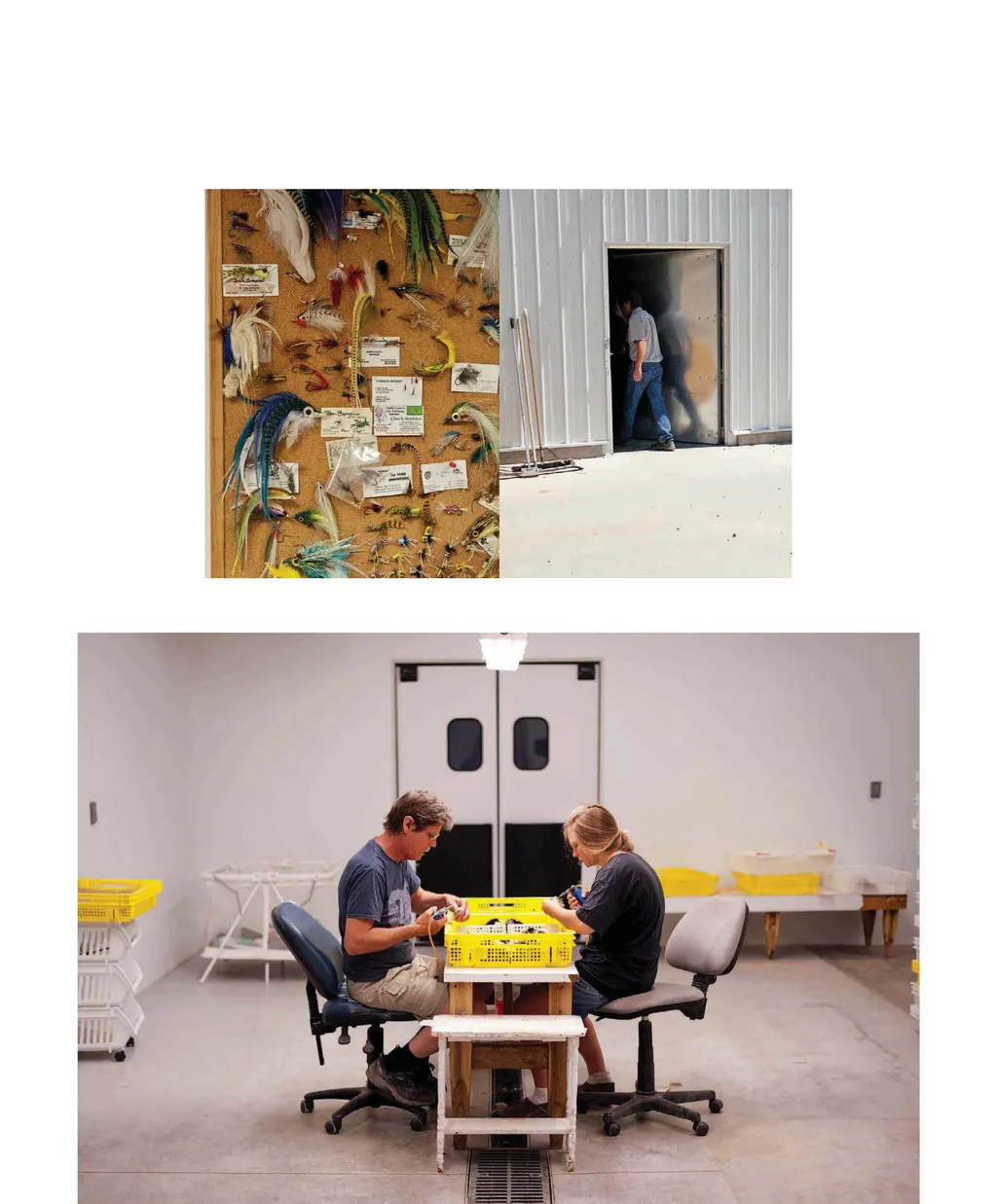
Whiting Farms’ headquarters are located in Delta, CO just past the livestock yard, over the Uncompahgre River, past Deer Run Taxidermy and the Rocking Horse Childcare center and just before the county medium-security correctional facility. “There’s only one road in,” Whiting says. “In case of a prisoner escape, we’ve been warned to never leave the keys in any vehicle, not even the tractors.” More than a dozen long white barns and industrial buildings make up the farm, and though Whiting has another site a few miles away with newer, cutting-edge technology and sustainable infrastructure, this is the heart of the business. “Originally this was a mink farm,” says Whiting, who chose the area around Delta in part because land was relatively inexpensive, but also because the dry, arid climate helps to limit problems with disease, mold and rot. “When I bought it, it was a mess, with head-high weeds everywhere and buildings falling apart.” It also stunk. Several years and many updates later, the facility functions year-round as ground zero for the farm’s har-vesting, preparing and shipping operations. The only odor is that of sun-warmed dirt and feed grain. In a back room of one of the midsized warehouses, the temperature is kept at 115 degrees Fahrenheit and the humidity is close to zero. Coming in from a cool fall day, it’s stifling. A series of racks cover one wall of the room and hanging from the bars are rectangles of cardboard stapled together to sandwich the skins of birds harvested in the last 24 hours. In the Death Valley-esque conditions of the room the fat remaining in the skins turns liquid and leaches onto the cardboard. It leaves grease stains reminiscent of a fast-food bag left on the dashboard, and just like fast food it leaves me uncomfortable. I both covet these feathers and feel un-ease at their procurement. CLOCKWISE FROM TOP LEFT Many fly tiers send Dr. Whiting bugs of all shapes, sizes and variety. Most end up here and not in Tom’s fly box, as surprisingly, Tom doesn’t fish much anymore. Back to the chicken shack. Dr. Whiting heads out of the bright 100-degree sun and into one of the newer, cooled rooster barns. Dr. Whiting and Elena Kennedy vaccinating day-old, feather-line chicks. This step will give them lifetime immunity to two basic chicken diseases, and is, according to Dr. Whiting, “basic herd health.” Once the drying process is finished, the skins are taken into another room where they are washed, and sometimes colored using specially formulated dyes. The process, Whiting says, is as much alchemy as chemistry. After being washed, the skins are placed on a circular drying rack and centrifugal force is used to spin out ex-cess water and fluff the attached feathers. From there the skins are once again hung on cardboard in a hot room to finish drying before farm employees collect them. The skins are then trimmed into tidy ovals, damaged feathers are removed and the clean, nearly odorless end product is packaged into consumer-friendly cellophane stamped with the Whiting Farms logo. According to Whiting, the farm harvests between 600 to 1,000 birds twice a week using a humane carbon dioxide tank to kill the birds. “They just go to sleep,” he says. After being collected from the tank, the carcasses are skinned, the skins processed and the bodies, along with wood chips from the farm, are placed in a long black composter. Whiting then uses the compost on fields around the farm to enrich the soil. “The feather birds are not USDA inspected, so cannot be sold for food, even for animal food,” says Whiting, who also raises several types of USDA-inspected meat birds for high-end specialty markets. “Composting is the best solution we’ve found so far.” Staring at the large black cylinder that is the com-poster, it hits me. None of these birds are getting out of here alive. The cost of the world’s best fly-tying hackle is 100,000 chicken deaths a year and a few tons of soil amendments. I wonder if Whiting struggles with that reality. His wife, Suzette, is a nonpracticing veterinarian. She ded-icates most of her time to running an animal rescue out of the couple’s home. “Our friends say she saves animals and I kill them,” Whiting says of the contrast in their work. “There’s some truth to that.” Staring at the large black cylinder that is the composter, it hits me. None of these birds are getting out of here alive. The cost of the world’s best fly-tying hackle is 100,000 chicken deaths a year and a few tons of soil amendments. 062 WHITING FARMS
The Flyfish Journal Volume Eight, Issue Two: Page 62