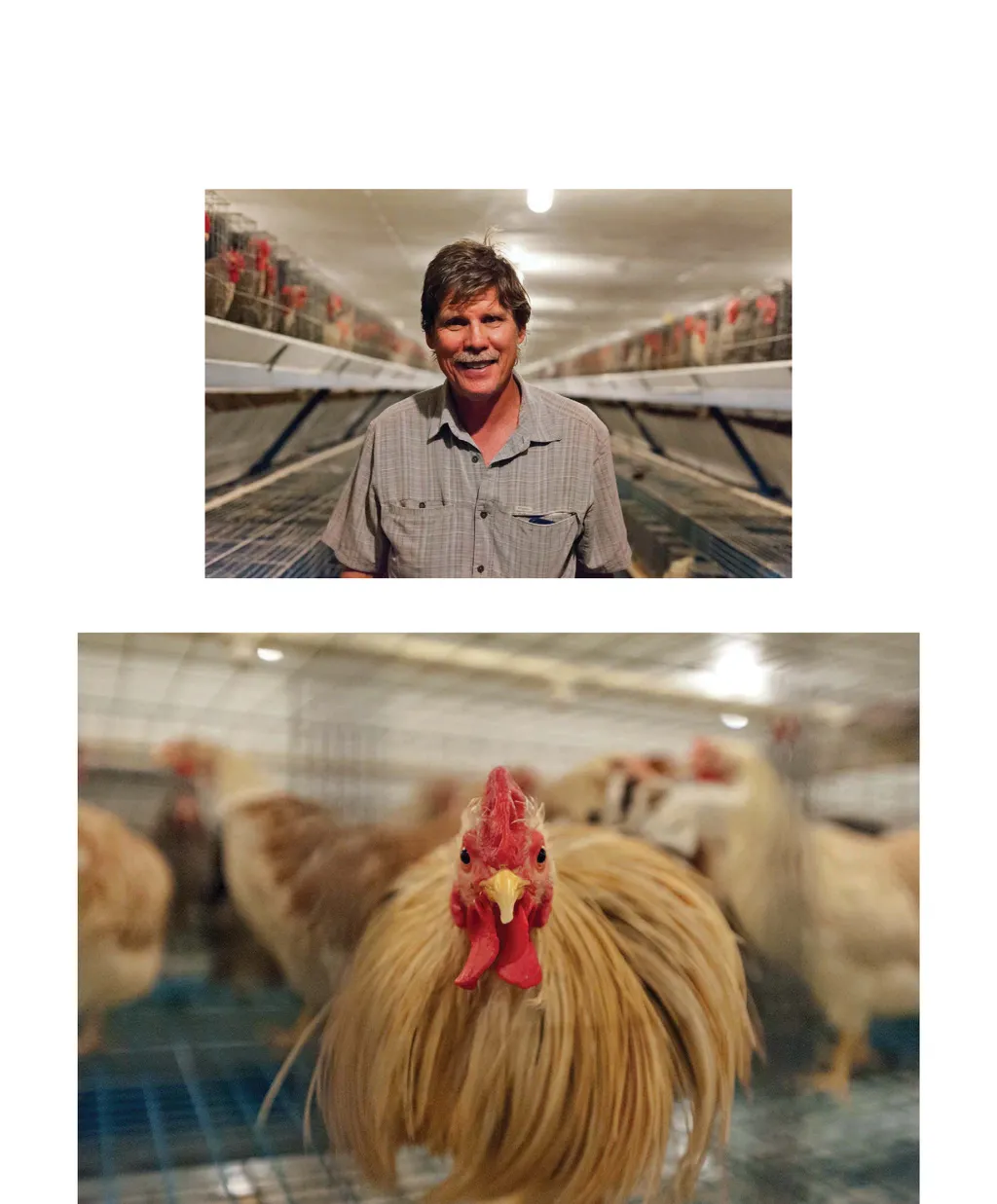
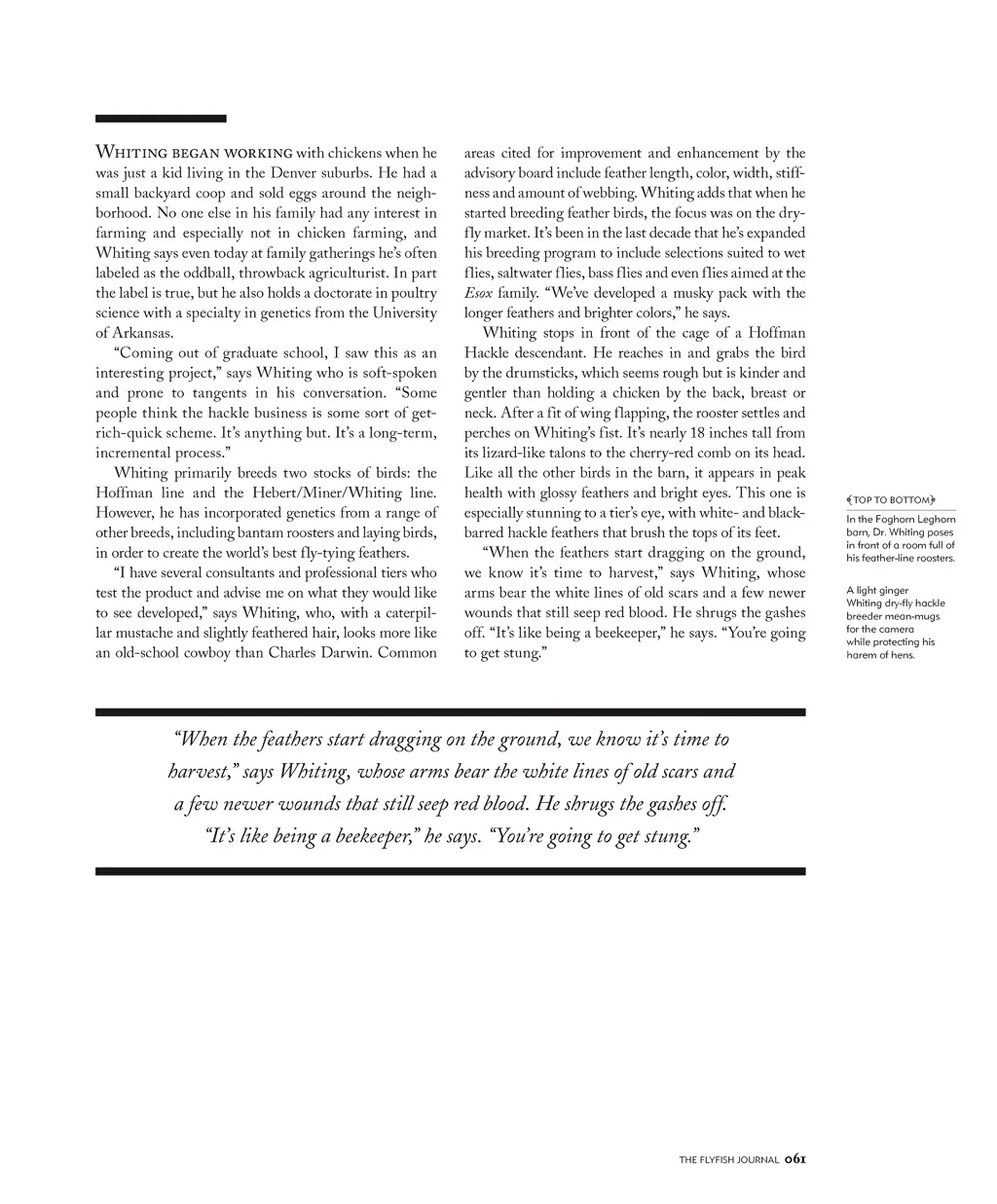
Whiting began working with chickens when he was just a kid living in the Denver suburbs. He had a small backyard coop and sold eggs around the neigh-borhood. No one else in his family had any interest in farming and especially not in chicken farming, and Whiting says even today at family gatherings he’s often labeled as the oddball, throwback agriculturist. In part the label is true, but he also holds a doctorate in poultry science with a specialty in genetics from the University of Arkansas. “Coming out of graduate school, I saw this as an interesting project,” says Whiting who is soft-spoken and prone to tangents in his conversation. “Some people think the hackle business is some sort of get-rich-quick scheme. It’s anything but. It’s a long-term, incremental process.” Whiting primarily breeds two stocks of birds: the Hoffman line and the Hebert/Miner/Whiting line. However, he has incorporated genetics from a range of other breeds, including bantam roosters and laying birds, in order to create the world’s best fly-tying feathers. “I have several consultants and professional tiers who test the product and advise me on what they would like to see developed,” says Whiting, who, with a caterpil-lar mustache and slightly feathered hair, looks more like an old-school cowboy than Charles Darwin. Common areas cited for improvement and enhancement by the advisory board include feather length, color, width, stiff-f ness and amount of webbing. Whiting adds that when he started breeding feather birds, the focus was on the dry-fly market. It’s been in the last decade that he’s expanded his breeding program to include selections suited to wet flies, saltwater flies, bass flies and even flies aimed at the Esox x family. “We’ve developed a musky pack with the longer feathers and brighter colors,” he says. Whiting stops in front of the cage of a Hoffman Hackle descendant. He reaches in and grabs the bird by the drumsticks, which seems rough but is kinder and gentler than holding a chicken by the back, breast or neck. After a fit of wing flapping, the rooster settles and perches on Whiting’s fist. It’s nearly 18 inches tall from its lizard-like talons to the cherry-red comb on its head. Like all the other birds in the barn, it appears in peak health with glossy feathers and bright eyes. This one is especially stunning to a tier’s eye, with white-and black-barred hackle feathers that brush the tops of its feet. “When the feathers start dragging on the ground, we know it’s time to harvest,” says Whiting, whose arms bear the white lines of old scars and a few newer wounds that still seep red blood. He shrugs the gashes off. “It’s like being a beekeeper,” he says. “You’re going to get stung.” TOP TO BOTTOM In the Foghorn Leghorn barn, Dr. Whiting poses in front of a room full of his feather-line roosters. A light ginger Whiting dry-fly hackle breeder mean-mugs for the camera while protecting his harem of hens. “When the feathers start dragging on the ground, we know it’s time to harvest,” says Whiting, whose arms bear the white lines of old scars and a few newer wounds that still seep red blood. He shrugs the gashes off. “It’s like being a beekeeper,” he says. “You’re going to get stung.” THE FLYFISH JOURNAL 061
The Flyfish Journal Volume Eight, Issue Two: Page 61