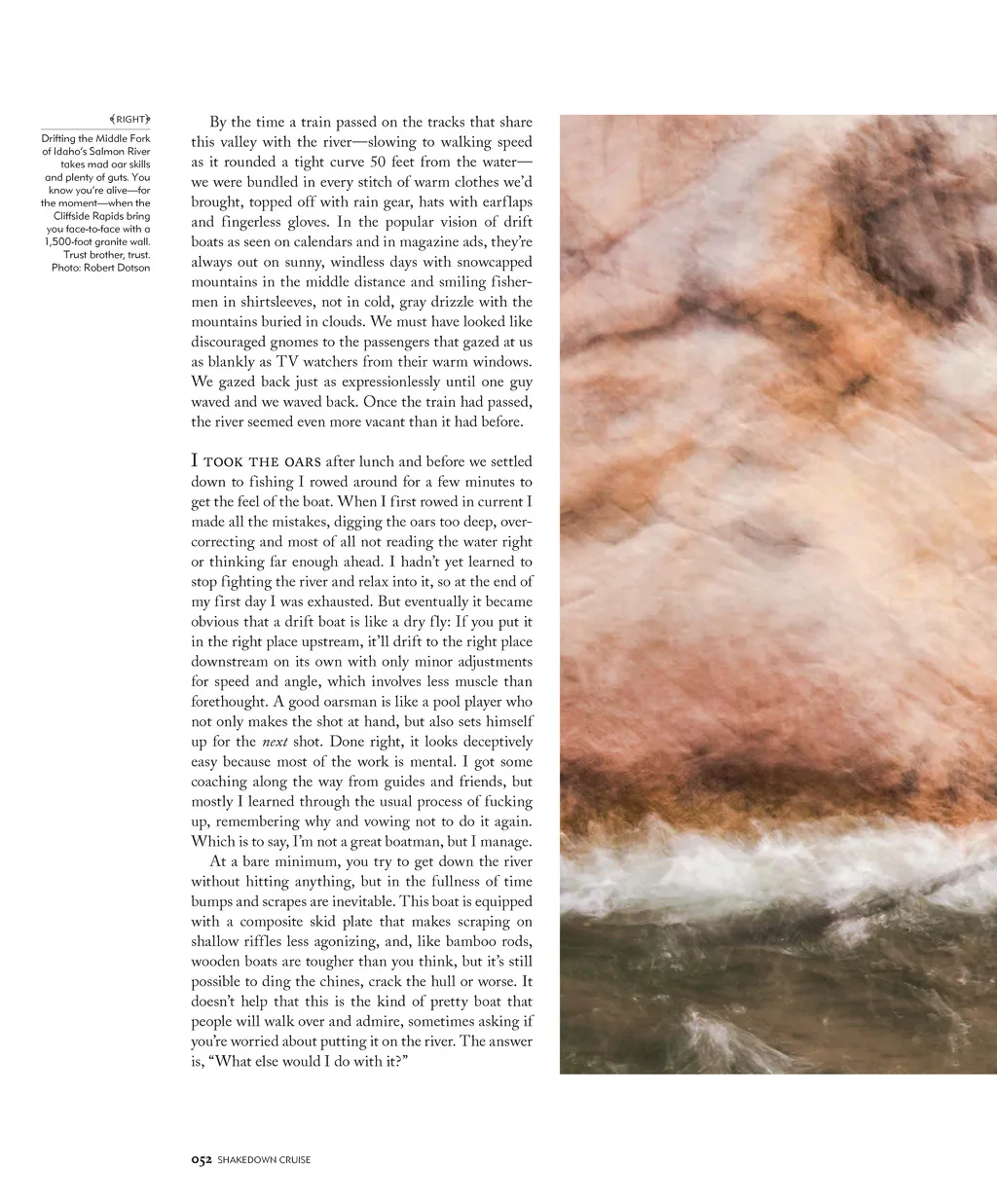
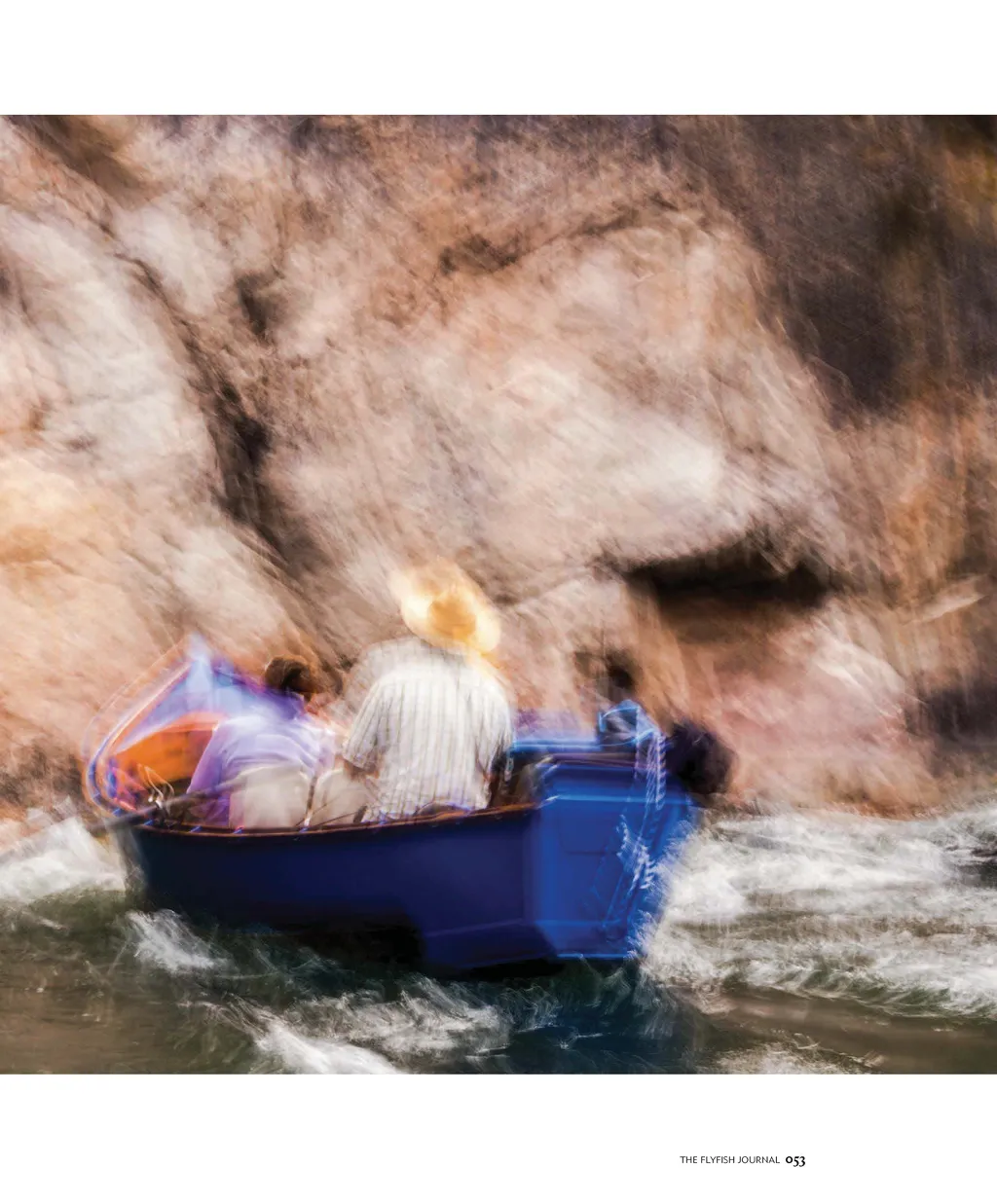
RIGHT Drifting the Middle Fork of Idaho’s Salmon River takes mad oar skills and plenty of guts. You know you’re alive—for the moment—when the Cliffside Rapids bring you face-to-face with a 1,500-foot granite wall. Trust brother, trust. Photo: Robert Dotson By the time a train passed on the tracks that share this valley with the river—slowing to walking speed as it rounded a tight curve 50 feet from the water— we were bundled in every stitch of warm clothes we’d brought, topped off with rain gear, hats with earflaps and fingerless gloves. In the popular vision of drift boats as seen on calendars and in magazine ads, they’re always out on sunny, windless days with snowcapped mountains in the middle distance and smiling fisher-men in shirtsleeves, not in cold, gray drizzle with the mountains buried in clouds. We must have looked like discouraged gnomes to the passengers that gazed at us as blankly as TV watchers from their warm windows. We gazed back just as expressionlessly until one guy waved and we waved back. Once the train had passed, the river seemed even more vacant than it had before. I took the oars after lunch and before we settled down to fishing I rowed around for a few minutes to get the feel of the boat. When I first rowed in current I made all the mistakes, digging the oars too deep, over-correcting and most of all not reading the water right or thinking far enough ahead. I hadn’t yet learned to stop fighting the river and relax into it, so at the end of my first day I was exhausted. But eventually it became obvious that a drift boat is like a dry fly: If you put it in the right place upstream, it’ll drift to the right place downstream on its own with only minor adjustments for speed and angle, which involves less muscle than forethought. A good oarsman is like a pool player who not only makes the shot at hand, but also sets himself up for the next t shot. Done right, it looks deceptively easy because most of the work is mental. I got some coaching along the way from guides and friends, but mostly I learned through the usual process of fucking up, remembering why and vowing not to do it again. Which is to say, I’m not a great boatman, but I manage. At a bare minimum, you try to get down the river without hitting anything, but in the fullness of time bumps and scrapes are inevitable. This boat is equipped with a composite skid plate that makes scraping on shallow riffles less agonizing, and, like bamboo rods, wooden boats are tougher than you think, but it’s still possible to ding the chines, crack the hull or worse. It doesn’t help that this is the kind of pretty boat that people will walk over and admire, sometimes asking if you’re worried about putting it on the river. The answer is, “What else would I do with it?” 052 SHAKEDOWN CRUISE
The Flyfish Journal Volume Eight, Issue Two: Page 52