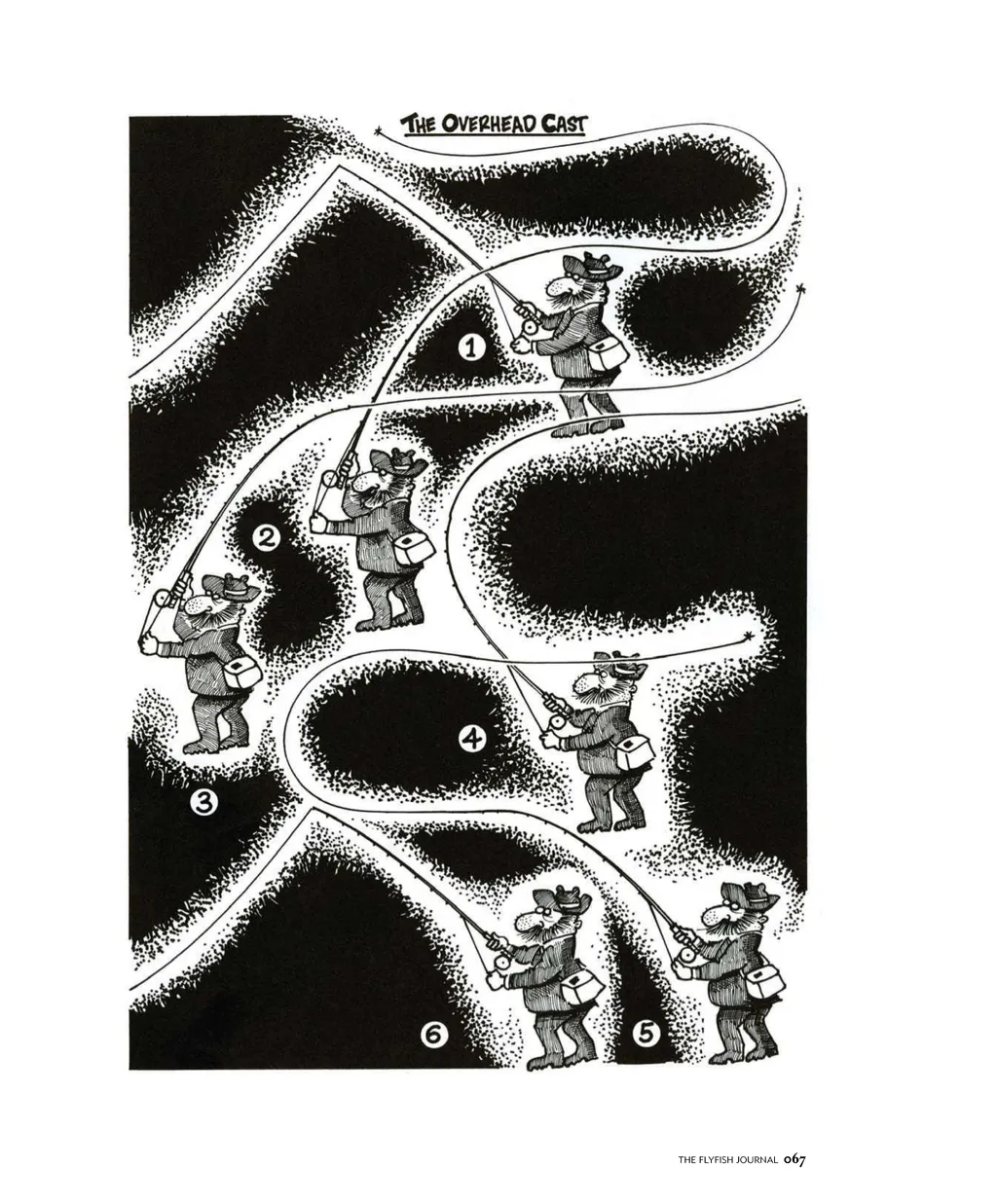
RIGHT Despite Anderson’s humorous, irreverent style, he had the uncanny ability to relate complicated technique in a simple, easy-to-understand manner. Illustration: The Curtis Creek Manifesto , Sheridan Anderson, Copyright 1978, Frank Amato Publications, Portland, OR Sheridan would lay out pages on the counter and he and Brackett would go over them. “He was all busi-ness,” Brackett said. “He came in to talk about his book. He really wasn’t very sociable, but I was very drawn to him.” The last time Brackett saw Sheridan was the day Winston Rod Co. left San Francisco for Twin Bridges, MT. It was early Sunday morning, before traffic, and a semi was parked in the road. “Here came Sheridan, wandering along,” Brackett said “We were loading the rod-building equipment into the trailer and he asked if we needed any help. I took one look at him—he’d clearly had a big night—and I told him, ‘No, Sheridan, you just take it easy.’ He had no idea we were leaving, but that was Sheridan—always showing up at strange times.” Brackett lost touch with Sheridan when he left San Francisco, but when The Manifesto came out he saw that Sheridan had done the job right. “It’s brilliant,” Brackett said. “It cuts through all the bullshit in the fishing busi-ness. There was a period of time that we’d provide a copy with all the rods that went out of the shop.” Painter Russ Chatham also crossed paths with Sheridan in 1970s San Francisco. “I loved the guy,” Chatham said. “I was in my late 30s then and up for any kind of hijinks. He was obvi-ously on the same wavelength, running around with the ZAP! Comix guys—R. Crumb, S. Clay Wilson—who were some of the smartest and the most bizarre people I’ve ever known.” In a storage locker in Montana, Chatham has a huge collection of underground comics. “The kind of stuff Sheridan and the underground guys were doing was deceptively simple,” he said. “It seems goofy, but that’s not really right. It’s quite sophisticated, if you want to know the truth.” Of the underground comic artists, Sheridan was closest with the legendary S. Clay Wilson. In 2008, Wilson suffered a severe brain injury. He rarely speaks, but through his wife, Lorraine Chamberlain, he was able to relate a list of people from the underground circle who knew Sheridan—a list that included the painter David Geiser. Geiser met Sheridan in 1969 at a comic convention in San Francisco. “This great big grizzly character comes up to my table and starts chuckling,” Geiser said. “He introduced himself and I pulled out a bottle of something and that was that. We were all living deep in the bowels of the Mission. We’d go down to Dick’s Bar to meet Wilson and the rest of the drinking bud-dies and storytellers. It was a really rolling scene for a neighborhood bar; a couple of big communes close by in the Castro, [writer/editor] Warren Hinckle was right there and he’d bring in Hunter Thompson. It was a real daisy chain.” Though Geiser was and is a flyfisherman, he and Sheridan never fished together. But Sheridan was ada-mant about teaching S. Clay Wilson to flyfish. “Poor Wilson probably thought he was going out to drink Jack and stare at a bobber,” Geiser said. “When they came back, Wilson had this befuddled look. ‘Sheridan’s worse than a goddamn Parris Island drill instructor,’ he said. I asked Sheridan about it later. He shook his head and said, ‘It’s a good thing Wilson can draw.’” “I loved the guy. I was in my late 30s then and up for any kind of hijinks. He was obviously on the same wavelength, running around with the ZAP! Comix guys—R. Crumb, S. Clay Wilson—who were some of the smartest and the most bizarre people I’ve ever known.” —Russ Chatham 066 SHERIDAN ANDERSON
The Flyfish Journal Volume Eight, Issue Four: Page 66