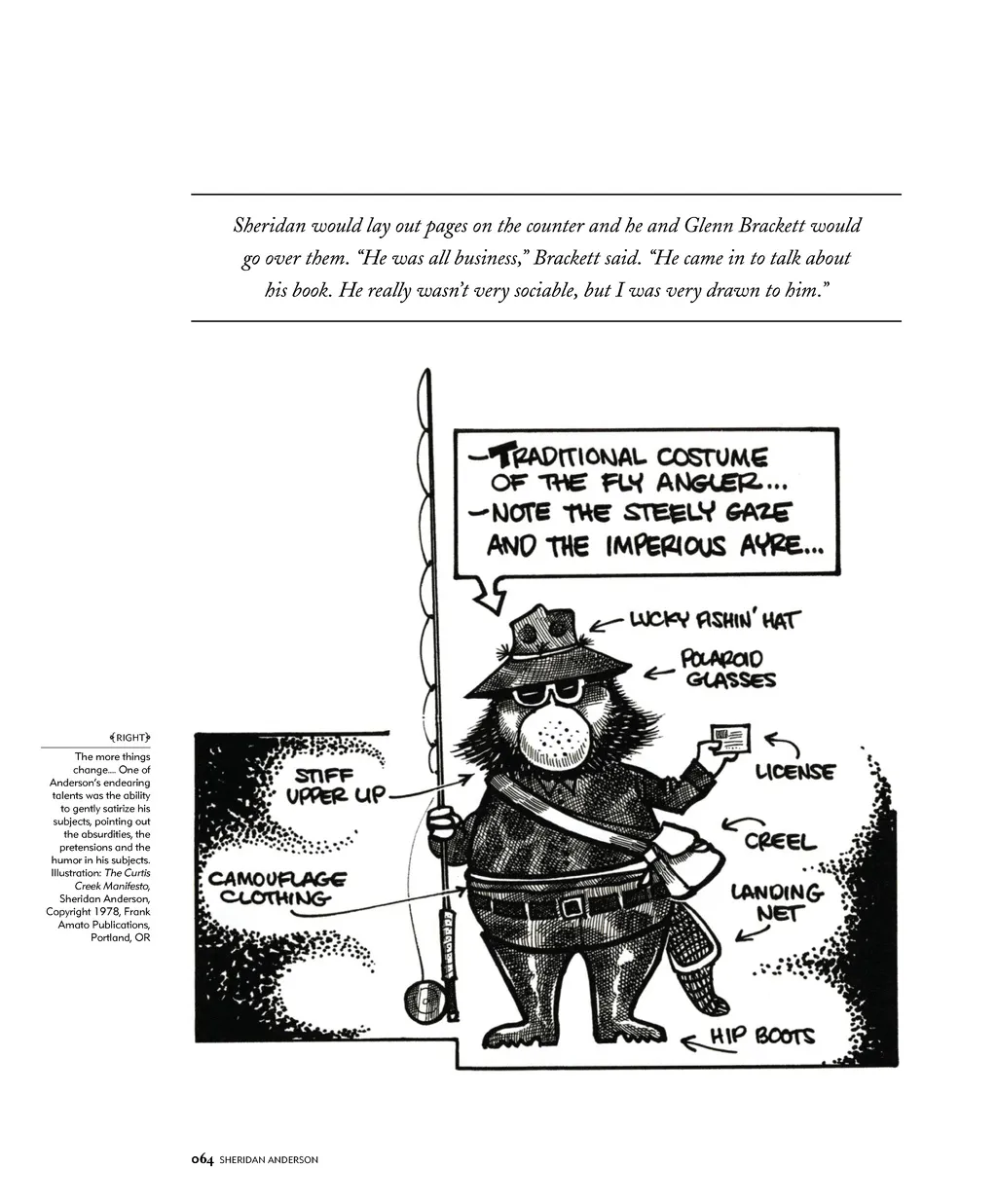
In 1966, Ed Cooper had just quit a job at a broker-age firm in San Francisco. He landed in an apartment on Haight Street; a crash pad for itinerant climbers, drug scenesters and garden-variety misfits. Sheridan was there too. “People were always coming and going,” Cooper said, “but Sheridan and I stuck around.” By sticking around, Cooper and Sheridan got to know each other and agreed to look for somewhere more permanent to live. At the edge of Haight-Ashbury, they found a one-time restaurant being rented as an apartment. “They still had deli furniture out front,” Cooper said. “We thought it was perfect.” Sheridan dubbed it the 6th Avenue Delicatessen & Commune. He staged his easel in the dining area and Cooper set up a darkroom in the kitchen. “When he got on a project, he’d really go at it in a big way,” Cooper said. “He liked to work standing up and he’d tack a sheet to his huge wooden easel and just start drawing. Sometimes, when he was really rolling, it would spill over onto the walls.” When the work didn’t come easily, Sheridan would stand and stare at the blank sheet. “Some nights he’d go on benders,” Cooper said. “He’d get real melancholy and sing the old Lee Marvin song ‘Wand’rin’ Star.’ He loved that song.” Cooper lived with Sheridan for about a year and a half between 1967 and ’68, but the two spent little time together. “I’d be coming back from the mountains,” Cooper said, “and Sheridan would be leaving for the Russian River, the Sierras, or back to Yosemite.” Climbing writer Joe Kelsey met Sheridan at Yosemite Lodge in the spring of 1968. Sheridan was in Camp Four and Kelsey, who edited a posthumous col-lection of Sheridan’s climbing cartoons, had just driven across the country with a friend who knew Sheridan and invited him for breakfast. “Of course, I knew who he was from the cartoons he did for Summit ,” Kelsey said. “It was really an honor to meet him. I don’t know what I expected, but I was surprised to find this big, boisterous guy with a laugh that filled up the lodge.” One year, Kelsey arrived in Yosemite to find Sheridan had taken up oil painting. “Right in the middle of this dirtbag climbing camp is Sheridan copying Remingtons and Charlie Russells,” Kelsey said. “He’d have his easel up against a pine tree— complete squalor all around—painting with oils.” In 1971, Sheridan fractured a vertebrae in a fall and stopped climbing altogether. “He was always kind of vague about it,” Kelsey said, “but, from what he told me, he fell off a trail hiking in the Sierras.” According to Frank Amato, he’d fallen off a bill-board he was painting. Fellow climber Dick Dumais thought he’d been caught in a rock fall. One magazine bio claimed he’d been “scrambling unroped on his way to a rather informal climbing school run by Warren Harding.” After the accident, Sheridan drove to Jackson, WY to stay with Kelsey. “He was in pretty bad shape,” Kelsey said. “While we were off climbing, he’d hang around camp and fish. There was a creek running over slabs near camp that was full of tiny, fingerling-sized trout. He’d catch them and laugh his head off. He said it was great practice—that it kept him sharp.” Kelsey returned to San Francisco sometime in the mid ’70s to find Sheridan already at work on The Curtis Creek Manifesto . Sheridan was living in a funky, slice-of-pie-shaped apartment on Potrero Hill. “I stayed there a few months while I was working in Berkeley,” Kelsey said. “I’d go off to work for the day and when I’d get back there’d be something new hang-ing on the wall.” When he needed inspiration, Sheridan would wan-der down to the casting ponds at Golden Gate Park or over to the Winston fly shop on Third Street. “He started coming in around the time I showed up,” Glenn Brackett, then-owner of the Winston Rod Co., said. “That would have been 1974 or ’75. At that time, San Francisco was the focal point of fishing.” “A lot of great things came out of the San Francisco fishing scene,” Brackett said. “The Golden Gate Casting Club, the Tyee Club, all the tackle history. And it’s a great jumping-off place for fishing. You could be fishing for stripers one day and steelhead the next. You had great salmon runs on the Eel, the Smith, the Mad, the Trinity—not to mention the small coastal streams. A couple hours away, you had the Sierras and the Truckee and Hot Creek. It was so rich in varied fisheries.” THE FLYFISH JOURNAL 065
The Flyfish Journal Volume Eight, Issue Four: Page 65