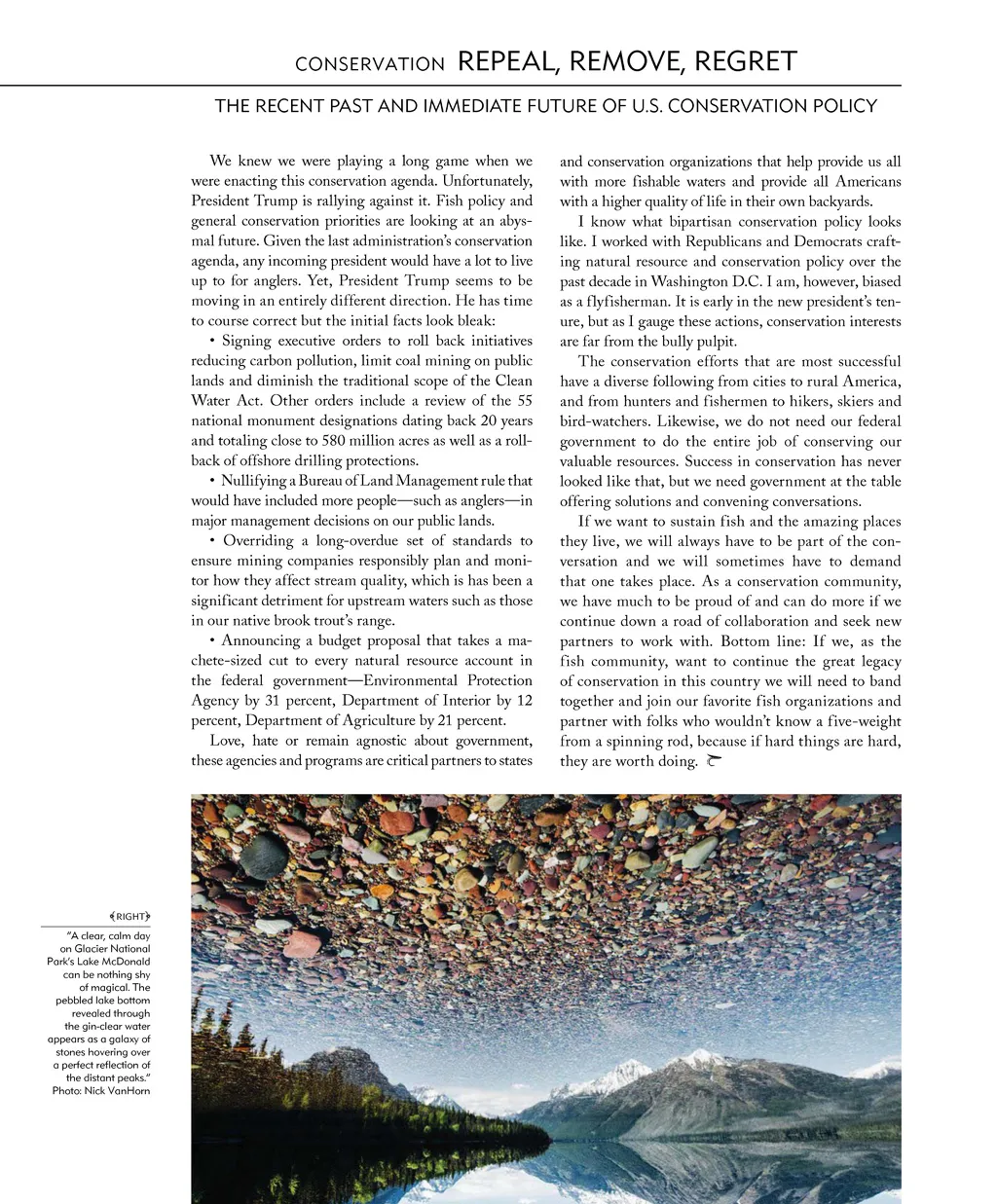
CONSERVATION REPEAL, REMOVE, REGRET THE RECENT PAST AND IMMEDIATE FUTURE OF U.S. CONSERVATION POLICY We knew we were playing a long game when we were enacting this conservation agenda. Unfortunately, President Trump is rallying against it. Fish policy and general conservation priorities are looking at an abys-mal future. Given the last administration’s conservation agenda, any incoming president would have a lot to live up to for anglers. Yet, President Trump seems to be moving in an entirely different direction. He has time to course correct but the initial facts look bleak: • Signing executive orders to roll back initiatives reducing carbon pollution, limit coal mining on public lands and diminish the traditional scope of the Clean Water Act. Other orders include a review of the 55 national monument designations dating back 20 years and totaling close to 580 million acres as well as a roll-back of offshore drilling protections. • Nullifying a Bureau of Land Management rule that would have included more people—such as anglers—in major management decisions on our public lands. • Overriding a long-overdue set of standards to ensure mining companies responsibly plan and moni-tor how they affect stream quality, which is has been a significant detriment for upstream waters such as those in our native brook trout’s range. • Announcing a budget proposal that takes a ma-chete-sized cut to every natural resource account in the federal government—Environmental Protection Agency by 31 percent, Department of Interior by 12 percent, Department of Agriculture by 21 percent. Love, hate or remain agnostic about government, these agencies and programs are critical partners to states and conservation organizations that help provide us all with more fishable waters and provide all Americans with a higher quality of life in their own backyards. I know what bipartisan conservation policy looks like. I worked with Republicans and Democrats craft-ing natural resource and conservation policy over the past decade in Washington D.C. I am, however, biased as a flyfisherman. It is early in the new president’s ten-ure, but as I gauge these actions, conservation interests are far from the bully pulpit. The conservation efforts that are most successful have a diverse following from cities to rural America, and from hunters and fishermen to hikers, skiers and bird-watchers. Likewise, we do not need our federal government to do the entire job of conserving our valuable resources. Success in conservation has never looked like that, but we need government at the table offering solutions and convening conversations. If we want to sustain fish and the amazing places they live, we will always have to be part of the con-versation and we will sometimes have to demand that one takes place. As a conservation community, we have much to be proud of and can do more if we continue down a road of collaboration and seek new partners to work with. Bottom line: If we, as the fish community, want to continue the great legacy of conservation in this country we will need to band together and join our favorite fish organizations and partner with folks who wouldn’t know a five-weight from a spinning rod, because if hard things are hard, they are worth doing. RIGHT “A clear, calm day on Glacier National Park’s Lake McDonald can be nothing shy of magical. The pebbled lake bottom revealed through the gin-clear water appears as a galaxy of stones hovering over a perfect reflection of the distant peaks.” Photo: Nick VanHorn
The Flyfish Journal Volume Eight, Issue Four: Page 102