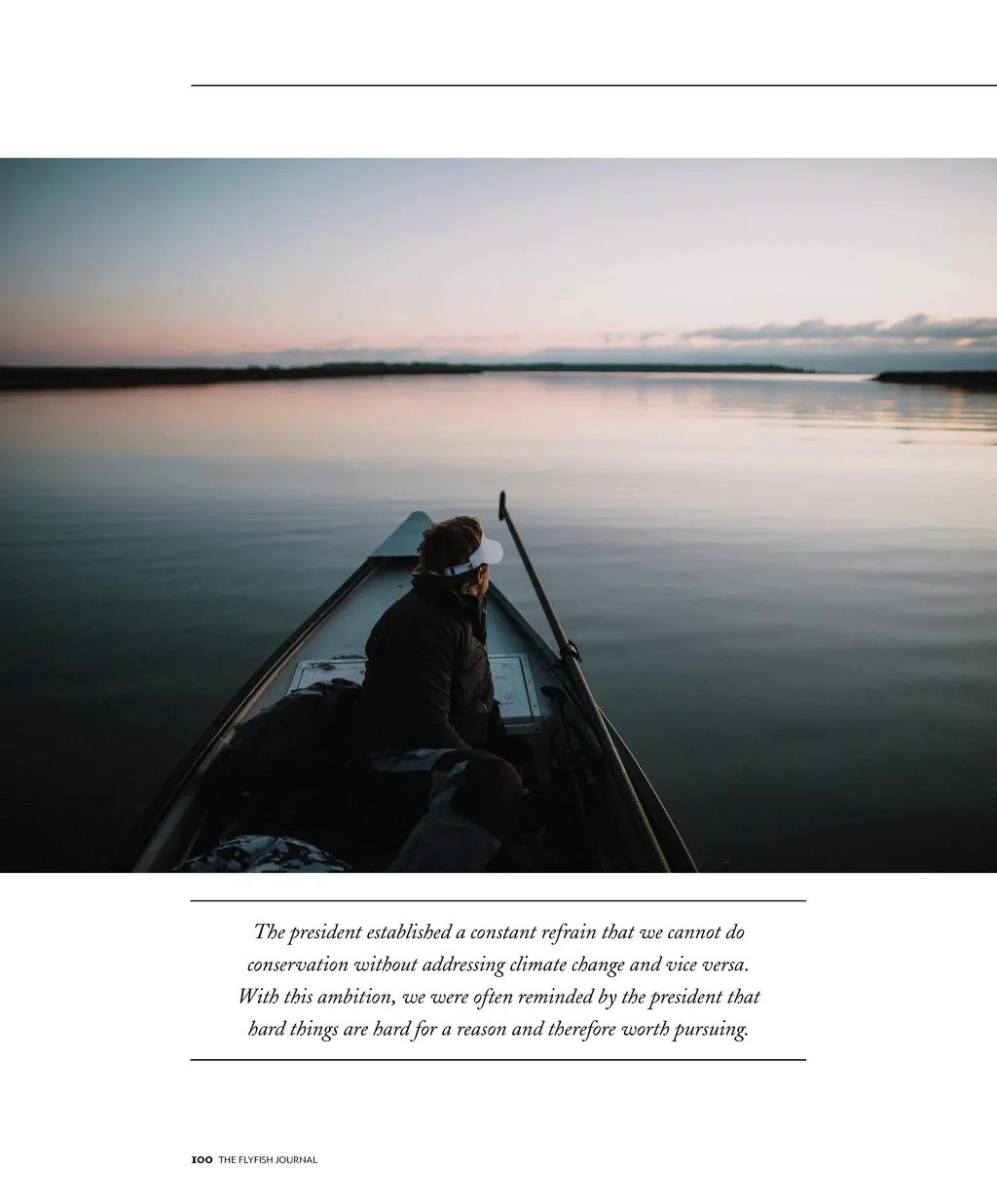
CONSERVATION REPEAL, REMOVE, REGRET THE RECENT PAST AND IMMEDIATE FUTURE OF U.S. CONSERVATION POLICY While I consider myself a flyfisherman first and environmental advocate second, over the past decade I have spent more time in the swamp of Washington D.C. than in my home waters of Michigan. Until re-cently, I was chief of staff of the White House Council on Environmental Quality, where my responsibilities included managing policy teams and working with federal agencies implementing conservation and com-bating climate change. I was privileged to take part in many important conservation discussions, and during the final two years of the Obama administration I saw more accomplished for fish, clean water and other valu-able natural resources than I could have imagined. The action stemmed from President Obama’s Climate Action Plan that included land, water and wildlife conservation initiatives as key priorities. Yes, reducing emissions was priority one, but ensuring our land, water and wildlife were more resilient to a changing climate became a vital parallel strategy. The president established a constant refrain that we cannot do conservation without addressing climate change and vice versa. With this ambition, we were often reminded by the president that hard things are hard for a reason and therefore worth pursuing. It started with commitments to reduce and establish limits for domestic carbon pollution stemming from vehicles and utility power plants. Moreover, given that climate pollution knows no boundaries, the president’s climate team and negotiators worked to lead 190 coun-tries to commit to historic climate pollution reductions in the Paris Agreement. Back home we worked to protect roughly 550 mil-lion acres of land and water—more than any other president in the history of this nation—which included natural areas such as the world’s largest marine pre-serve in the Pacific to the headwaters and home of the native redband trout. While controversial to some spe-cial interests, outdoor recreational access—including fishing—was at the forefront of these designations. Specific fish-first policy wins included the first ever traceability program for commercial fishers. Known as the Illegal, Unreported, and Unregulated Fisheries Enforcement Act of 2015 and the Moratorium Protection Act, these measures combat pirate fishing to help ensure what we purchase is not fraudulent or harvested illegally. Climate change continues to exacerbate the de-cline of biodiversity. While in office, we were able to maximize creative collaborations to help recover more endangered and threatened species than any previ-ous administration. These wins included a coalition that includes 11 states across 70 million acres of the American West to prevent the continuing decline of sage grouse and an iconic Western landscape. We applied this model of partnerships internation-ally to stiffen penalties for wildlife trafficking—one of the most challenging conservation efforts of our time as black-market demands continue to decimate wildlife across the planet. While challenging to track, estimates suggest that more than 26 million tons of fish per year are a part of illegal trade—not to men-tion animals such as rhinos and elephants that have seen dramatic rises in poaching. Few of these conservation priorities were “fish-only” initiatives. They touched aspects such as drought resil-iency, water quality, clean air and therefore nearly every part of our population, whether you fish, hike, bike, ski or just enjoy a respite in your local park. As a result, good fish policy contributes billions to our economy through increased fish stock for commercial fishing, better habitat and access for recreational anglers and improved outdoor experiences for all users—not to mention decreases in costs to our nation’s public health. While proud of these efforts, we weren’t able meet the call from every community to protect neighboring public lands from special interests. As a nation we will need to take more aggressive steps to meet scientists’ calls to reduce greenhouse gas pollution by 2050 to prevent economic and environmental disasters. As an administration, we also failed to convince enough of our conservative colleagues that conservation does not have to be at odds with strong economic policy. Conservation work is hard by nature and requires ex-tensive locally led discussions with diverse people. We made progress and built new partnerships, but building trust requires time and investment. Words: Chris Adamo LEFT “Doug Roland and I left the ramp early on a chilly December morning, headed north from Charleston, SC, toward Cape Romain to fish some not-so-familiar water. Long runs in tiny skiffs are always a treat when the wind isn’t blowing, and this particular morning was very calm. Although we had hot coffee, the prospect of big redfish was enough to keep us jittery.” Photo: Jeremy Clark THE FLYFISH JOURNAL 101
The Flyfish Journal Volume Eight, Issue Four: Page 101