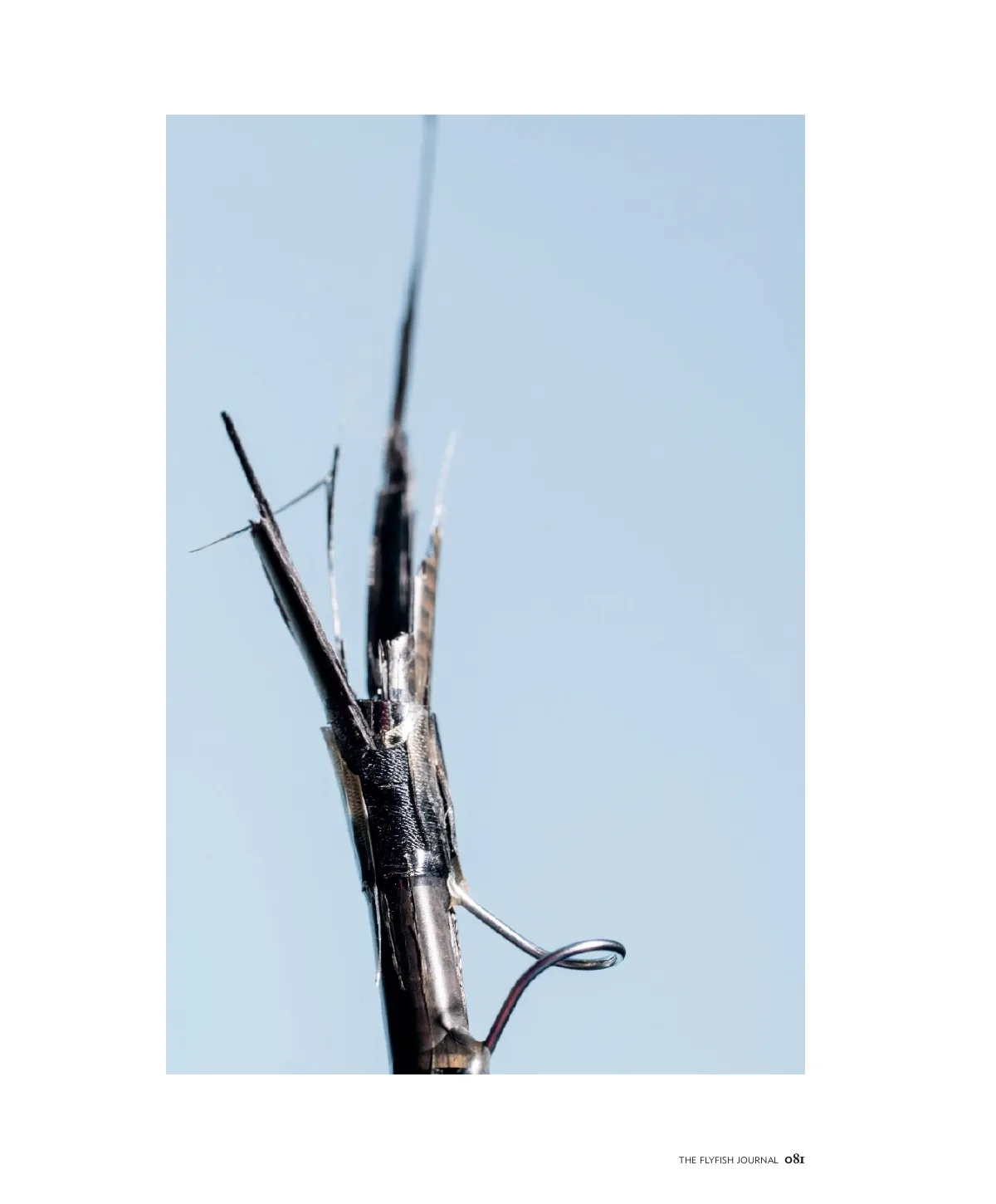
RIGHT When the façade not only cracks, but also explodes. Photo: Tim Romano The first morning of the trip I worked across the river with the Hardy, casting to converging currents and submerged structures before I landed my flies where a crystalline hunk of rock on the far bank di-verted the river’s flow, accelerating it into a seam be-side a pocket of soft water. Nothing. I tried again and watched my white strike indicator as it bobbed along. It dipped under. I lifted my rod to set the hook; the trout felt heavy as it pulled line out into the current. I swung the rod to my side to coax it away from the rapids at the end of the pool then saw its silvery silhouette as it ran hard. It was a good fish. “Hey Kristin!” I hollered to my wife who was fish-ing upstream. “Got one!” Eventually, I muscled the fish toward where I stood, balanced on slick stones with the water making a wake against my legs. I dove at it with my net but couldn’t close the last two feet, so I reached impatiently for the leader. The tension in the line went slack when the tippet snapped against the weight of the fish. It fell backward and disappeared into the rapid, and I cursed and flogged the water with my rod. “Zack! Stop that!” Kristin yelled. Her voice barely carried over the rush of the water. I had witnessed and participated in a few river thrashings over the years and when I swung my rod at the river, I had expected the forgiving surface of the water to absorb my sudden rage. But there it was, a clean break revealing the circle of a hollow tube on the tip side and splintered carbon fiber on the other. I lifted the broken rod. Its severed tip hung on the line. When my father repaired a piece of porcelain, he could complete either an invisible or museum restoration. Bent over his workbench beneath bright lights, he first roughed up the exposed edges of a broken piece using sandpaper so fine it didn’t deserve the name. Peering through a magnifying headset, he then brushed on a thin layer of epoxy. His certain, practiced hands fit the pieces together as the epoxy began to harden. Tape or a weight or a jig constructed using odd objects like books or pens or rocks held the pieces while the epoxy set enough to fire every-thing in a warm oven, completing the chemical process. He used sparing strokes again to sand any excess adhe-sive, smoothing the seam. A museum restoration stopped there. The break, left visible, became part of the piece’s provenance, history and character. To complete an invisible restoration, he went one step further and committed an act of art—of decep-tion—by painting over the break. He mixed paints to match the colors of a piece before airbrushing on the mimetic tones. Once the paint had dried, if the pieces fit and the colors blended, only the most sensitive eye could detect his work. While some people may prefer an invisible restoration for a piece in their private col-lection, hidden damage is less desirable, and if found impacts the value of a piece more than a visible repair. Like most things, it is better to be honest about imper-fections and blemishes. The evidence left by trauma always varies. Since I got the Hardy back, I’ve fished it a couple of times and caught a few trout, but mostly I’ve kept it in its case, away from the water. Remembering the rod’s break reminds me too much of the times when I cracked. When I returned the rod for warranty repair, I listed the reason as “Lost Big Fish,” which I con-sidered a factually correct root cause. One skilled fly caster I know told me that whenever he breaks a rod, he sells it as soon as he gets it fixed. He maintains it never casts the same again, its action altered by the re-placement section, and he would rather unload it and move on than be stuck with a rod that was an inferior version of its former self. Casting the revived Hardy, I was unsure if I could feel a difference. It still flicked a tight loop off the tip and loaded evenly. But when Hardy returned the rod to me, they didn’t send a fer-rule stopper—a tiny machined-aluminum plug meant to keep dust out of the rod—for the new tip section. It felt like the rod was somehow incomplete, even if only in some small, superficial way. The Upper Sacramento River , just west of the McCloud, was pronounced dead in 1991. Downstream from a stretch of shady pocket water a train car de-railed, tumbling from a curved bridge and spilling 19,000 gallons of weed killer into the river. All along the river fish huddled near shore or beached themselves on shallow gravel, trying to escape the toxic plume that would eventually suffocate them along with salaman-ders, insects, crustaceans and other creatures. The poison didn’t stop at animals, killing algae, aquatic plants, cottonwoods, alders and willows along the river. People filled trash bags with brown and rainbow trout that had washed onto the banks. When officials closed the water to fishing, it must have come as a strange pronouncement—all life in the river was already gone. 080 RESTORATION
The Flyfish Journal Volume 13, Issue 2: Page 80