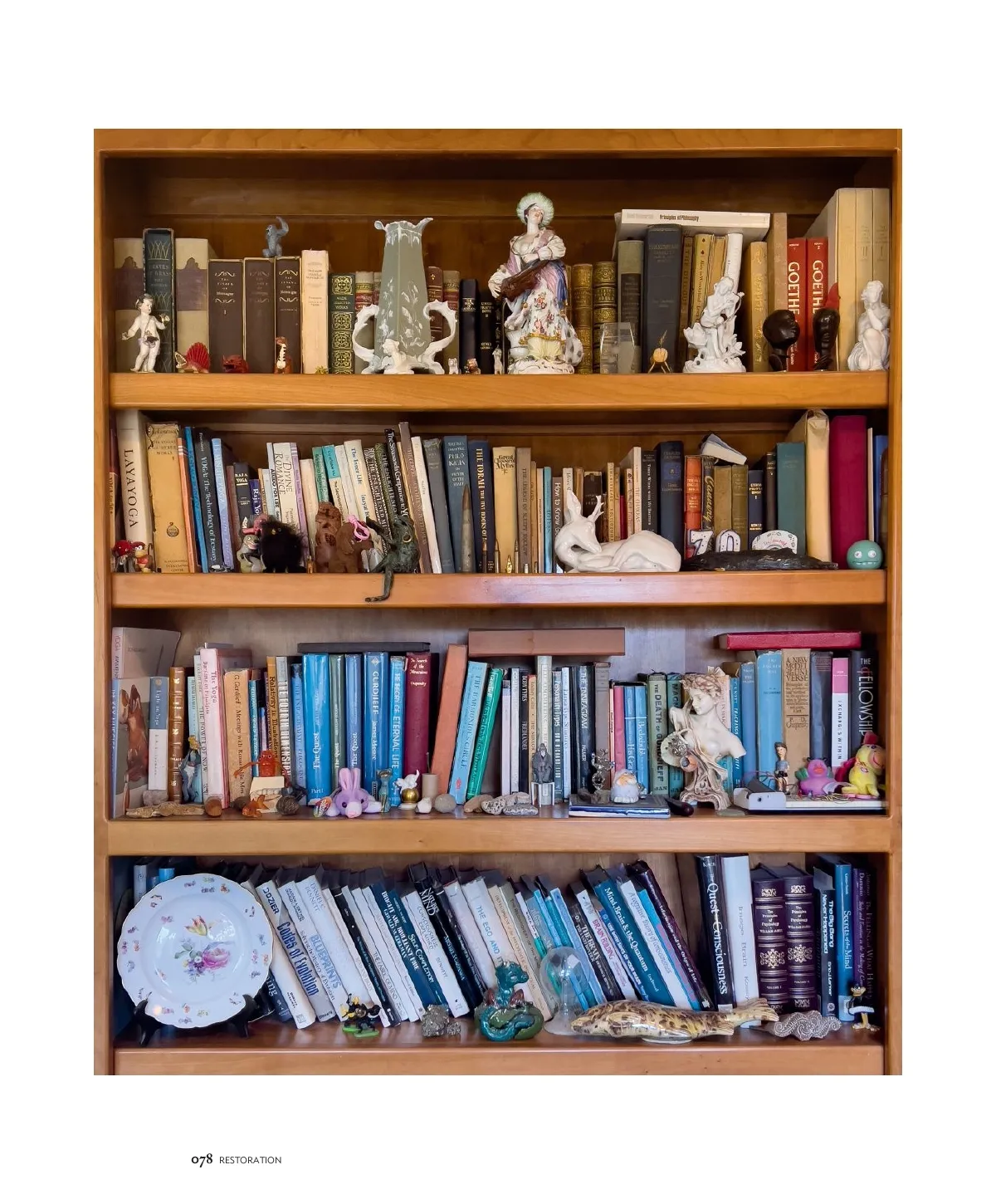
my father destroy a 19 -century Meissen service plate, a tavern scene with scarlet reticulated edges trimmed with gold leaf. Our house was like a small porcelain museum—a midnight blue Limoges tray with the textured relief of a woman’s face emerging from delicate layers of pâte-sur-pâte; art nouveau Teplitz vases decorated with pastel and metallic-tinted grapes and birds and bats; a hypnotic, cross-legged Meissen pagoda nodder, wrapped in floral patterned robes, whose pale pink tongue slid in and out as its head rocked back and forth. “Be careful” was a constant refrain as I navigated my clumsy growing body through the cluttered hallways. I knew that handling an artifact required the utmost attention and care. The Meissen plate had once been part of the Smithsonian’s collection, and 20-odd years before, my dad acquired it in a trade after he repaired a crack in it while he was an apprentice conservationist in London. He picked it up from its folding display holder where it sat on a shelf next to another plate with a purple lily—I can’t remember why—and it just slipped through his fingers and shattered into dozens of pieces on the living-room floor. We both stood there, gaping in silence. His shaking hands collected the pieces like they were picking up the pieces of his own heart, and he placed them in a shoebox that he kept in the the back of his closet. Several times over the years I asked him if he was going to fix it, but he just shook his head and sighed. “It would take too much time,” he said. W hen I was 10 or 12 years old, I watched th The rod was a beloved thing , a birthday gift to myself when I lived in London. I’d handled it—a 4-weight Hardy Zephrus—several times in Farlows before I purchased it. Farlows, at the end of Pall Mall, is London’s last real fly shop. Stocked with three floors of tweed country clothes and high-end tackle, it caters to a discerning clientele from the nearby members-only clubs who can afford access to private trout and salmon fish-ing. But despite its prestige, the guys who worked there were always willing to discuss less-esteemed pursuits like reservoirs, pike and carp with an American who was confused about fishing in the United Kingdom. In Farlows, I bounced the rod in my hand to test its weight and faux cast it to test its action. Its yellow-streaked, moss-green reel seat looked handsome at the end of the olive rod blank, with dark wraps and titanium stripping guides. The cigar-shaped cork was a light blonde color, and the smooth taper toward the end set nicely into the flesh of my pinky and ring fingers. I paired the rod with a Hardy Duchess reel that had a knurled palming edge, lacquered wooden handle and gold rivets. I fished often with the rod and doted over it every time I slid it from its black cotton sleeve. A few years later I brought the rod to the McCloud River, hidden just south of California’s Mt. Shasta in a steep canyon covered with incense cedars and pon-derosa pines. The river’s deep emerald waters cascade over a bed of rounded boulders. Umbrella plants, with their clusters of dinner-plate-sized leaves, droop over the shoreline. Wherever they can find relief from the current, grasses spring up from rocks in the middle of the river. In the fall, the yellow and red of the black oaks and western dogwood come into sharp relief against the evergreens, and bald eagles and great blue herons pass overhead. The canyon is cool and shady, and the rapid flowing water is ice cold. LEFT “My father’s bookshelf is replete with three centuries of porcelain displayed among a lifetime’s collection of knickknacks, oddities and curios. For some collectors, the rare and the valuable meld into the sentimental, creating an exhibit of memory and meaning.” Photo: Zack Wohl THE FLYFISH JOURNAL 079
The Flyfish Journal Volume 13, Issue 2: Page 79