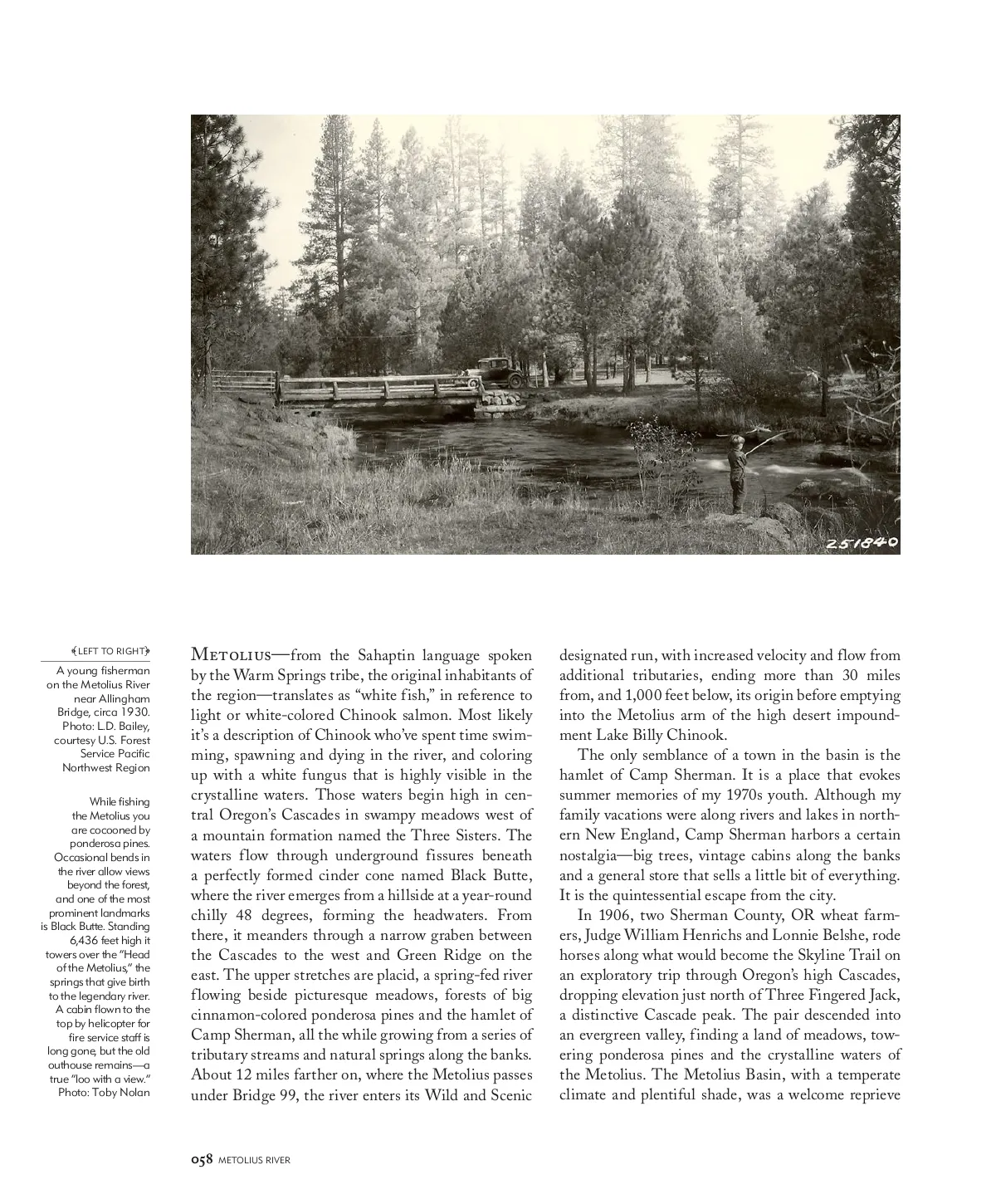
from the scorching summer temperatures at their Columbia Basin farms nearly 80 miles away. In 1908, they returned with their families just after the annual harvest. Thus began an annual summer tradition. The farmers nailed up a sign—made from a wooden shoe box top—with an arrow pointing the way to the place they called “Camp Sherman.” They steered wagons along the primitive roads and rut-ted tracks through the wild canyons and grasslands of Central Oregon, roads that were little more than wagon trails. If a wagon axle broke, the entire train stopped, everyone pitched in to make the repair and then they journeyed on. Though some intrepid homesteaders had filed Homestead Act claims for land along the banks of the Metolius—establishing limited private land holdings on the river that exist to this day—any opportunity to stake a claim in the basin ended when President Grover Cleveland established the area as a federal forest preserve in 1893. By 1917, a growing number of families regularly traveled and vacationed in Camp Sherman, traveling with horse and wagon over Green Ridge. They built summer cabins along the river, some on private land that was purchased, others on Forest Service land with USFS permission. The Civilian Conservation Corps (CCC), formed in 1933 to provide employment during the height of the Great Depression, was a cornerstone of President Franklin Roosevelt’s New Deal. Their legacy in Central Oregon and along the Metolius includes picnic structures, roads, trails and lodges. A favorite of many are the picnic structures in the Camp Sherman, Pine Rest and Pioneer Ford campgrounds, complete with stone fireplaces and cast-iron stovetops that would be perfect for making outdoor wood-fired pizzas. While there are still a few magnificent residences in the area built on the original private land holdings by business magnates from another time, many cabins along the river are simple and completely original. Most of them are built on USFS land and hold long-term leases, with covenants imposed by the Forest Service restricting expansions and changes in archi-tecture. These restrictions, together with the Wild and Scenic designation and the more recent 2009 Metolius Protection Act, limit commercial activity in the Metolius Basin to just the Camp Sherman Store. THE FLYFISH JOURNAL 059
The Flyfish Journal Volume 13, Issue 2: Page 59