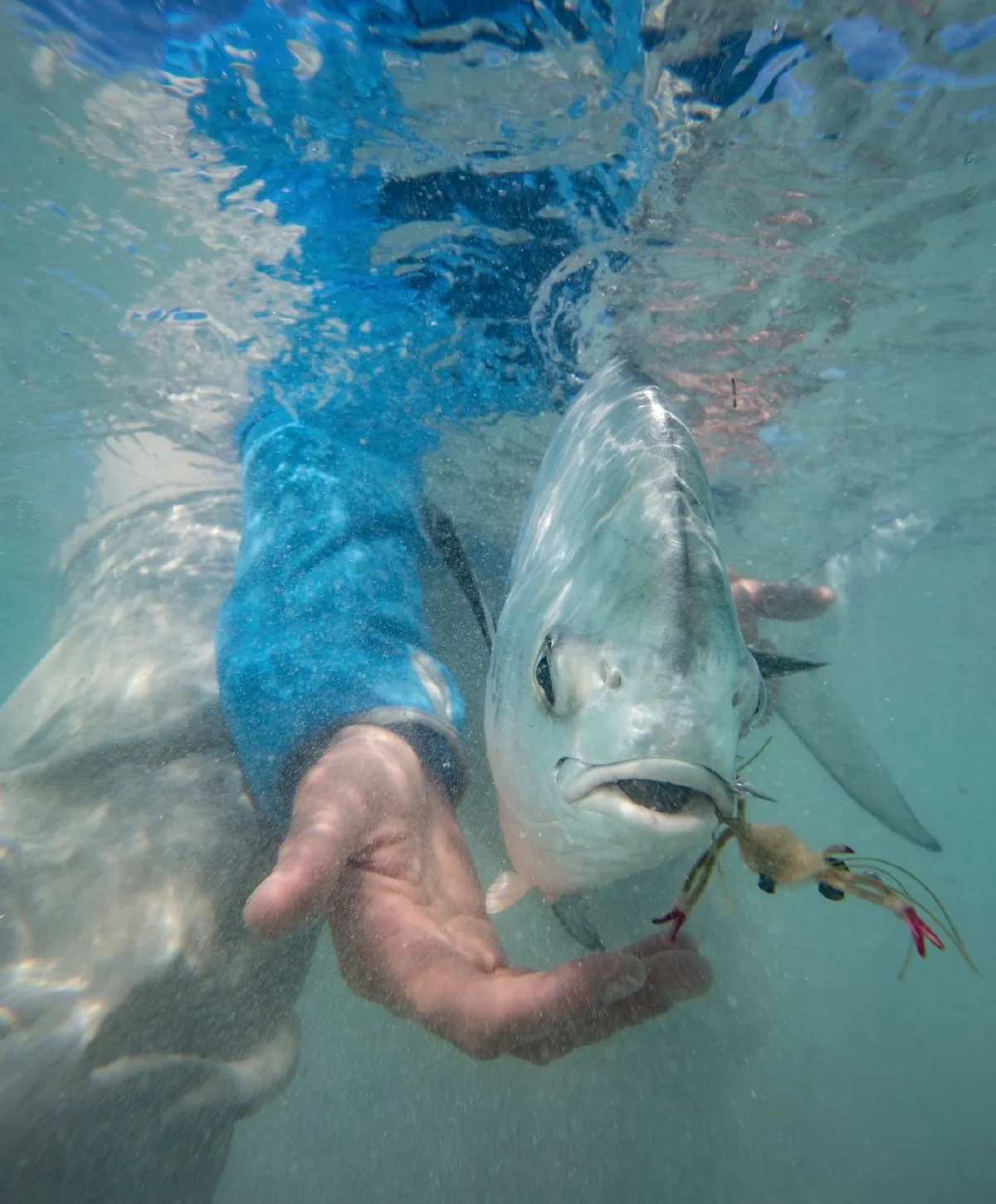
RIGHT Angler Kristen Tripp made the most of a cloudy January day in Cuba’s Cayo Cruz fishery, connecting with this obliging permit despite windy and silty conditions. Photo: Jess McGlothlin Seventy feet off the bow, water tears open and a twisting, rattling blur of silver vaults into the air as if shot from a catapult. Three more explosive leaps, a hundred yards of backing, and a slowly descending tail walk tire the fish, and when it pauses, I am able to gain line and move it toward the boat. Then, on a short line, another flurry of crazed—and, I will admit, slightly frightening—jumps right next to the boat and the fish is out of gas. It swims in a wide circle, pumping its tail to dive, but slower each time it passes around the boat. Finally, I pull the tarpon alongside and Señor Holler grabs it by the lower jaw, leaning the fish’s big head against the gunwale. I pull the hook out, lift it for a photo, then feel it power away into the murk. One cast, one tarpon. Not exactly how I picture tarpon fishing, but still, there must be a bunch of them under the boat here. I hand the rod to Mauro, crack a Cristal, and sit back against the ice chest. “No fishing for you!” Señor Holler shouts, jabbing a finger at Mauro. “Only him! Grand slam! Bonefish now!” “Come on,” I say, as a creeping déjà vu sets in, “the fish are here, let’s fish.” Señor Holler throws his arms in the air and stomps his foot against the floorboards. “Grand slam! Grand slam!” he yells, “Only you fish!” He snatches the tar-pon rod from Mauro, furiously winds up the line, then points it at me, shouting, “Only you!” For Señor Holler, the coveted grand slam is now a slam dunk. It’s only ten o’clock in the morning, which leaves eight more hours for me to catch a bonefish. While the permit seemed impossible, and the tarpon doubtful and random, bonefish here are a dime a dozen. Señor Holler poles us through a narrow cut hidden by mangroves and into an open saltwater lake. The glassy surface is pierced by dozens of bonefish tails and backs glinting in the sun. With the grand slam now within easy grasp, Señor Holler has taken it down a notch, confident in his success. He hands me my bonefish rod, extends his arm horizontally, and with palm up, gestures magnanimously to cast in any direction. I hand the rod to Mauro and Señor Holler boils over. “Grand slam!” he screams, spit flying and neck veins bulging. “Grand slam! No fishing for Mauro! Only you!” I sit down on the cooler and look up at Mauro. Then I extend my arm horizontally, and with palm up, indi-cate that he should cast in any direction. Yes, it was a boondoggle, a week of incredible opulence and comfort in a spectacularly beautiful place with good friends. An extravagance I could never even imagine, let alone deserve, and one I soaked up and savored. But “boondoggle” also carries a connotation of bogus intent or lack of results, and here’s the thing: That closed-containment salmon-farm technology? In the months since we talked about it, it’s grown into a viable business, with several of the group investing in the rollout. The World Salmon Forum, the first-ever gathering of salmon activists, scientists, and managers from around the globe, became reality, with the inaugu-ral three-day symposium in Seattle. A comprehensive, coast-wide strategy for saving wild Pacific salmon started with a fully operational selective-harvest fish trap on the Columbia River. The idea for a film about the cost of fish farms and hatcheries turned into the documentary Artifishal . Add it all up and boondoggle or not, at least in my book, it beats a grand slam any day. This excerpt appears in the book Moving Water, which will be released in April 2022 by Patagonia Books. 052 CUBA
The Flyfish Journal Volume 13, Issue 2: Page 52