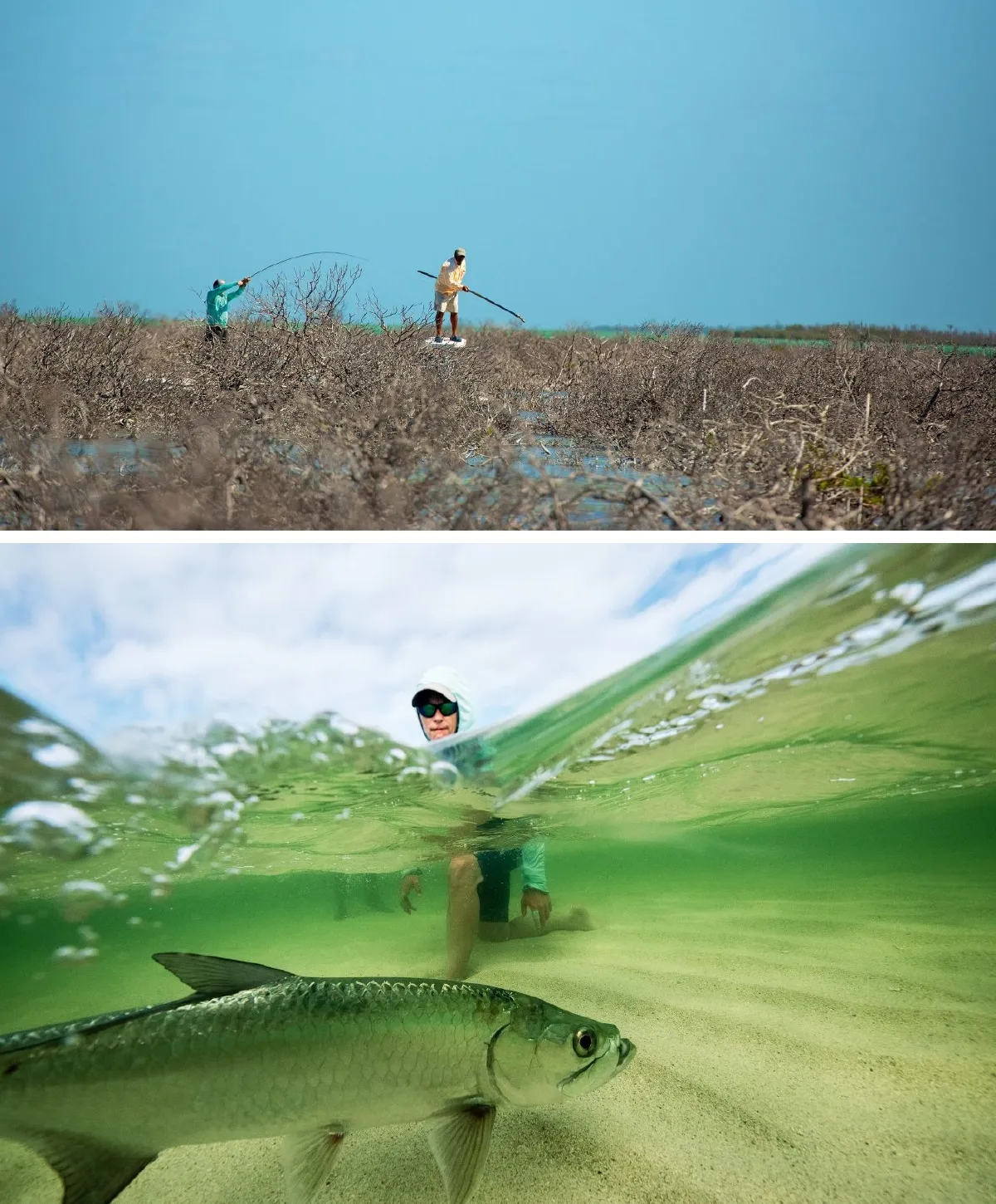
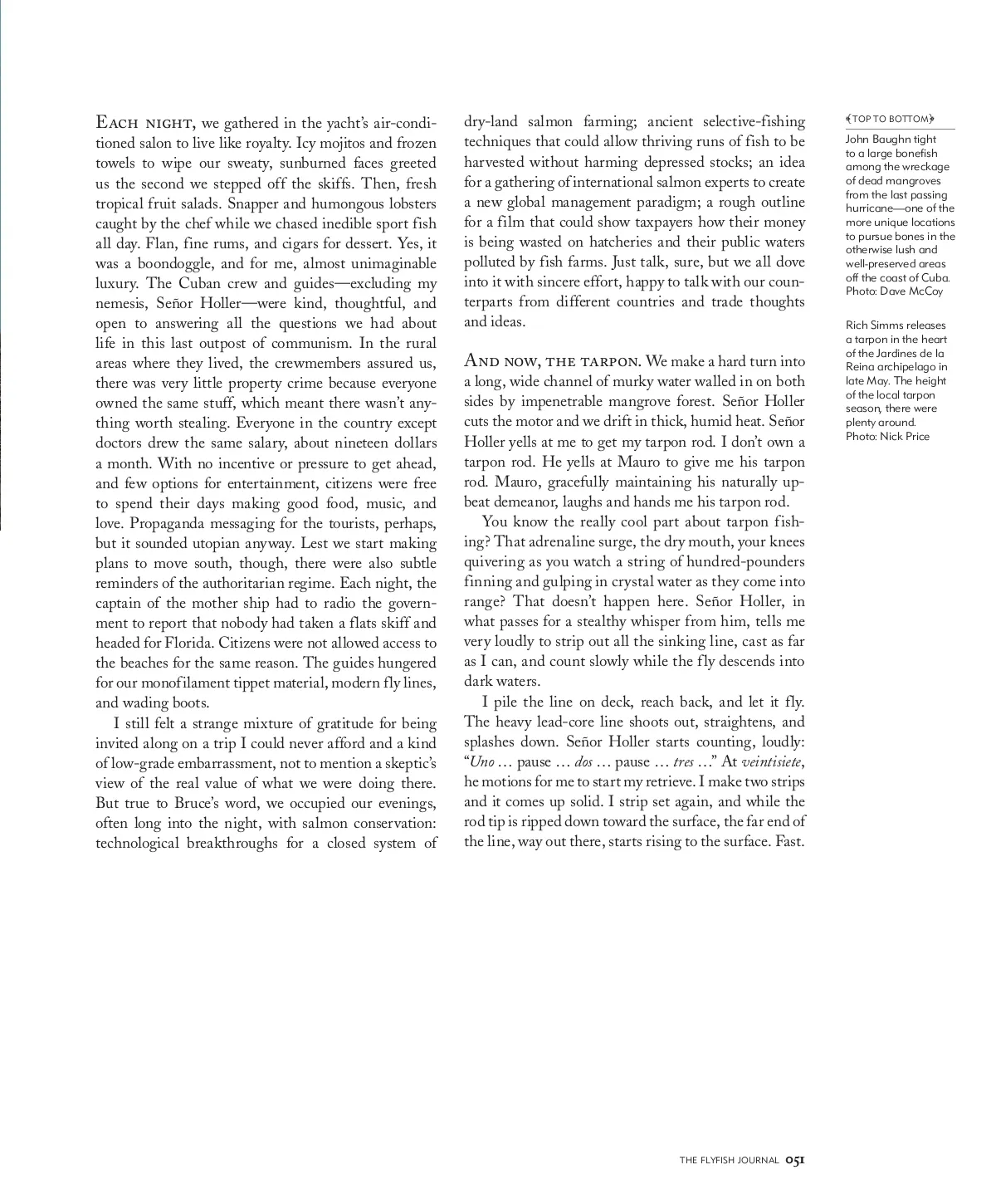
Each night, we gathered in the yacht’s air-condi-tioned salon to live like royalty. Icy mojitos and frozen towels to wipe our sweaty, sunburned faces greeted us the second we stepped off the skiffs. Then, fresh tropical fruit salads. Snapper and humongous lobsters caught by the chef while we chased inedible sport fish all day. Flan, fine rums, and cigars for dessert. Yes, it was a boondoggle, and for me, almost unimaginable luxury. The Cuban crew and guides—excluding my nemesis, Señor Holler—were kind, thoughtful, and open to answering all the questions we had about life in this last outpost of communism. In the rural areas where they lived, the crewmembers assured us, there was very little property crime because everyone owned the same stuff, which meant there wasn’t any-thing worth stealing. Everyone in the country except doctors drew the same salary, about nineteen dollars a month. With no incentive or pressure to get ahead, and few options for entertainment, citizens were free to spend their days making good food, music, and love. Propaganda messaging for the tourists, perhaps, but it sounded utopian anyway. Lest we start making plans to move south, though, there were also subtle reminders of the authoritarian regime. Each night, the captain of the mother ship had to radio the govern-ment to report that nobody had taken a flats skiff and headed for Florida. Citizens were not allowed access to the beaches for the same reason. The guides hungered for our monofilament tippet material, modern fly lines, and wading boots. I still felt a strange mixture of gratitude for being invited along on a trip I could never afford and a kind of low-grade embarrassment, not to mention a skeptic’s view of the real value of what we were doing there. But true to Bruce’s word, we occupied our evenings, often long into the night, with salmon conservation: technological breakthroughs for a closed system of dry-land salmon farming; ancient selective-fishing techniques that could allow thriving runs of fish to be harvested without harming depressed stocks; an idea for a gathering of international salmon experts to create a new global management paradigm; a rough outline for a film that could show taxpayers how their money is being wasted on hatcheries and their public waters polluted by fish farms. Just talk, sure, but we all dove into it with sincere effort, happy to talk with our coun-terparts from different countries and trade thoughts and ideas. TOP TO BOTTOM John Baughn tight to a large bonefish among the wreckage of dead mangroves from the last passing hurricane—one of the more unique locations to pursue bones in the otherwise lush and well-preserved areas off the coast of Cuba. Photo: Dave McCoy Rich Simms releases a tarpon in the heart of the Jardines de la Reina archipelago in late May. The height of the local tarpon season, there were plenty around. Photo: Nick Price And now, the tarpon. We make a hard turn into a long, wide channel of murky water walled in on both sides by impenetrable mangrove forest. Señor Holler cuts the motor and we drift in thick, humid heat. Señor Holler yells at me to get my tarpon rod. I don’t own a tarpon rod. He yells at Mauro to give me his tarpon rod. Mauro, gracefully maintaining his naturally up-beat demeanor, laughs and hands me his tarpon rod. You know the really cool part about tarpon fish-ing? That adrenaline surge, the dr y mouth, your knees quivering as you watch a string of hundred-pounders finning and gulping in crystal water as they come into range? That doesn’t happen here. Señor Holler, in what passes for a stealthy whisper from him, tells me very loudly to strip out all the sinking line, cast as far as I can, and count slowly while the fly descends into dark waters. I pile the line on deck, reach back, and let it fly. The heavy lead-core line shoots out, straightens, and splashes down. Señor Holler starts counting, loudly: “ Uno … pause … dos … pause … tres …” At veintisiete , he motions for me to start my retrieve. I make two strips and it comes up solid. I strip set again, and while the rod tip is ripped down toward the surface, the far end of the line, way out there, starts rising to the surface. Fast. THE FLYFISH JOURNAL 051
The Flyfish Journal Volume 13, Issue 2: Page 51