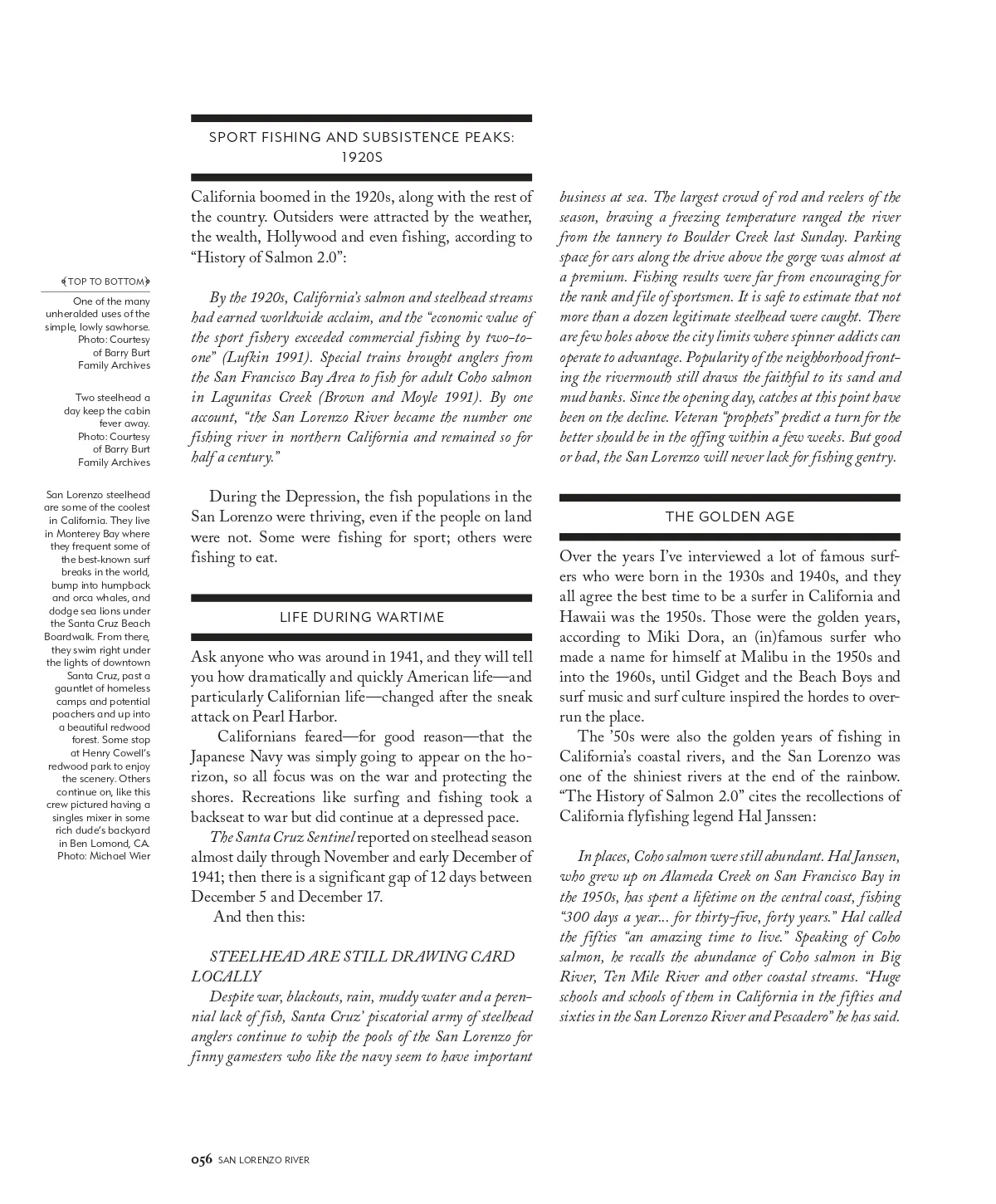
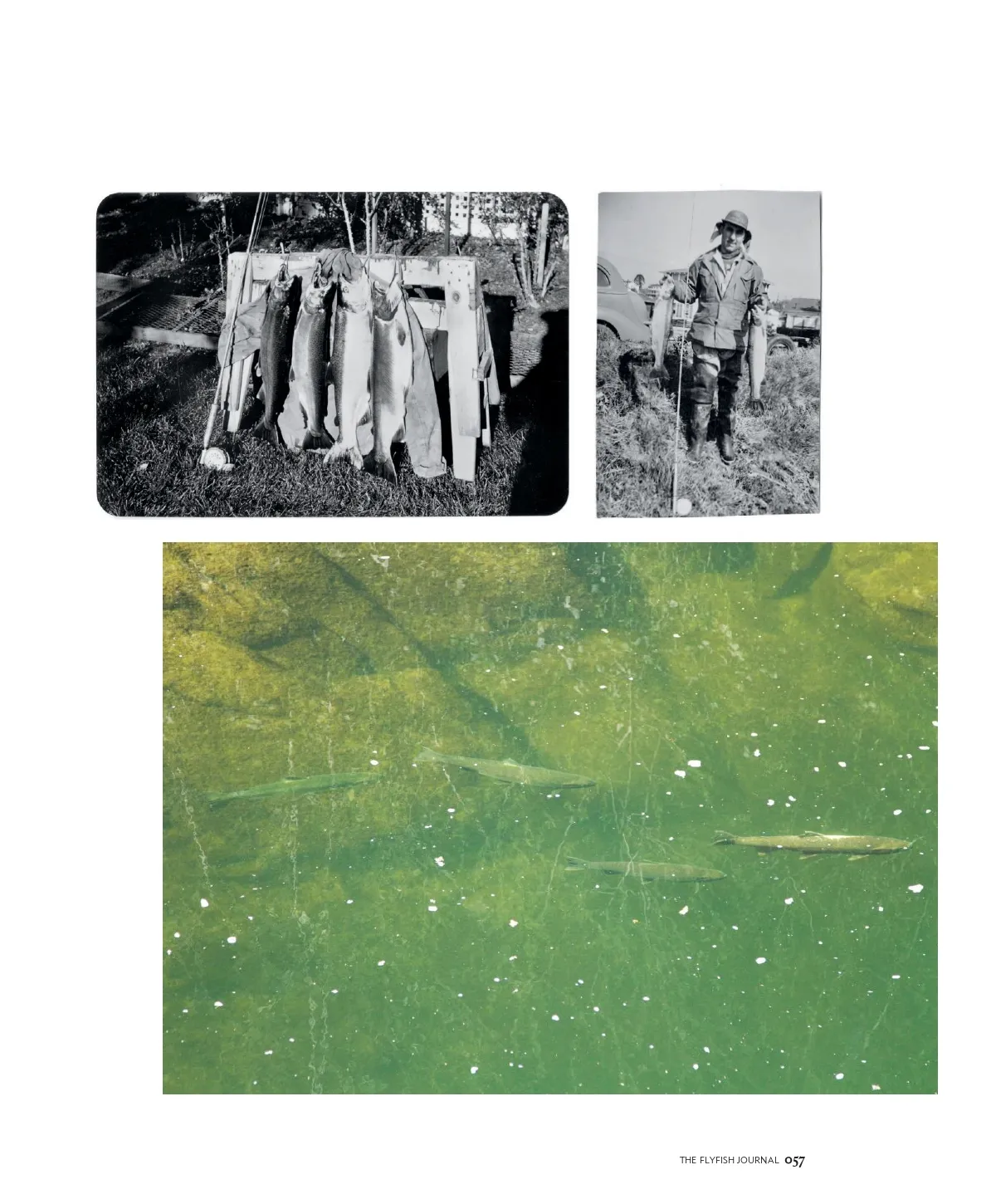
SPORT FISHING AND SUBSISTENCE PEAKS: 1920S California boomed in the 1920s, along with the rest of the country. Outsiders were attracted by the weather, the wealth, Hollywood and even fishing, according to “History of Salmon 2.0”: TOP TO BOTTOM One of the many unheralded uses of the simple, lowly sawhorse. Photo: Courtesy of Barry Burt Family Archives Two steelhead a day keep the cabin fever away. Photo: Courtesy of Barry Burt Family Archives San Lorenzo steelhead are some of the coolest in California. They live in Monterey Bay where they frequent some of the best-known surf breaks in the world, bump into humpback and orca whales, and dodge sea lions under the Santa Cruz Beach Boardwalk. From there, they swim right under the lights of downtown Santa Cruz, past a gauntlet of homeless camps and potential poachers and up into a beautiful redwood forest. Some stop at Henry Cowell’s redwood park to enjoy the scenery. Others continue on, like this crew pictured having a singles mixer in some rich dude’s backyard in Ben Lomond, CA. Photo: Michael Wier By the 1920s, California’s salmon and steelhead streams had earned worldwide acclaim, and the “economic value of the sport fishery exceeded commercial fishing by two-to-one” (Lufkin 1991). Special trains brought anglers from the San Francisco Bay Area to fish for adult Coho salmon in Lagunitas Creek (Brown and Moyle 1991). By one account, “the San Lorenzo River became the number one fishing river in northern California and remained so for half a century.” During the Depression, the fish populations in the San Lorenzo were thriving, even if the people on land were not. Some were fishing for sport; others were fishing to eat. business at sea. The largest crowd of rod and reelers of the season, braving a freezing temperature ranged the river from the tannery to Boulder Creek last Sunday. Parking space for cars along the drive above the gorge was almost at a premium. Fishing results were far from encouraging for the rank and file of sportsmen. It is safe to estimate that not more than a dozen legitimate steelhead were caught. There are few holes above the city limits where spinner addicts can operate to advantage. Popularity of the neighborhood front-ing the rivermouth still draws the faithful to its sand and mud banks. Since the opening day, catches at this point have been on the decline. Veteran “prophets” predict a turn for the better should be in the offing within a few weeks. But good or bad, the San Lorenzo will never lack for fishing gentry. THE GOLDEN AGE LIFE DURING WARTIME Ask anyone who was around in 1941, and they will tell you how dramatically and quickly American life—and particularly Californian life—changed after the sneak attack on Pearl Harbor. Californians feared—for good reason—that the Japanese Navy was simply going to appear on the ho-rizon, so all focus was on the war and protecting the shores. Recreations like surfing and fishing took a backseat to war but did continue at a depressed pace. The Santa Cruz Sentinel reported on steelhead season almost daily through November and early December of 1941; then there is a significant gap of 12 days between December 5 and December 17. And then this: STEELHEAD ARE STILL DRAWING CARD LOCALLY Despite war, blackouts, rain, muddy water and a peren-nial lack of fish, Santa Cruz’ piscatorial army of steelhead anglers continue to whip the pools of the San Lorenzo for finny gamesters who like the navy seem to have important Over the years I’ve interviewed a lot of famous surf-ers who were born in the 1930s and 1940s, and they all agree the best time to be a surfer in California and Hawaii was the 1950s. Those were the golden years, according to Miki Dora, an (in)famous surfer who made a name for himself at Malibu in the 1950s and into the 1960s, until Gidget and the Beach Boys and surf music and surf culture inspired the hordes to over-run the place. The ’50s were also the golden years of fishing in California’s coastal rivers, and the San Lorenzo was one of the shiniest rivers at the end of the rainbow. “The History of Salmon 2.0” cites the recollections of California flyfishing legend Hal Janssen: In places, Coho salmon were still abundant. Hal Janssen, who grew up on Alameda Creek on San Francisco Bay in the 1950s, has spent a lifetime on the central coast, fishing “300 days a year... for thirty-five, forty years.” Hal called the fifties “an amazing time to live.” Speaking of Coho salmon, he recalls the abundance of Coho salmon in Big River, Ten Mile River and other coastal streams. “Huge schools and schools of them in California in the fifties and sixties in the San Lorenzo River and Pescadero” he has said. 056 SAN LORENZO RIVER
The Flyfish Journal Volume 11, Issue 1: Page 56