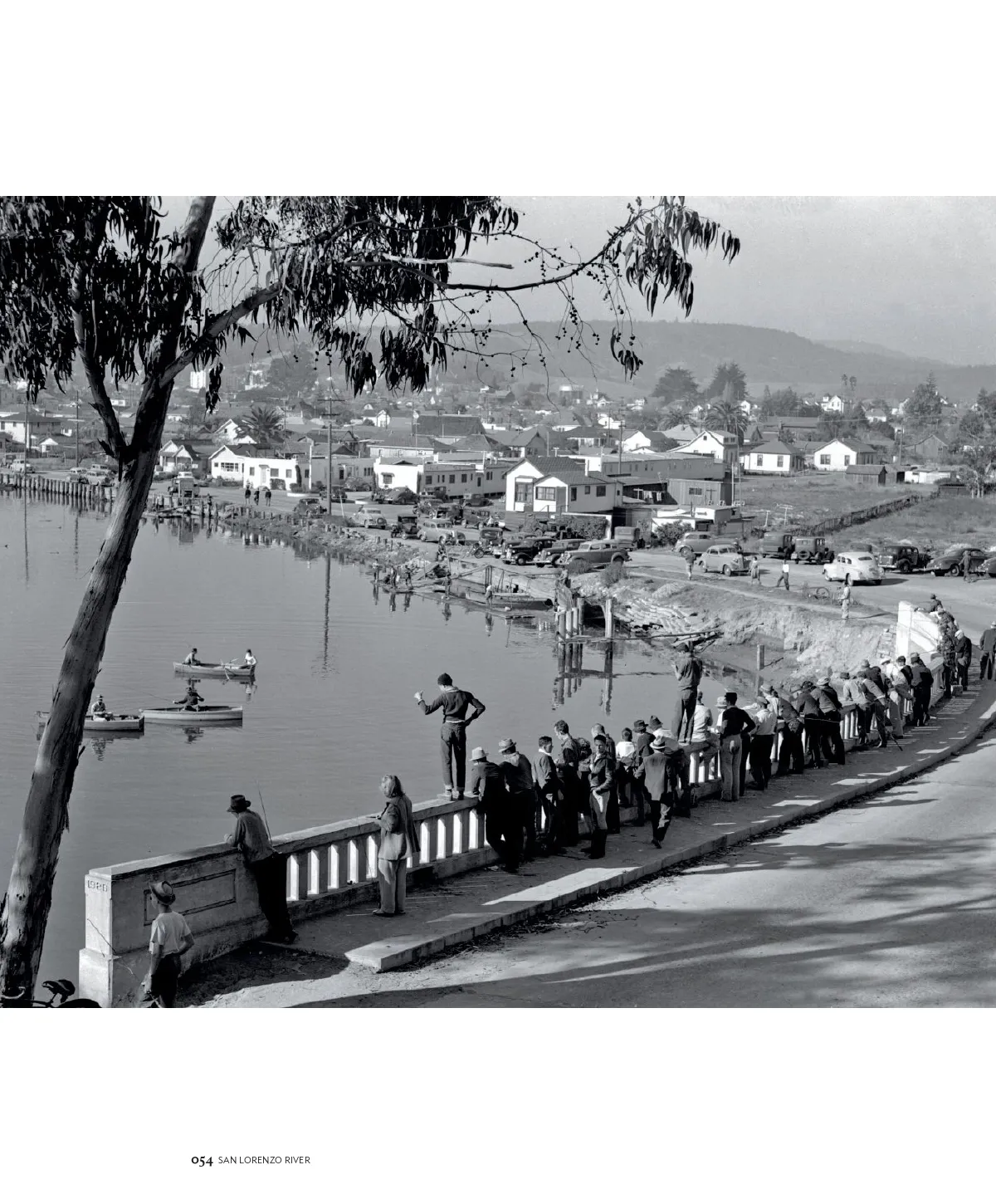
THIS LAND IS MY LAND: 1905 Way back when, in 1905, there was concern about sec-tions of the San Lorenzo being privatized, excluding the public from access to the river and the fish now thriving in it. On August 3, 1905, The Santa Cruz Sentinel pub-lished an article from a concerned citizen titled: “OBJECT TO RESERVED WATERS: OWNERS IN SANTA CRUZ CO. WHO RESERVE FISHING WATERS ARE IN DISFAVOR.” The article expressed concern that “the owners of land through which flow many inviting trout streams in Santa Cruz Co., are attempting to preserve or con-templating preserving those streams for their own personal enjoyment.” It also expressed hope that a new hatchery at Brookdale would keep the population alive and kicking: The anglers of San Francisco will, in the near future, find the streams of Santa Cruz Co. ideal for fishing. Last week I spent a couple of days at Brookdale, a beautiful spot in the heart of the redwoods. Brookdale is a comparatively new resort, and the genial proprietor, Judge Logan, tells me that he can not accommodate with cottages his many guests. Ground was broken for the hatchery last February and today a suitable and commodious building marks the spot. In the hatchery at present are 800,000 rainbow and steel-head fry, all lively and healthy and growing under the most suitable surroundings. (Next spring several ponds will be added to the plant and the hatchery people will then be in a position to plentifully supply every river and creek in Santa Cruz Co.) The Southern Pacific Co., I am told, is largely interested in this enterprise in a financial way, which will be appreci-ated by anglers in general. Stocking the San Lorenzo with fresh fry for future generations was taken so seriously that on February 18, 1906, The Santa Cruz Sentinel did the math relating weight to quantity in a story called “How Fish Eggs Are Counted”: LEFT By careful counting it has been ascertained that the average ounce of salmon or steelhead spawn contains 220 eggs. Therefore, by simply multiplying the number of ounces of eggs taken from the fish, or a number of fish, by 220, gives altogether accurate results. Two fish were taken in the Soquel Creek recently from which 86 ounces of eggs were taken. This number of ounces multiplied by 220, gave the product of the two fish at 18,920 eggs, or 9,460 for each fish. Pretty good ratio of increase that even if only one-half are propagated and raised. But the hatchery results are much better than that, as something like 80 or 90 per cent are hatched and raised, when taken for hatchery purposes. Opening day on the San Lorenzo River, Dec. 8th 1940, San Lorenzo Boulevard, Santa Cruz, CA. Photo: Ed Webber/ Covello & Covello Historical Collection. Going back to the ’70s and ’80s —the 197 0s and 19 80s—there were fishermen at the base of the Santa Cruz Municipal Wharf casting into swirling bait balls of anchovies and pulling out steelhead who hadn’t yet moved into the river, a weird way to catch a steelhead, but still a way. (A way of catching steelhead I also failed at.) But apparently catching steelhead while they were all at sea was nothing new. On December 2, 1908, The Santa Cruz Sentinel reported: BIG STEELHEAD CAUGHT OFF SHORE: Tuesday was the Game Warden’s day. Mr. Welch was in great luck. While fishing in the bay off Capitola, not more than 300 yards from shore, he hooked a steelhead that weighed 7 ½ pounds. The fish fought for his life, but the spoon bait was too much for him. The Game Warden was proud of his catch. He also hooked a silver salmon weighing 2 ½ pounds. Recently there have been caught in the bay a number of salmon of a variety not known, but which it is thought are from the Brookdale Fish Hatchery. Some of the fish were sent back to the hatchery for examination by Prof. Gilbert, the fish expert of Stanford University. THE FLYFISH JOURNAL 055
The Flyfish Journal Volume 11, Issue 1: Page 55