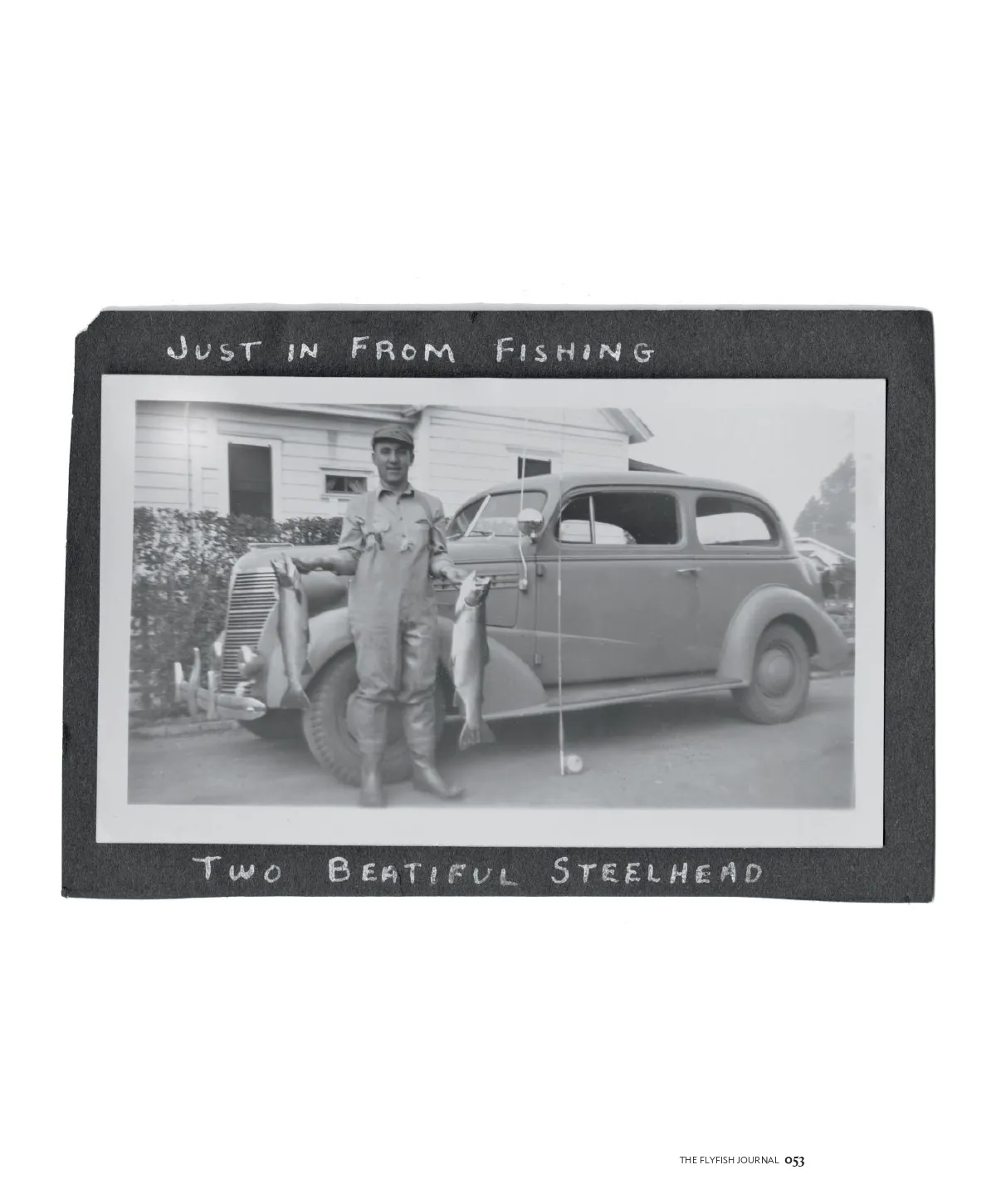
THE HISTORY OF SALMON 2.0 TROUT OR SALMON: 1885 The first sawmills in Santa Cruz predate the Gold Rush, but the lumbering pace picked up after 1849 with the influx of people, need and capital. According to NOAA Fisheries West Coast Region’s “The History of Salmon 2.0,” milling lumber—and other practices— began to sully and silt up the San Lorenzo before and after the Gold Rush: RIGHT The first mention of “steelhead” in The Santa Cruz Sentinel was in the December 4, 1885, edition, and began a debate over whether steelhead were salmon or trout: The question whether the “steelhead” belongs to the salmon or the trout family will soon be settled in court. Dr. David Starr Jordan, the renowned piscatorial expert, now at the head of the Stanford Jr. University, has declared that these fish belong to the trout family, but the fishermen, not those who fish for sport, but those who catch fish for a living, have decided that the steelhead is a salmon. A few weeks later, at the end of the month and the year, Judge Low came to a no-decision: An Unsolved Problem. San Francisco, Dec. 31. Judge Low this morning held that the scientific distinc-tion between steelhead salmon and steelhead trout was too fine for the law to recognize, and so dismissed the case against A. Pardini, arrested recently by Fish Commissioner Babcock. Pardini was arrested for unlawfully exposing trout for sale. He defended himself on the ground that the fish were steelhead salmon, and not trout. Experts from Stanford University testified that the fish were trout, but Judge Low had a doubt in his mind which he resolved in favor of the defendant. Whether the steelhead was a salmon or a trout, they were good sport and good eatin’ for the rest of the 19 th century and into the 20 th century. “Just in from fishing, two beautiful steelhead,” and a sweet fishing rig. Photo: Courtesy of Barry Burt Family Archives A common practice in the 19th century was to dump the waste into the same stream that powered the mill. As early as 1867, The Santa Cruz Sentinel reported that, “the sawmills on the Pescadero have... injured the fishing, from the sawdust running down the creek.” Four years later, an article in the same newspaper described how the “impact of sawmills on trout fishing was always a matter of conten-tion in the communities along the streams flowing out of the redwood-covered canyons of the Santa Cruz Mountains.” THE GOLDEN SPIKE: 1876 The second most significant event in California his-tory—after the Gold Rush, historically and chrono-logically—was the coming of the railroad. Spurred by the Gold Rush and the reports of abundant, most-ex-cellent soil and weather and just about everything else humans crave, the population of California mutated as folks came west to grow with the country. First to San Francisco, then Los Angeles and Santa Cruz the same year: 1876. The train made it to Santa Cruz to expedite the movement of machinery in and lumber out, and brought folks to fish the abundance of Monterey Bay— from rockfish to salmon—and the river that ran into it. According to NOAA’s “History”: “In the San Lorenzo River (Santa Cruz County), ‘railroad workers... while building the South Pacific Coast Railroad in the late 1870s, often used explosives to “fish.”’ (Lydon 2003).” 052 SAN LORENZO RIVER
The Flyfish Journal Volume 11, Issue 1: Page 52