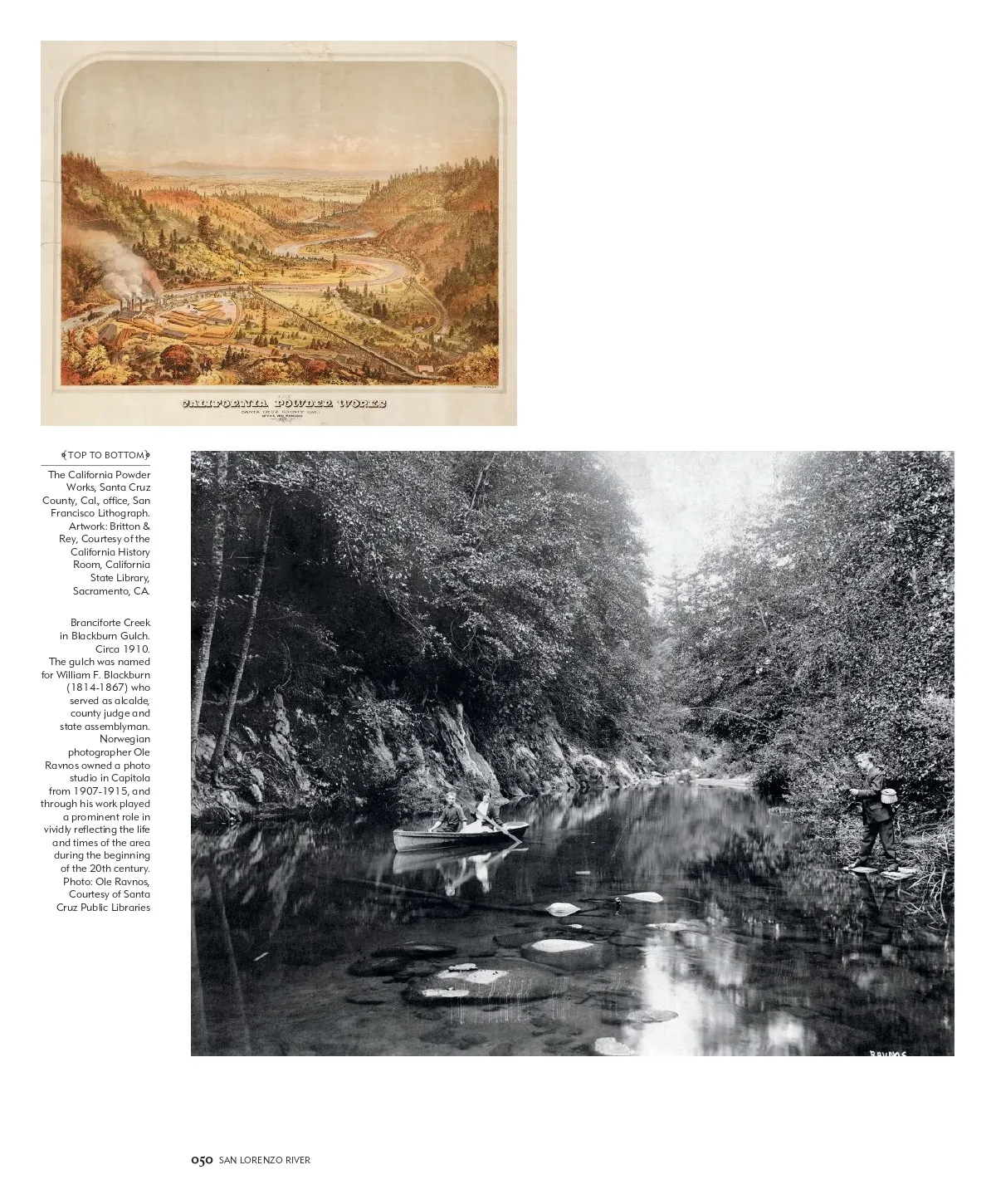
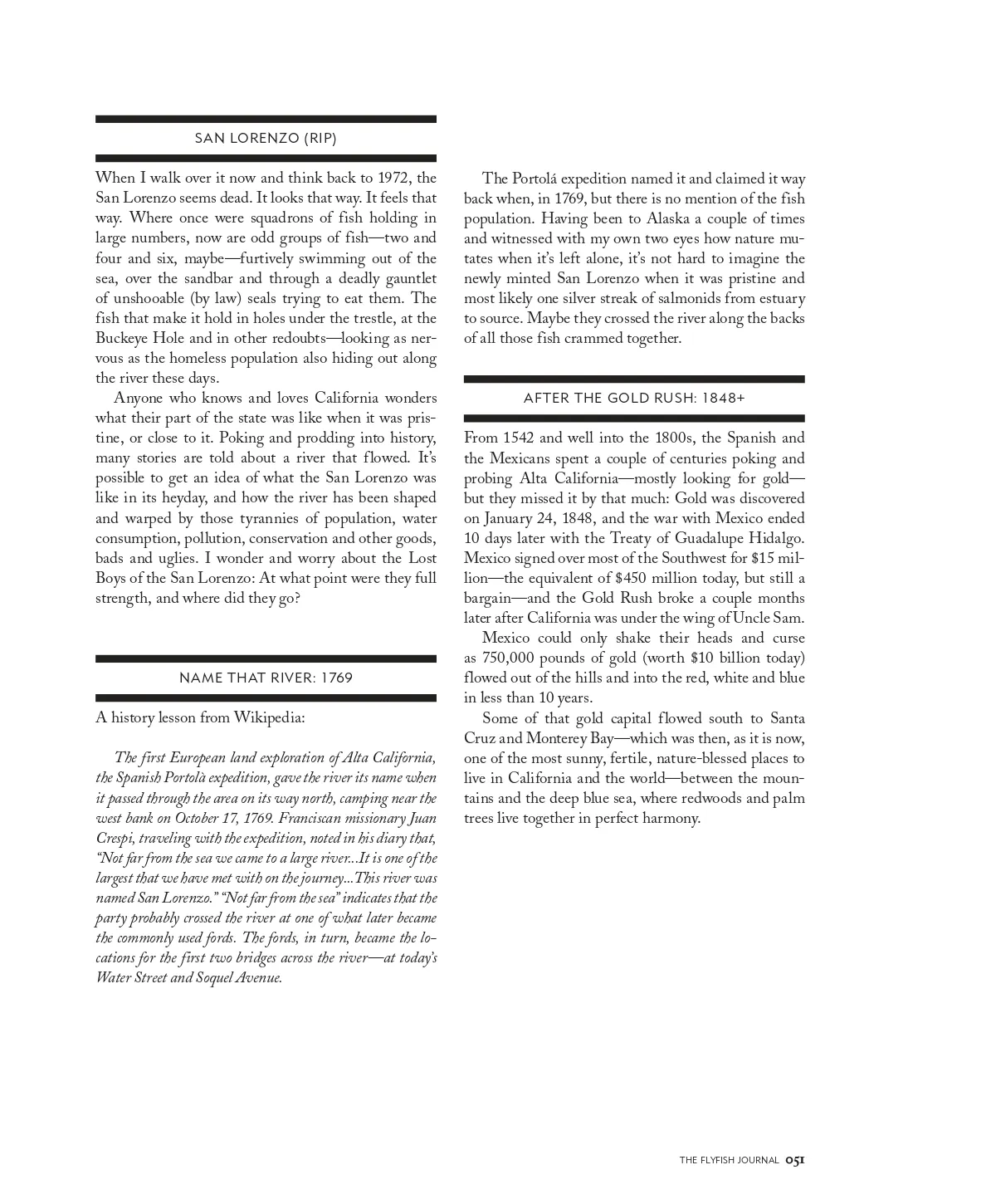
SAN LORENZO (RIP) When I walk over it now and think back to 1972, the San Lorenzo seems dead. It looks that way. It feels that way. Where once were squadrons of fish holding in large numbers, now are odd groups of fish—two and four and six, maybe—furtively swimming out of the sea, over the sandbar and through a deadly gauntlet of unshooable (by law) seals trying to eat them. The fish that make it hold in holes under the trestle, at the Buckeye Hole and in other redoubts—looking as ner-vous as the homeless population also hiding out along the river these days. Anyone who knows and loves California wonders what their part of the state was like when it was pris-tine, or close to it. Poking and prodding into history, many stories are told about a river that flowed. It’s possible to get an idea of what the San Lorenzo was like in its heyday, and how the river has been shaped and warped by those tyrannies of population, water consumption, pollution, conservation and other goods, bads and uglies. I wonder and worry about the Lost Boys of the San Lorenzo: At what point were they full strength, and where did they go? The Portolá expedition named it and claimed it way back when, in 1769, but there is no mention of the fish population. Having been to Alaska a couple of times and witnessed with my own two eyes how nature mu-tates when it’s left alone, it’s not hard to imagine the newly minted San Lorenzo when it was pristine and most likely one silver streak of salmonids from estuary to source. Maybe they crossed the river along the backs of all those fish crammed together. AFTER THE GOLD RUSH: 1848+ NAME THAT RIVER: 1769 A history lesson from Wikipedia: The first European land exploration of Alta California, the Spanish Portolà expedition, gave the river its name when it passed through the area on its way north, camping near the west bank on October 17, 1769. Franciscan missionary Juan Crespi, traveling with the expedition, noted in his diary that, “Not far from the sea we came to a large river...It is one of the largest that we have met with on the journey...This river was named San Lorenzo.” “Not far from the sea” indicates that the party probably crossed the river at one of what later became the commonly used fords. The fords, in turn, became the lo-cations for the first two bridges across the river—at today’s Water Street and Soquel Avenue. From 1542 and well into the 1800s, the Spanish and the Mexicans spent a couple of centuries poking and probing Alta California—mostly looking for gold— but they missed it by that much: Gold was discovered on January 24, 1848, and the war with Mexico ended 10 days later with the Treaty of Guadalupe Hidalgo. Mexico signed over most of the Southwest for $15 mil-lion—the equivalent of $450 million today, but still a bargain—and the Gold Rush broke a couple months later after California was under the wing of Uncle Sam. Mexico could only shake their heads and curse as 750,000 pounds of gold (worth $10 billion today) flowed out of the hills and into the red, white and blue in less than 10 years. Some of that gold capital flowed south to Santa Cruz and Monterey Bay—which was then, as it is now, one of the most sunny, fertile, nature-blessed places to live in California and the world—between the moun-tains and the deep blue sea, where redwoods and palm trees live together in perfect harmony. THE FLYFISH JOURNAL 051
The Flyfish Journal Volume 11, Issue 1: Page 51