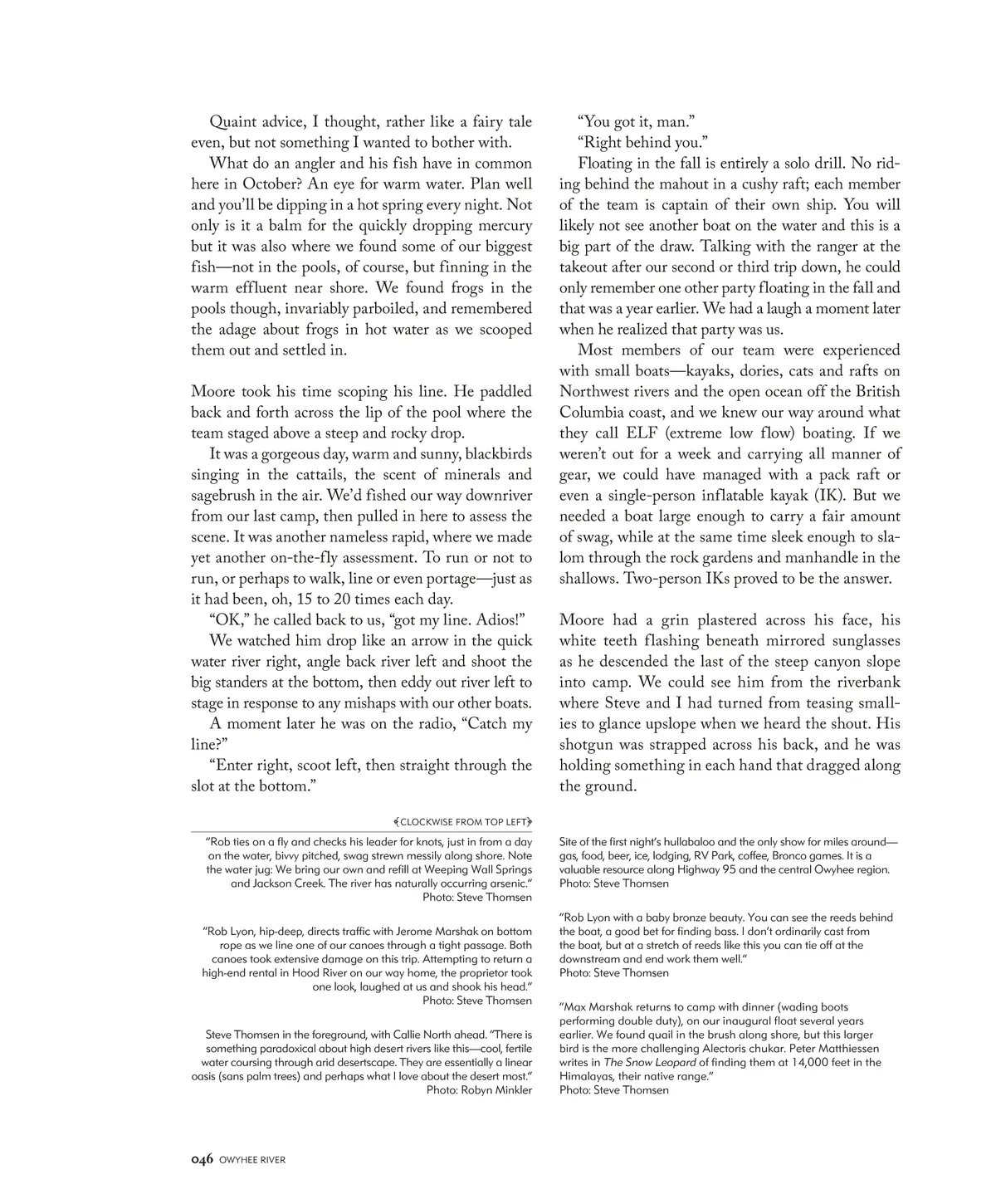
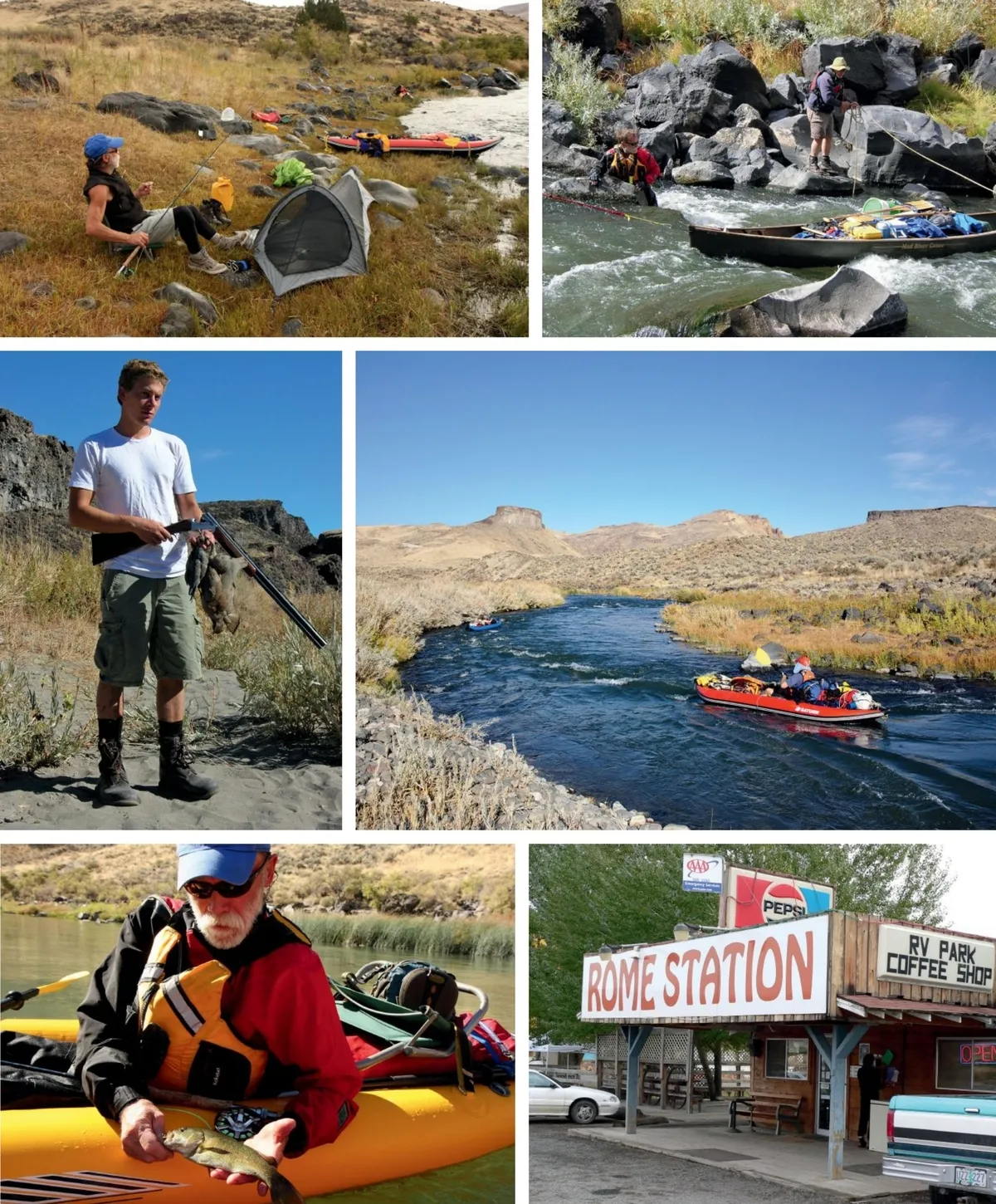
Quaint advice, I thought, rather like a fairy tale even, but not something I wanted to bother with. What do an angler and his fish have in common here in October? An eye for warm water. Plan well and you’ll be dipping in a hot spring every night. Not only is it a balm for the quickly dropping mercury but it was also where we found some of our biggest fish—not in the pools, of course, but finning in the warm effluent near shore. We found frogs in the pools though, invariably parboiled, and remembered the adage about frogs in hot water as we scooped them out and settled in. Moore took his time scoping his line. He paddled back and forth across the lip of the pool where the team staged above a steep and rocky drop. It was a gorgeous day, warm and sunny, blackbirds singing in the cattails, the scent of minerals and sagebrush in the air. We’d fished our way downriver from our last camp, then pulled in here to assess the scene. It was another nameless rapid, where we made yet another on-the-fly assessment. To run or not to run, or perhaps to walk, line or even portage—just as it had been, oh, 15 to 20 times each day. “OK,” he called back to us, “got my line. Adios!” We watched him drop like an arrow in the quick water river right, angle back river left and shoot the big standers at the bottom, then eddy out river left to stage in response to any mishaps with our other boats. A moment later he was on the radio, “Catch my line?” “Enter right, scoot left, then straight through the slot at the bottom.” • CLOCKWISE FROM TOP LEFT • “You got it, man.” “Right behind you.” Floating in the fall is entirely a solo drill. No rid-ing behind the mahout in a cushy raft; each member of the team is captain of their own ship. You will likely not see another boat on the water and this is a big part of the draw. Talking with the ranger at the takeout after our second or third trip down, he could only remember one other party floating in the fall and that was a year earlier. We had a laugh a moment later when he realized that party was us. Most members of our team were experienced with small boats—kayaks, dories, cats and rafts on Northwest rivers and the open ocean off the British Columbia coast, and we knew our way around what they call ELF (extreme low flow) boating. If we weren’t out for a week and carrying all manner of gear, we could have managed with a pack raft or even a single-person inflatable kayak (IK). But we needed a boat large enough to carry a fair amount of swag, while at the same time sleek enough to sla-lom through the rock gardens and manhandle in the shallows. Two-person IKs proved to be the answer. Moore had a grin plastered across his face, his white teeth flashing beneath mirrored sunglasses as he descended the last of the steep canyon slope into camp. We could see him from the riverbank where Steve and I had turned from teasing small-ies to glance upslope when we heard the shout. His shotgun was strapped across his back, and he was holding something in each hand that dragged along the ground. “Rob ties on a fly and checks his leader for knots, just in from a day on the water, bivvy pitched, swag strewn messily along shore. Note the water jug: We bring our own and refill at Weeping Wall Springs and Jackson Creek. The river has naturally occurring arsenic.” Photo: Steve Thomsen “Rob Lyon, hip-deep, directs traffic with Jerome Marshak on bottom rope as we line one of our canoes through a tight passage. Both canoes took extensive damage on this trip. Attempting to return a high-end rental in Hood River on our way home, the proprietor took one look, laughed at us and shook his head.” Photo: Steve Thomsen Steve Thomsen in the foreground, with Callie North ahead. “There is something paradoxical about high desert rivers like this—cool, fertile water coursing through arid desertscape. They are essentially a linear oasis (sans palm trees) and perhaps what I love about the desert most.” Photo: Robyn Minkler Site of the first night’s hullabaloo and the only show for miles around— gas, food, beer, ice, lodging, RV Park, coffee, Bronco games. It is a valuable resource along Highway 95 and the central Owyhee region. Photo: Steve Thomsen “Rob Lyon with a baby bronze beauty. You can see the reeds behind the boat, a good bet for finding bass. I don’t ordinarily cast from the boat, but at a stretch of reeds like this you can tie off at the downstream and end work them well.” Photo: Steve Thomsen “Max Marshak returns to camp with dinner (wading boots performing double duty), on our inaugural float several years earlier. We found quail in the brush along shore, but this larger bird is the more challenging Alectoris chukar. Peter Matthiessen writes in The Snow Leopard of finding them at 14,000 feet in the Himalayas, their native range.” Photo: Steve Thomsen 046 OWYHEE RIVER
The Flyfish Journal The Flyfish Journal 15.3: Page 46