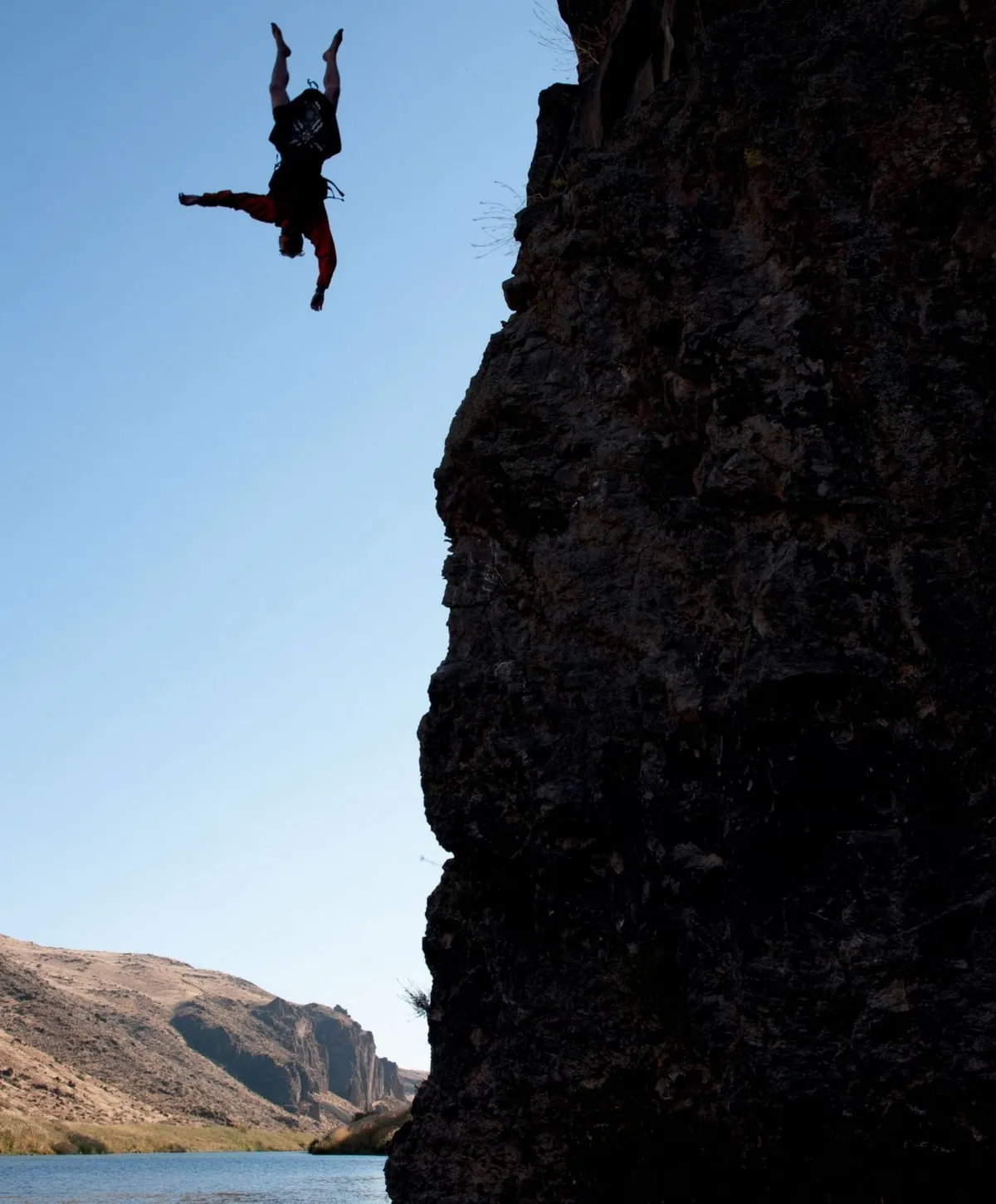
We drifted lazily north, passing under a rudimen-tary bridge with leaking irrigation pipes strapped to the undercarriage, past weathered farmhouses and cattle gates. We heard the iron cough of a farm truck starting up, the lowing of cattle, the bark of a dog, the splash of our paddles. I felt as if we were drifting through the backyard of the ranching west. The river was very, very low but there was enough water for our boats if we minded the deeper channels. Finally we left farm buildings behind and our sur-roundings morphed as the tiny river purled between tall fields of yellow hay and green corn. Fat carp flared like yearling pigs under our boats and towering bulrushes combed dark green back eddies where we glimpsed the coppery flash of our quarry. I stopped to examine the sun-bleached skeleton of a five-point buck resting on a gravel bar midstream, then contin-ued on, when the strangest thing happened. A dozen pheasant burst out of a field atop the embankment river left and launched over the stream in single file. Four bird dogs emerged and braked sharply; they looked chagrined at their fate and glanced quickly between us and the birds. We heard three shots, but they were in vain. In the course of the 50-mile float from Rome to Birch Creek you will find an unimaginable amount of fly water. The river is crystal clear and drop-dead gorgeous. The first couple of days we punched hop-per patterns tightly under brushy overhung banks. Rushes lined sweet pockets along deeper channels where I could imagine an alpha bass waiting for just the right appetizer to swim past. Mayfly hatches provided us the chance to fish bass like we would trout. High cover holes were always promising in such thin water, where as often as not a smallie would shoot up out of the water with my fly in its mouth, wriggling furiously through a half-moon arc, then bolting downriver and leaving the tip of my 4-weight tattooing the river’s surface and putting throat to my little CFO. The fishing was nothing at all like our summer steelhead fishery closer to home. Summers on the Deschutes are often a quasi-military operation, whereas fishing the O’ was easy. I was reminded of Sobey Pond, a dawn bike ride every Saturday morning outside our subdivision in northern California, where we honed our chops on black bass and bluegill and it felt like God’s backyard to me and my grade-school buddies. Not just the fishing either, but the exotic aura of the aquatic world it was steeped in—to such a degree that I was inspired to write a paper (my first) on pond ecology for science class. There was a hint of that old ingenuousness here in the Oregon desert. Before our first Owyhee float trip I had gotten ahold of Ray Perkins, a biologist for the Malheur Watershed District. I thought maybe the smaller-sized fish common in not only the Owyhee, but the John Day as well, might be stunted. But he explained there was a relative dearth of cyprinids (minnows) in these desert systems compared to the smallmouth-rich streams of Tennessee, for example. As for stunted, he told me, “To me the word ‘stunted’ means you have most year classes, but the older in-dividuals do not grow very much. What I think we have in the Owyhee is a population dominated by younger-age fish. Once they spawn, at about 10 to 12 inches, they have a very low survival rate.” Aquatic insects are stacked in the Owyhee and a primary food source for the bass. You don’t need to tie on the tiniest bug in the box either—hungry bass cut you a lot of slack. Working a hatch of blue-winged olives or sniping hoppers close to shore is the name of the game. Bass can sip mays as delicately as any highbrow trout . There are boss bad boys around, the dark kingpins of the underwater, but they’re not likely to waste their time on a bug. I had managed to track down a local old man of the river who seemed to be in the know. I asked him the secret. “First,” he said, “build yourself a little rock-lined pool beside the hole you’re fishing. You have to fish out the small bass that you’ll catch at first. The big ones are hanging down beneath and have the patience to wait for something worth their time to come along. So, put all the little fish you catch in that holding pool and once you winnow out the population a bit you might have a chance to catch that lunker.” • LEFT • Moore Huffman, waiting another nanosecond before nailing his entry. Moore has extreme sport DNA. Photo: Robyn Minkler THE FLYFISH JOURNAL 045
The Flyfish Journal The Flyfish Journal 15.3: Page 45