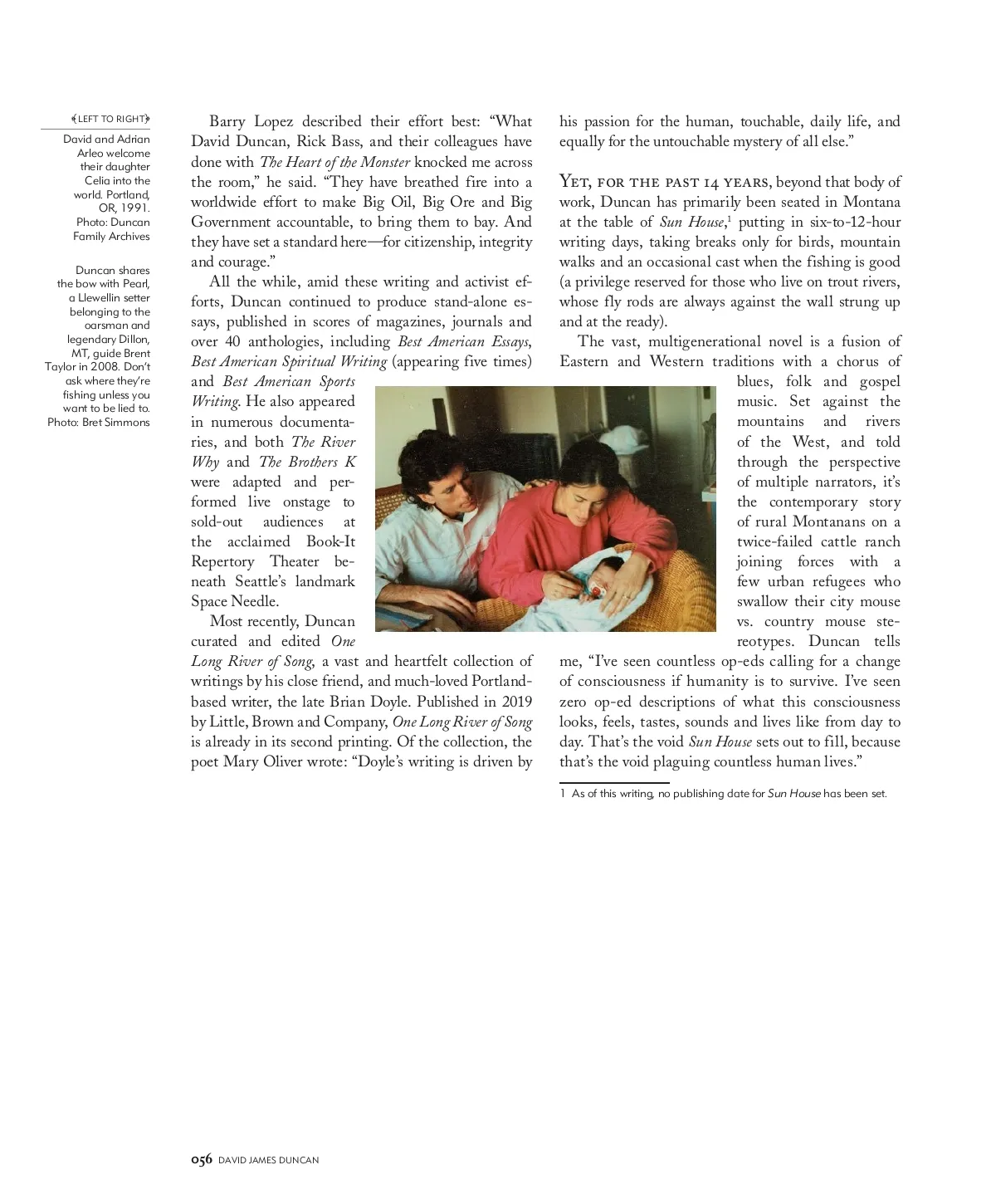
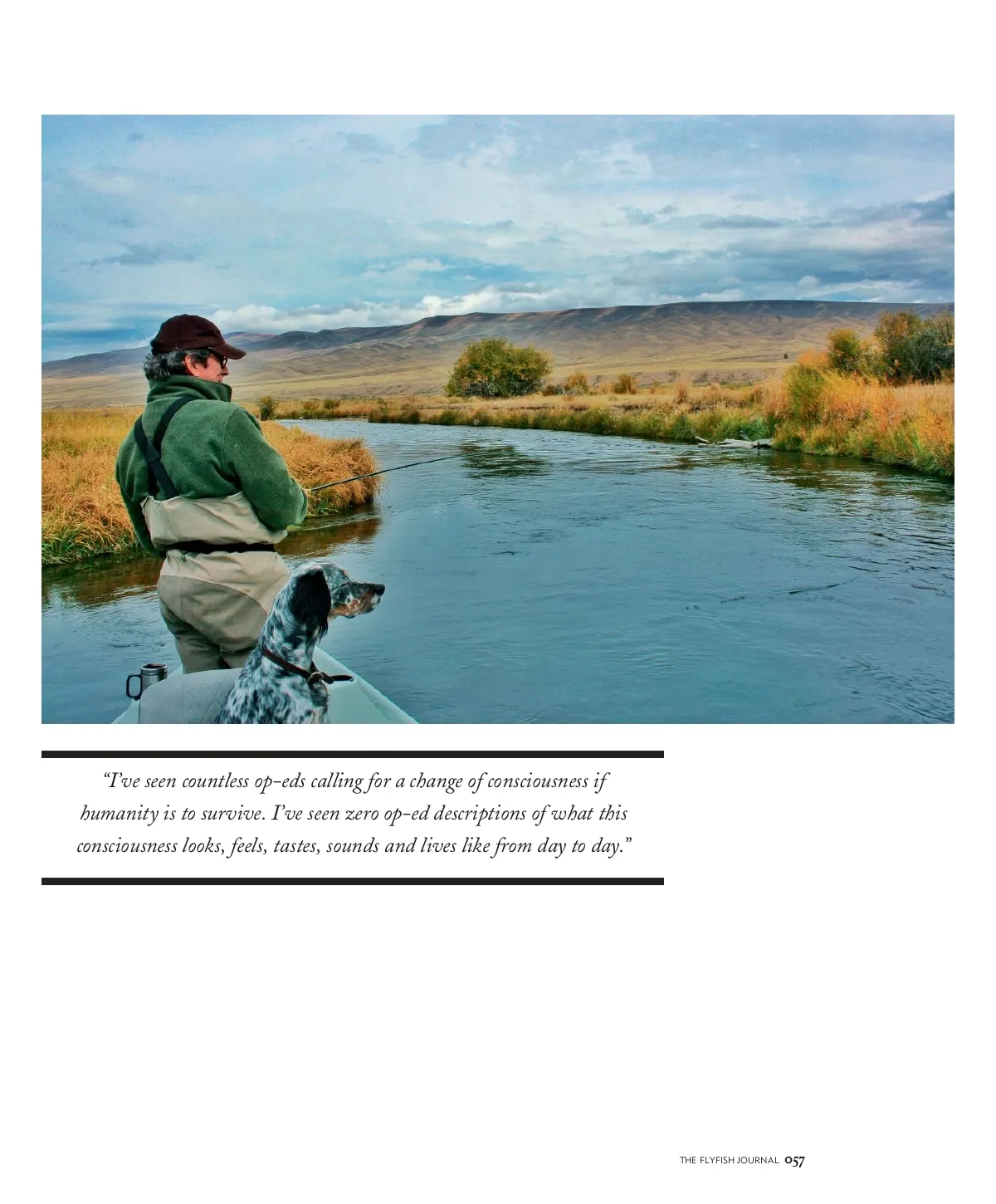
LEFT TO RIGHT David and Adrian Arleo welcome their daughter Celia into the world. Portland, OR, 1991. Photo: Duncan Family Archives Duncan shares the bow with Pearl, a Llewellin setter belonging to the oarsman and legendary Dillon, MT, guide Brent Taylor in 2008. Don’t ask where they’re fishing unless you want to be lied to. Photo: Bret Simmons Barry Lopez described their effort best: “What David Duncan, Rick Bass, and their colleagues have done with The Heart of the Monster knocked me across the room,” he said. “They have breathed fire into a worldwide effort to make Big Oil, Big Ore and Big Government accountable, to bring them to bay. And they have set a standard here—for citizenship, integrity and courage.” All the while, amid these writing and activist ef-forts, Duncan continued to produce stand-alone es-says, published in scores of magazines, journals and over 40 anthologies, including Best American Essays , Best American Spiritual Writing (appearing five times) and Best American Sports Writing . He also appeared in numerous documenta-ries, and both The River Why and The Brothers K were adapted and per-formed live onstage to sold-out audiences at the acclaimed Book-It Repertory Theater be-neath Seattle’s landmark Space Needle. Most recently, Duncan curated and edited One Long River of Song , a vast and heartfelt collection of writings by his close friend, and much-loved Portland-based writer, the late Brian Doyle. Published in 2019 by Little, Brown and Company, One Long River of Song is already in its second printing. Of the collection, the poet Mary Oliver wrote: “Doyle’s writing is driven by his passion for the human, touchable, daily life, and equally for the untouchable mystery of all else.” Yet, for the past 14 years , beyond that body of work, Duncan has primarily been seated in Montana at the table of Sun House , 1 putting in six-to-12-hour writing days, taking breaks only for birds, mountain walks and an occasional cast when the fishing is good (a privilege reserved for those who live on trout rivers, whose fly rods are always against the wall strung up and at the ready). The vast, multigenerational novel is a fusion of Eastern and Western traditions with a chorus of blues, folk and gospel music. Set against the mountains and rivers of the West, and told through the perspective of multiple narrators, it’s the contemporary story of rural Montanans on a twice-failed cattle ranch joining forces with a few urban refugees who swallow their city mouse vs. country mouse ste-reotypes. Duncan tells me, “I’ve seen countless op-eds calling for a change of consciousness if humanity is to survive. I’ve seen zero op-ed descriptions of what th is consciousness looks, feels, tastes, sounds and lives like from day to day. That’s the void Sun House sets out to fill, because that’s the void plaguing countless human lives.” 1 As of this writing, no publishing date for Sun House has been set. 056 DAVID JAMES DUNCAN
The Flyfish Journal The Flyfish Journal 13.4: Page 56