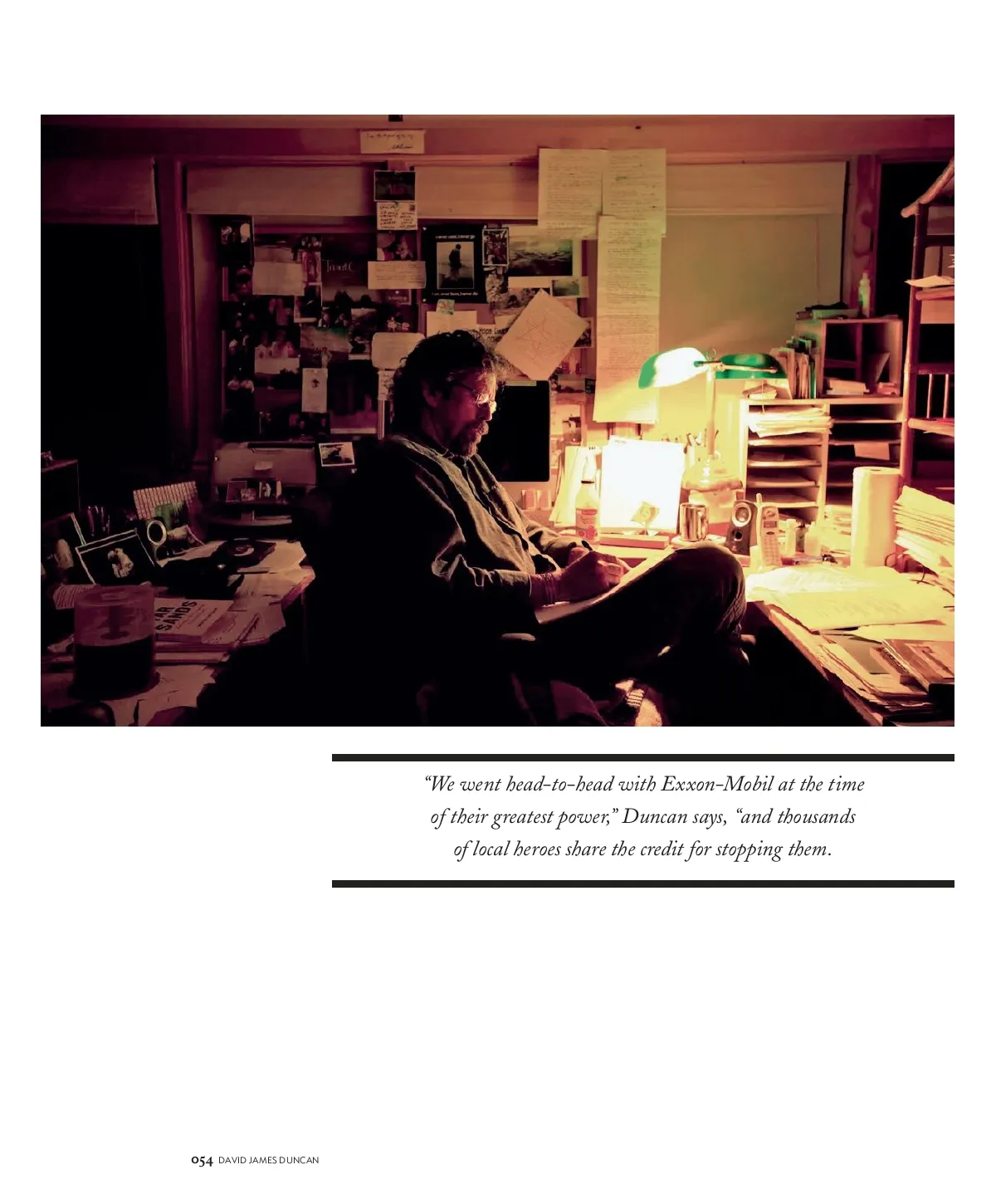
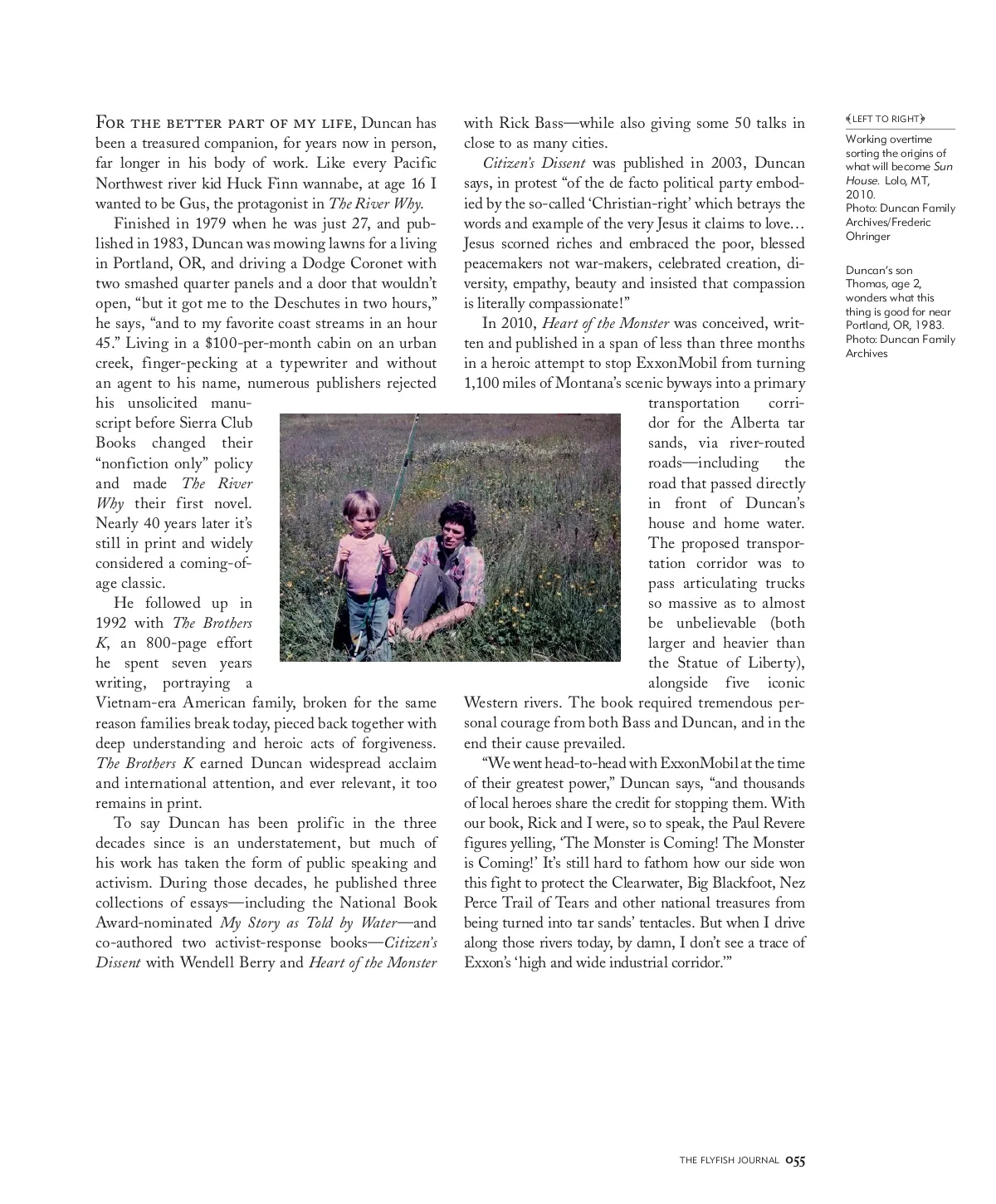
For the better part of my life , Duncan has been a treasured companion, for years now in person, far longer in his body of work. Like every Pacific Northwest river kid Huck Finn wannabe, at age 16 I wanted to be Gus, the protagonist in The River Why . Finished in 1979 when he was just 27, and pub-lished in 1983, Duncan was mowing lawns for a living in Portland, OR, and driving a Dodge Coronet with two smashed quarter panels and a door that wouldn’t open, “but it got me to the Deschutes in two hours,” he says, “and to my favorite coast streams in an hour 45.” Living in a $100-per-month cabin on an urban creek, finger-pecking at a typewriter and without an agent to his name, numerous publishers rejected his unsolicited manu-script before Sierra Club Books changed their “nonfiction only” policy and made The River Why their first novel. Nearly 40 years later it’s still in print and widely considered a coming-of-age classic. H e fol l o w e d u p i n 1992 with The Brothers K , an 800-page effort he spent seven years writing, portraying a Vietnam-era American family, broken for the same reason families break today, pieced back together with deep understanding and heroic acts of forgiveness. The Brothers K earned Duncan widespread acclaim and international attention, and ever relevant, it too remains in print. To say Duncan has been prolific in the three decades since is an understatement, but much of his work has taken the form of public speaking and activism. During those decades, he published three collections of essays—including the National Book Award-nominated My Story as Told by Water —and co-authored two activist-response books— Citizen’s Dissent with Wendell Berry and Heart of the Monster with Rick Bass—while also giving some 50 talks in close to as many cities. Citizen’s Dissent was published in 2003, Duncan says, in protest “of the de facto political party embod-ied by the so-called ‘Christian-right’ which betrays the words and example of the very Jesus it claims to love… Jesus scorned riches and embraced the poor, blessed peacemakers not war-makers, celebrated creation, di-versity, empathy, beauty and insisted that compassion is literally compassionate!” In 2010, Heart of the Monster was conceived, writ-ten and published in a span of less than three months in a heroic attempt to stop ExxonMobil from turning 1,100 miles of Montana’s scenic byways into a primary transportation corri-dor for the Alberta tar sands, via river-routed roads—including the road that passed directly in front of Duncan’s house and home water. The proposed transpor-tation corridor was to pass articulating trucks so massive as to almost be unbelievable (both larger and heavier than the Statue of Liberty), alongside five iconic Western rivers. The book required tremendous per-sonal courage from both Bass and Duncan, and in the end their cause prevailed. “We went head-to-head with ExxonMobil at the time of their greatest power,” Duncan says, “and thousands of local heroes share the credit for stopping them. With our book, Rick and I were, so to speak, the Paul Revere figures yelling, ‘The Monster is Coming! The Monster is Coming!’ It’s still hard to fathom how our side won this fight to protect the Clearwater, Big Blackfoot, Nez Perce Trail of Tears and other national treasures from being turned into tar sands’ tentacles. But when I drive along those rivers today, by damn, I don’t see a trace of Exxon’s ‘high and wide industrial corridor.’” LEFT TO RIGHT Working overtime sorting the origins of what will become Sun House. Lolo, MT, 2010. Photo: Duncan Family Archives/Frederic Ohringer Duncan’s son Thomas, age 2, wonders what this thing is good for near Portland, OR, 1983. Photo: Duncan Family Archives THE FLYFISH JOURNAL 055
The Flyfish Journal The Flyfish Journal 13.4: Page 55