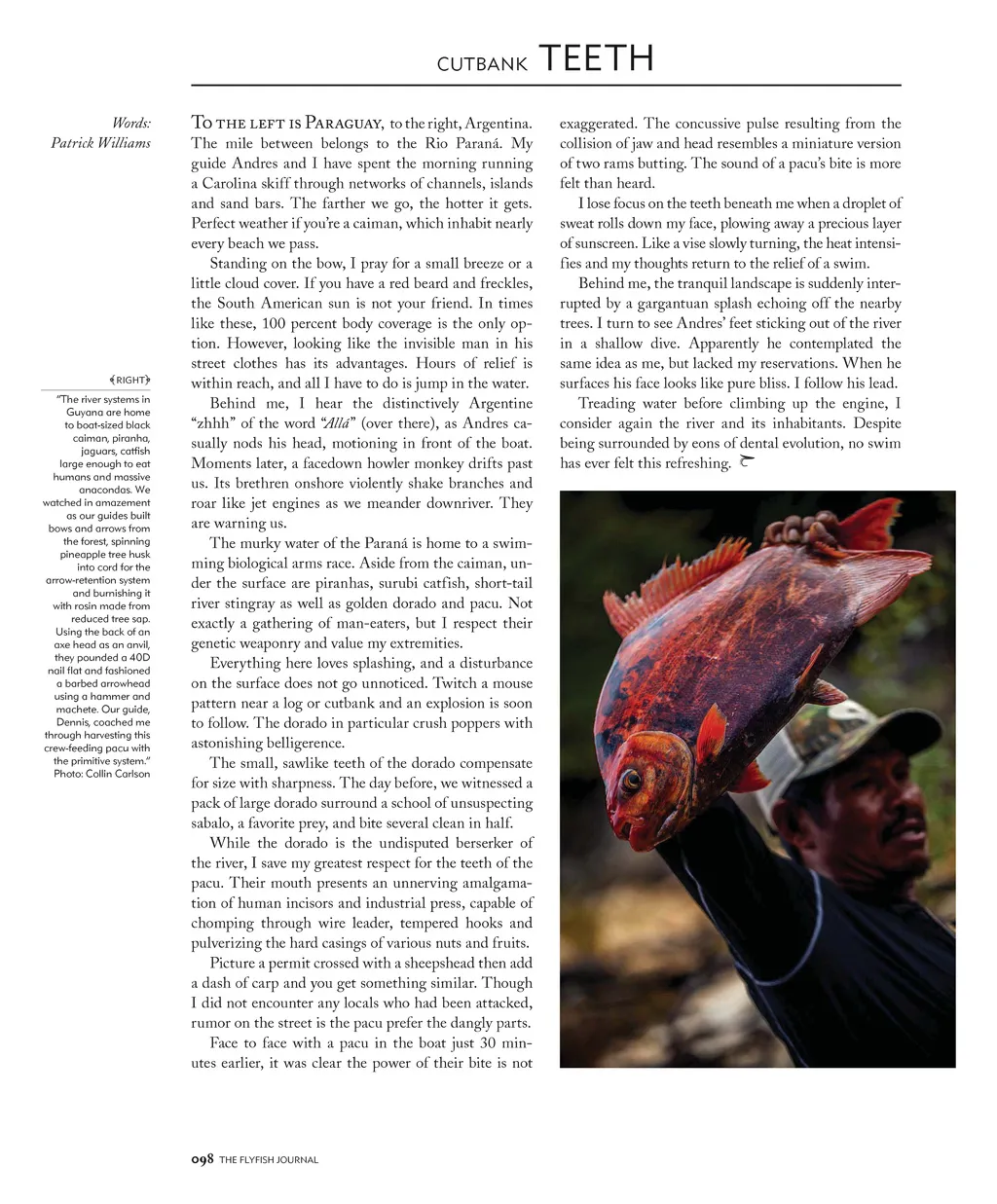
CUTBANK Words: Patrick Williams TEETH exaggerated. The concussive pulse resulting from the collision of jaw and head resembles a miniature version of two rams butting. The sound of a pacu’s bite is more felt than heard. I lose focus on the teeth beneath me when a droplet of sweat rolls down my face, plowing away a precious layer of sunscreen. Like a vise slowly turning, the heat intensi-fies and my thoughts return to the relief of a swim. Behind me, the tranquil landscape is suddenly inter-rupted by a gargantuan splash echoing off the nearby trees. I turn to see Andres’ feet sticking out of the river in a shallow dive. Apparently he contemplated the same idea as me, but lacked my reservations. When he surfaces his face looks like pure bliss. I follow his lead. Treading water before climbing up the engine, I consider again the river and its inhabitants. Despite being surrounded by eons of dental evolution, no swim has ever felt this refreshing. To the left is Paraguay y , to the right, Argentina. The mile between belongs to the Rio Paraná. My guide Andres and I have spent the morning running a Carolina skiff through networks of channels, islands and sand bars. The farther we go, the hotter it gets. Perfect weather if you’re a caiman, which inhabit nearly every beach we pass. Standing on the bow, I pray for a small breeze or a little cloud cover. If you have a red beard and freckles, the South American sun is not your friend. In times like these, 100 percent body coverage is the only op-tion. However, looking like the invisible man in his street clothes has its advantages. Hours of relief is within reach, and all I have to do is jump in the water. Behind me, I hear the distinctively Argentine “zhhh” of the word “ Allá ” (over there), as Andres ca-sually nods his head, motioning in front of the boat. Moments later, a facedown howler monkey drifts past us. Its brethren onshore violently shake branches and roar like jet engines as we meander downriver. They are warning us. The murky water of the Paraná is home to a swim-ming biological arms race. Aside from the caiman, un-der the surface are piranhas, surubi catfish, short-tail river stingray as well as golden dorado and pacu. Not exactly a gathering of man-eaters, but I respect their genetic weaponry and value my extremities. Everything here loves splashing, and a disturbance on the surface does not go unnoticed. Twitch a mouse pattern near a log or cutbank and an explosion is soon to follow. The dorado in particular crush poppers with astonishing belligerence. The small, sawlike teeth of the dorado compensate for size with sharpness. The day before, we witnessed a pack of large dorado surround a school of unsuspecting sabalo, a favorite prey, and bite several clean in half. While the dorado is the undisputed berserker of the river, I save my greatest respect for the teeth of the pacu. Their mouth presents an unnerving amalgama-tion of human incisors and industrial press, capable of chomping through wire leader, tempered hooks and pulverizing the hard casings of various nuts and fruits. Picture a permit crossed with a sheepshead then add a dash of carp and you get something similar. Though I did not encounter any locals who had been attacked, rumor on the street is the pacu prefer the dangly parts. Face to face with a pacu in the boat just 30 min-utes earlier, it was clear the power of their bite is not RIGHT “The river systems in Guyana are home to boat-sized black caiman, piranha, jaguars, catfish large enough to eat humans and massive anacondas. We watched in amazement as our guides built bows and arrows from the forest, spinning pineapple tree husk into cord for the arrow-retention system and burnishing it with rosin made from reduced tree sap. Using the back of an axe head as an anvil, they pounded a 40D nail flat and fashioned a barbed arrowhead using a hammer and machete. Our guide, Dennis, coached me through harvesting this crew-feeding pacu with the primitive system.” Photo: Collin Carlson 098 THE FLYFISH JOURNAL
The Flyfish Journal Volume Eight, Issue Two: Page 98