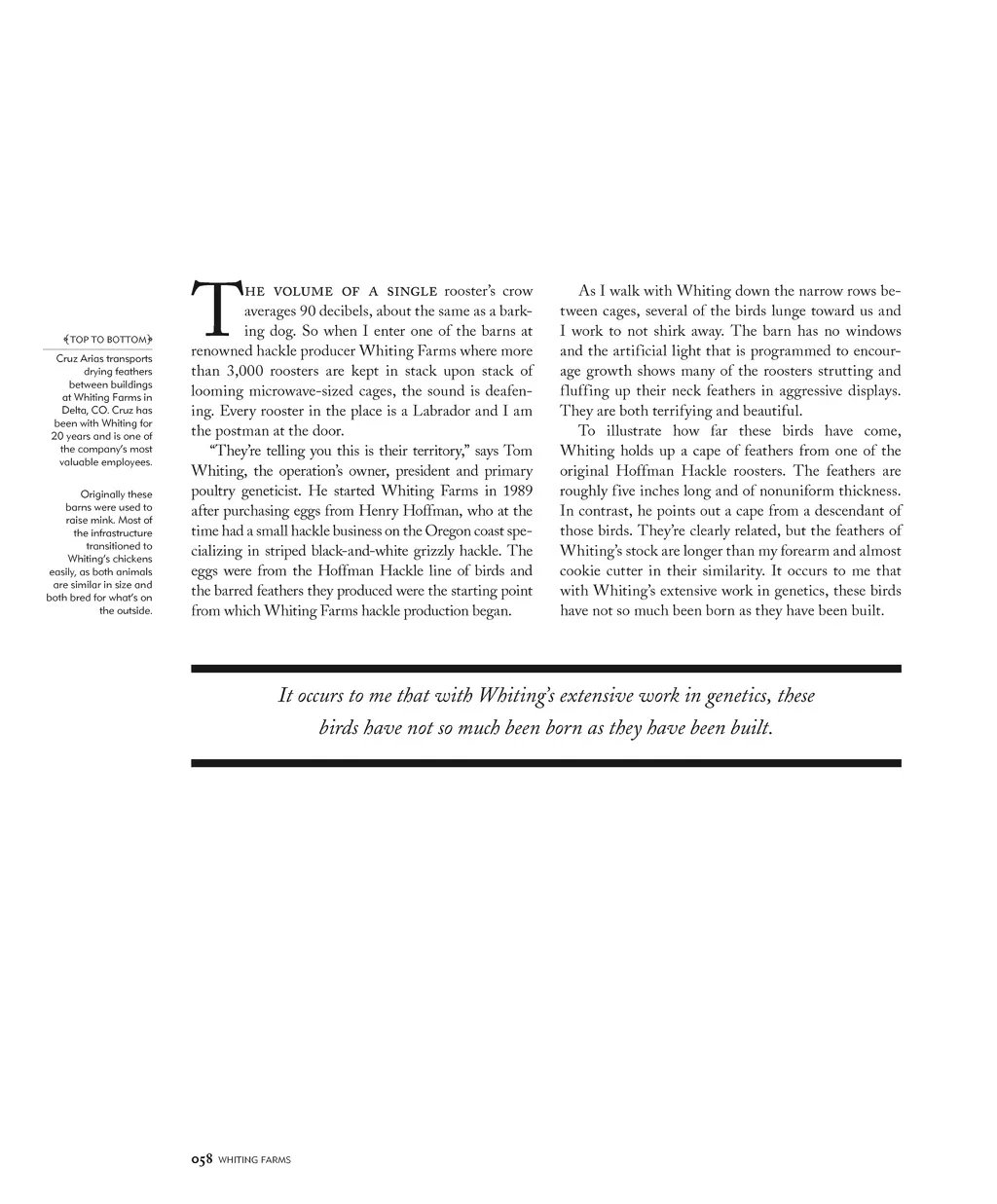
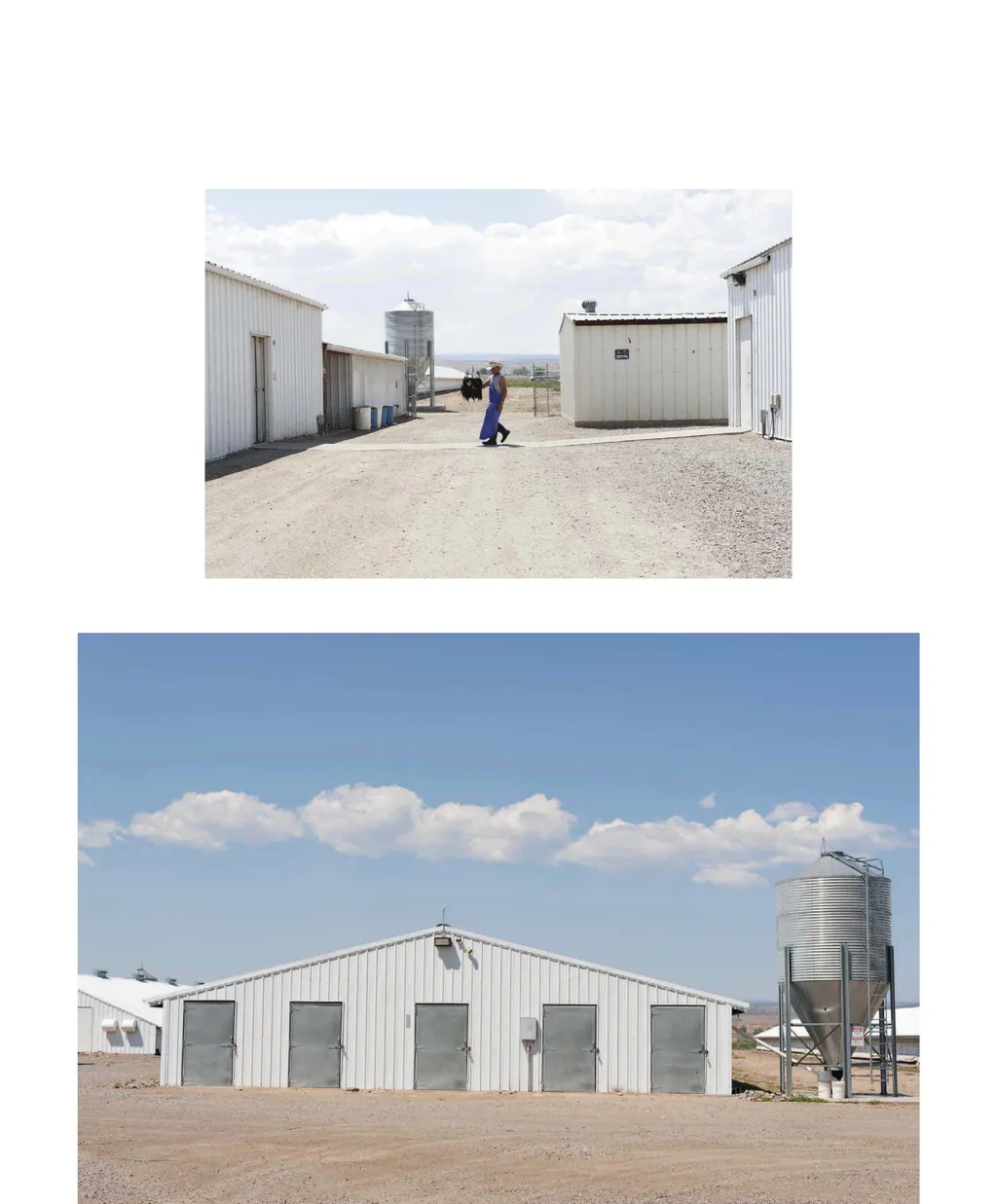
TOP TO BOTTOM Cruz Arias transports drying feathers between buildings at Whiting Farms in Delta, CO. Cruz has been with Whiting for 20 years and is one of the company’s most valuable employees. Originally these barns were used to raise mink. Most of the infrastructure transitioned to Whiting’s chickens easily, as both animals are similar in size and both bred for what’s on the outside. averages 90 decibels, about the same as a bark-k ing dog. So when I enter one of the barns at renowned hackle producer Whiting Farms where more than 3,000 roosters are kept in stack upon stack of looming microwave-sized cages, the sound is deafen-ing. Every rooster in the place is a Labrador and I am the postman at the door. “They’re telling you this is their territory,” says Tom Whiting, the operation’s owner, president and primary poultry geneticist. He started Whiting Farms in 1989 after purchasing eggs from Henry Hoffman, who at the time had a small hackle business on the Oregon coast spe-cializing in striped black-and-white grizzly hackle. The eggs were from the Hoffman Hackle line of birds and the barred feathers they produced were the starting point from which Whiting Farms hackle production began. T he volume of a single rooster’s crow As I walk with Whiting down the narrow rows be-tween cages, several of the birds lunge toward us and I work to not shirk away. The barn has no windows and the artificial light that is programmed to encour-age growth shows many of the roosters strutting and fluffing up their neck feathers in aggressive displays. They are both terrifying and beautiful. To illustrate how far these birds have come, Whiting holds up a cape of feathers from one of the original Hoffman Hackle roosters. The feathers are roughly five inches long and of nonuniform thickness. In contrast, he points out a cape from a descendant of those birds. They’re clearly related, but the feathers of Whiting’s stock are longer than my forearm and almost cookie cutter in their similarity. It occurs to me that with Whiting’s extensive work in genetics, these birds have not so much been born as they have been built. It occurs to me that with Whiting’s extensive work in genetics, these birds have not so much been born as they have been built. 058 WHITING FARMS
The Flyfish Journal Volume Eight, Issue Two: Page 58