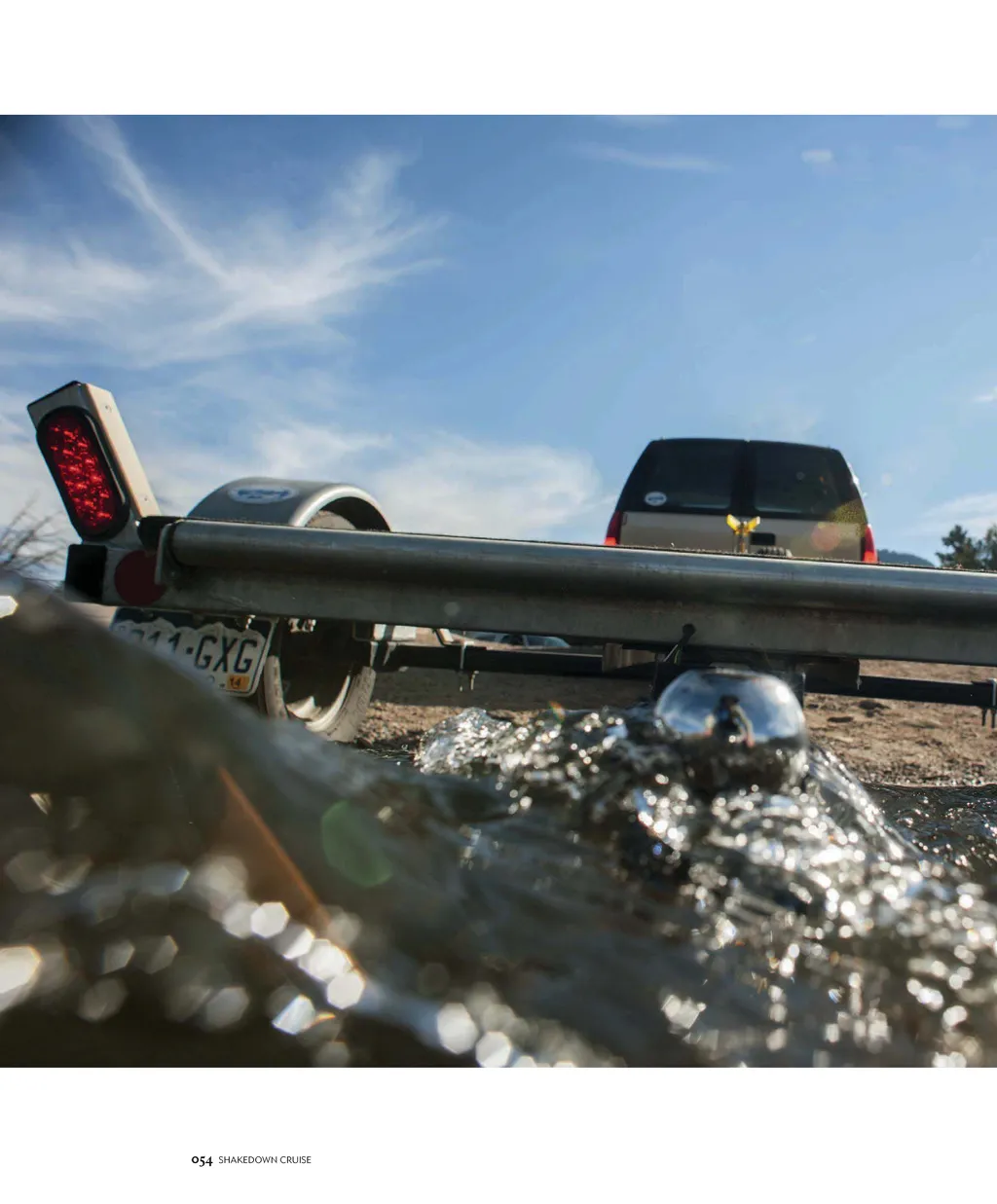
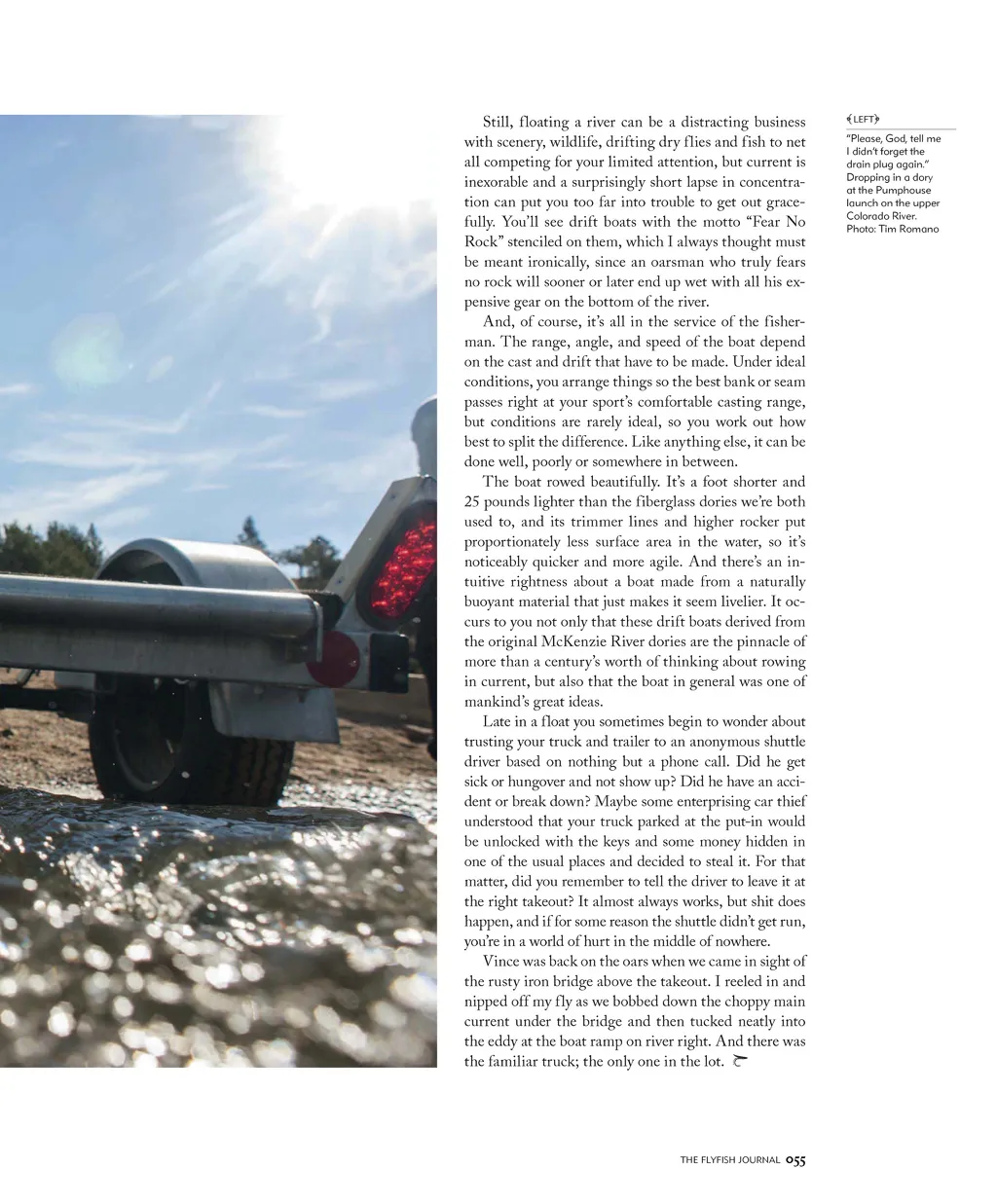
Still, floating a river can be a distracting business with scenery, wildlife, drifting dry flies and fish to net all competing for your limited attention, but current is inexorable and a surprisingly short lapse in concentra-tion can put you too far into trouble to get out grace-fully. You’ll see drift boats with the motto “Fear No Rock” stenciled on them, which I always thought must be meant ironically, since an oarsman who truly fears no rock will sooner or later end up wet with all his ex-pensive gear on the bottom of the river. And, of course, it’s all in the service of the fisher-man. The range, angle, and speed of the boat depend on the cast and drift that have to be made. Under ideal conditions, you arrange things so the best bank or seam passes right at your sport’s comfortable casting range, but conditions are rarely ideal, so you work out how best to split the difference. Like anything else, it can be done well, poorly or somewhere in between. The boat rowed beautifully. It’s a foot shorter and 25 pounds lighter than the fiberglass dories we’re both used to, and its trimmer lines and higher rocker put proportionately less surface area in the water, so it’s noticeably quicker and more agile. And there’s an in-tuitive rightness about a boat made from a naturally buoyant material that just makes it seem livelier. It oc-curs to you not only that these drift boats derived from the original McKenzie River dories are the pinnacle of more than a century’s worth of thinking about rowing in current, but also that the boat in general was one of mankind’s great ideas. Late in a float you sometimes begin to wonder about trusting your truck and trailer to an anonymous shuttle driver based on nothing but a phone call. Did he get sick or hungover and not show up? Did he have an acci-dent or break down? Maybe some enterprising car thief understood that your truck parked at the put-in would be unlocked with the keys and some money hidden in one of the usual places and decided to steal it. For that matter, did you remember to tell the driver to leave it at the right takeout? It almost always works, but shit does happen, and if for some reason the shuttle didn’t get run, you’re in a world of hurt in the middle of nowhere. Vince was back on the oars when we came in sight of the rusty iron bridge above the takeout. I reeled in and nipped off my fly as we bobbed down the choppy main current under the bridge and then tucked neatly into the eddy at the boat ramp on river right. And there was the familiar truck; the only one in the lot. LEFT “Please, God, tell me I didn’t forget the drain plug again.” Dropping in a dory at the Pumphouse launch on the upper Colorado River. Photo: Tim Romano THE FLYFISH JOURNAL 055
The Flyfish Journal Volume Eight, Issue Two: Page 55