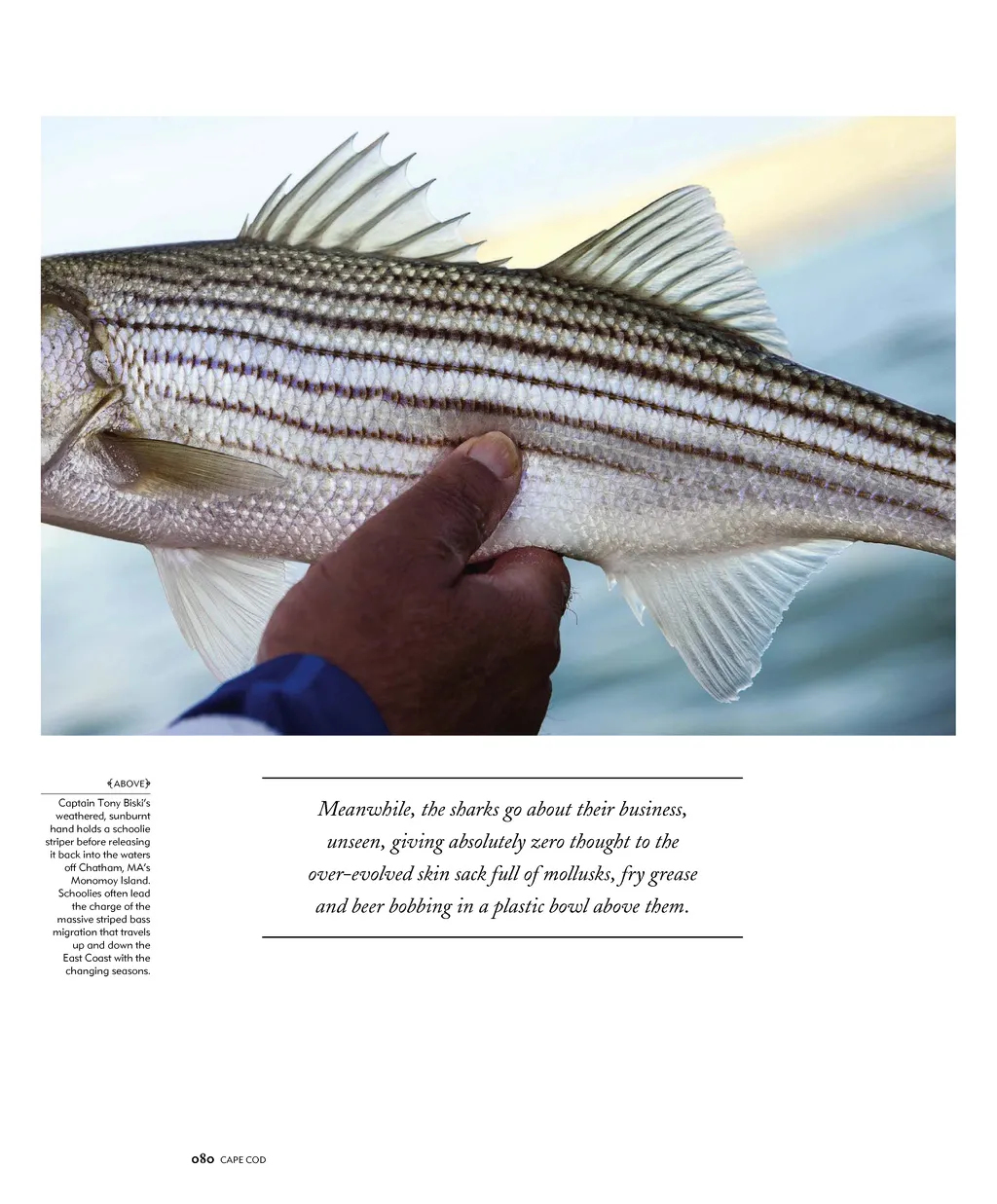
Here’s the impossible thing about kayaking in a place you know is heavily populated by great white sharks: pushing those toothy, gory Jaws scenes out of your head. You try to avoid looking down while pad-dling in even, steady strokes so as to not unintention-ally impersonate a wounded sea creature and trigger the prey instinct of any passing apex predators. This is best accomplished with eyes fixed ahead, teeth gritted, Neil Diamond’s greatest AM radio gold running through your mind to keep that overactive imagination at bay. Meanwhile, the sharks go about their business, unseen, giving absolutely zero thought to the over-evolved skin sack full of mollusks, fry grease and beer bobbing in a plastic bowl above them. I sighed, staring ahead as JT stalwartly led the way, navigating a moderate chop and passing fishing boats without a thought to the stunning irony of fishermen being caught and eaten by a fish. Would I even want to be caught and released? Would it be better to just have it end in a bloody flash of bubbles? We weren’t caught, or even hunted, so far as I could tell. Then again, we also didn’t catch anything ourselves. Apart from casting to a few shadows, which slunk around in formation and uniformly ignored us, we returned to shore without so much as a schoolie or snapper blue. All I could do was shrug and apologize lamely—I’d lured the pair into something of a bust, striper-wise. It’s easy to get caught up in the negative aspects of where you live, especially when it’s overstuffed with milling tourists battling for the same limited resources locals are. You find yourself letting frustration and a sense of entitlement take over while waiting in long lines at the store, getting stuck in traffic in the middle of your small town, or showing up to fish and seeing the shore lined with cigarette-flicking strangers. But there’s a reason all these people choose to spend their vacations crammed shoulder-to-shoulder or bumper-to-bumper, and it’s the same reason locals brave the gray, bone-chilling winters and limited employment and cultural opportunities—because Cape Cod is a uniquely magical place. Sure, anyone can find reasons to hate on where they live after a while, but at the end of the day, locals know we have it good. Maybe that’s why it’s so easy to be snarky about the place to outsiders—a subversive, reverse-psychology play at keeping them away. As he pulled his bags from the back of my truck at Logan Airport before dawn the next morning, JT vowed with a handshake to return to Monomoy’s flats in peak season. From the determined glint in his eye, I fully expect to see him next summer. There’s an old wives’ tale that claims once you get Cape Cod sand in your shoes, you’ll always come back. Smiling and waving goodbye, I had a hunch that hooking up with a striper, no matter how small, has much the same effect. I just hope this time he gets here before the sharks do. THE FLYFISH JOURNAL 081
The Flyfish Journal Volume Eight, Issue Four: Page 81