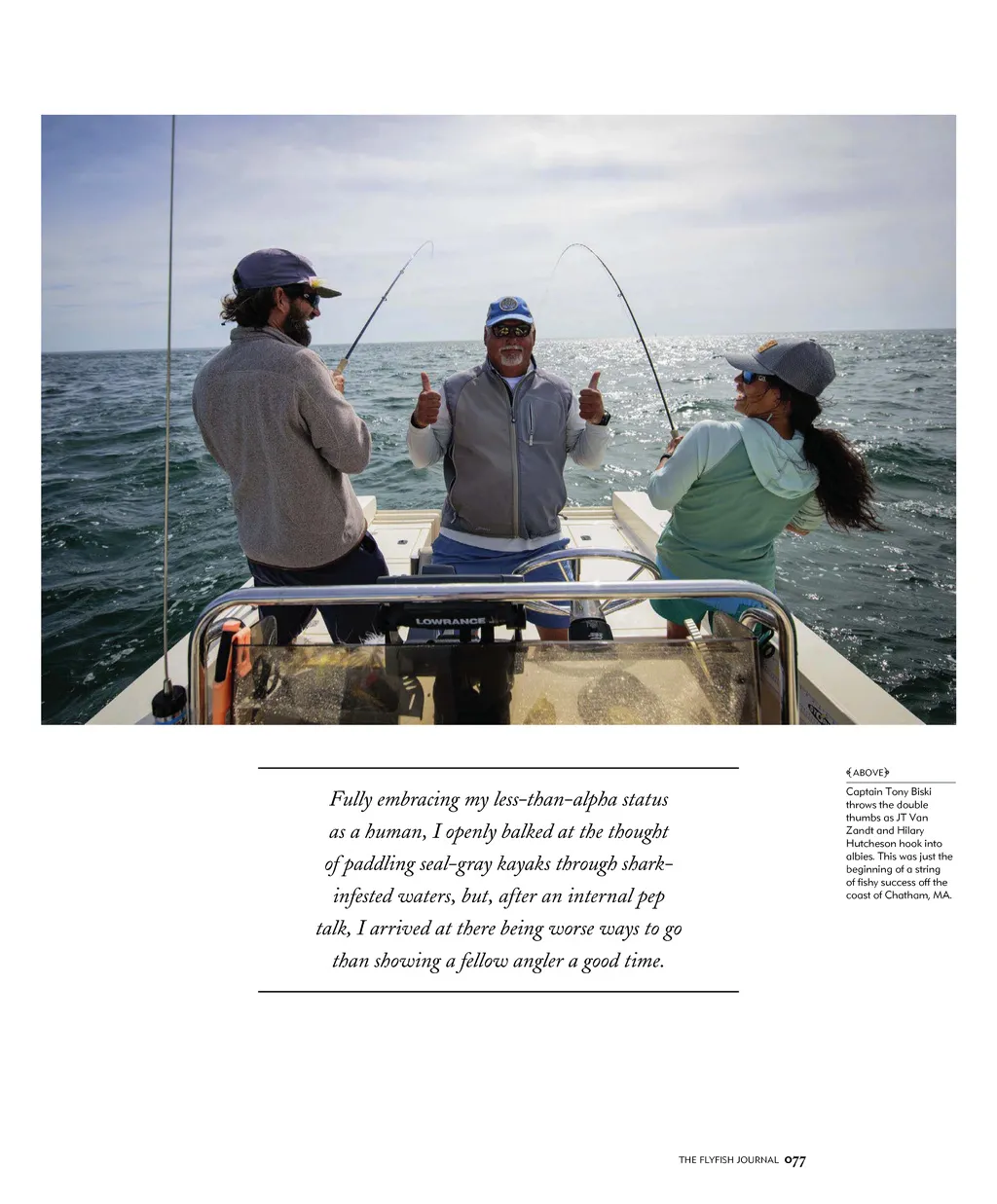
Unfortunately, man does not live on fried food alone. Fortunately, every Cape bay and stream houses its own muddy flats of oyster claims, each with a unique flavor profile. My personal favorites hail from Cotuit Oyster Company on the south side of the island. They’re sweet, buttery perfection, best consumed at the village’s only watering hole, the Kettle Ho, named for the two items settlers conned the local Wampanoag tribe into taking for the patch of land upon which they founded the town. The next morning Hilary caught her flight back to Montana and JT and I considered our options. Yesterday he’d been taken by the clear waters around Monomoy, more so by Tony’s stories of pursuing tailing stripers across the shallow sandy shelf running around the island. Fully embracing my less-than-alpha status as a human, I openly balked at the thought of paddling seal-gray kayaks through shark-infested waters, but, after an internal pep talk, I arrived at there being worse ways to go than showing a fellow angler a good time. After a quick stop to stock up on liquid courage, we were on our way down Cape. Cape Cod’s Route 6A is heralded as one of the most scenic drives in America. Winding more than 60 miles from the two bridges separating us from the rest of America via manmade canal, it runs all the way to Orleans, gateway to the outer Cape’s miles of sandy beaches, towering dunes and surfable waves. It’s one of the only ways to cross multiple villages without getting on the actual highway, which devolves to a hot mess of sun worshippers and speed traps during the summer months. Driving along, it’s impossible not to notice that Cape Cod is a place where fishing is a way of life that borders on insanity. Every Dunkin’ Donuts parking lot—and there are dozens of them—is jammed with jacked-up Jeeps and pickup trucks bristling like rusty porcupines with surf rods. Splayed liberally across their chassis, often covering the salt-infused rust spots that overcome every metal surface due to ocean salt in the summer and rock salt in the winter, are all manner of kitschy, cutesy fishing stickers. Obligatory cooler and sunglass company logos mingle with giant striped bass chasing lures, social statements such as “piping plovers (an en-dangered local seabird) taste like chicken,” and nauti-cally themed brand names with cheesy heavy-metal fonts. Wobbly old men weave in and out of traffic on “canal cruisers,” rusty vintage bikes with PVC tubes attached to hold fishing rods and a milk crate lashed on for beer and bait. Dilapidated seasonal bait-and-tackle shops are propped up every quarter mile, some a little too close for comfort to a neighboring seafood restaurant. Even the graffiti is fishy—one highway underpass along 6A is famously tagged with a giant striper courtesy of local painter Edie Vonnegut, whose famous writer father used to sell cars down the road in Barnstable. The action on Cape Cod is not limited to the salt. More than 1,000 lakes and ponds pock the landscape, many bleeding to the sea through brackish rivers that were home to some of our young nation’s first trout clubs. Emerging from this cultural detritus is a small, not-exactly-close-knit community of fly anglers. The scene is equal parts nose-in-the-air retired CEO types kitted out in the latest and greatest gear and a particular salty, East Coast version of a trout bum: working-class folks who ride the seasonal economy as best they can in order to spend the warmer half of the year in wad-ers chasing the striper migration out of beater trucks, surviving on the graciousness of friends with restaurant jobs and a clammer’s meager income. 076 CAPE COD
The Flyfish Journal Volume Eight, Issue Four: Page 76