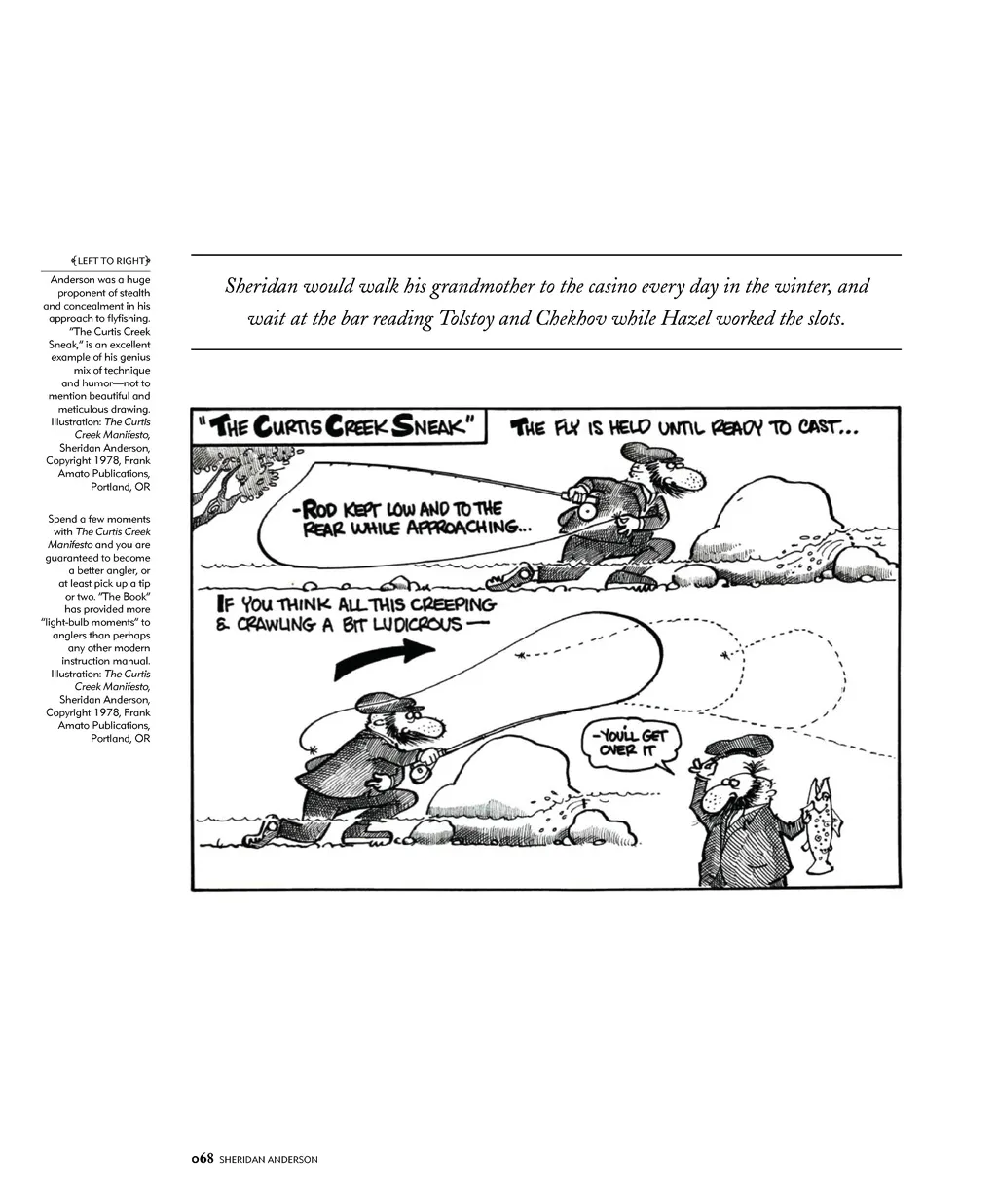
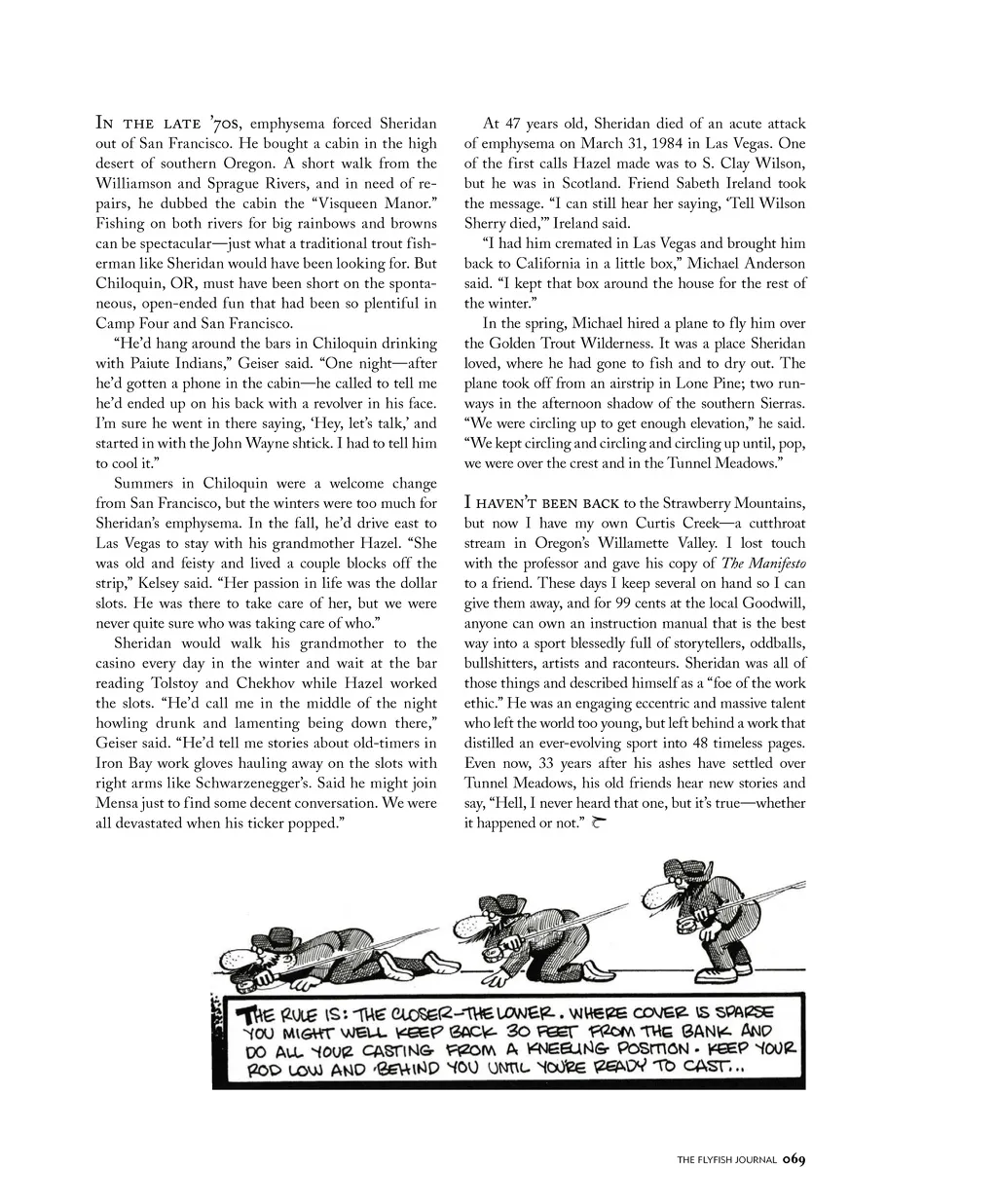
In the late ’70s , emphysema forced Sheridan out of San Francisco. He bought a cabin in the high desert of southern Oregon. A short walk from the Williamson and Sprague Rivers, and in need of re-pairs, he dubbed the cabin the “Visqueen Manor.” Fishing on both rivers for big rainbows and browns can be spectacular—just what a traditional trout fish-erman like Sheridan would have been looking for. But Chiloquin, OR, must have been short on the sponta-neous, open-ended fun that had been so plentiful in Camp Four and San Francisco. “He’d hang around the bars in Chiloquin drinking with Paiute Indians,” Geiser said. “One night—after he’d gotten a phone in the cabin—he called to tell me he’d ended up on his back with a revolver in his face. I’m sure he went in there saying, ‘Hey, let’s talk,’ and started in with the John Wayne shtick. I had to tell him to cool it.” Summers in Chiloquin were a welcome change from San Francisco, but the winters were too much for Sheridan’s emphysema. In the fall, he’d drive east to Las Vegas to stay with his grandmother Hazel. “She was old and feisty and lived a couple blocks off the strip,” Kelsey said. “Her passion in life was the dollar slots. He was there to take care of her, but we were never quite sure who was taking care of who.” Sheridan would walk his grandmother to the casino every day in the winter and wait at the bar reading Tolstoy and Chekhov while Hazel worked the slots. “He’d call me in the middle of the night howling drunk and lamenting being down there,” Geiser said. “He’d tell me stories about old-timers in Iron Bay work gloves hauling away on the slots with right arms like Schwarzenegger’s. Said he might join Mensa just to find some decent conversation. We were all devastated when his ticker popped.” At 47 years old, Sheridan died of an acute attack of emphysema on March 31, 1984 in Las Vegas. One of the first calls Hazel made was to S. Clay Wilson, but he was in Scotland. Friend Sabeth Ireland took the message. “I can still hear her saying, ‘Tell Wilson Sherry died,’” Ireland said. “I had him cremated in Las Vegas and brought him back to California in a little box,” Michael Anderson said. “I kept that box around the house for the rest of the winter.” In the spring, Michael hired a plane to fly him over the Golden Trout Wilderness. It was a place Sheridan loved, where he had gone to fish and to dry out. The plane took off from an airstrip in Lone Pine; two run-ways in the afternoon shadow of the southern Sierras. “We were circling up to get enough elevation,” he said. “We kept circling and circling and circling up until, pop, we were over the crest and in the Tunnel Meadows.” I haven’t been back to the Strawberry Mountains, but now I have my own Curtis Creek—a cutthroat stream in Oregon’s Willamette Valley. I lost touch with the professor and gave his copy of The Manifesto to a friend. These days I keep several on hand so I can give them away, and for 99 cents at the local Goodwill, anyone can own an instruction manual that is the best way into a sport blessedly full of storytellers, oddballs, bullshitters, artists and raconteurs. Sheridan was all of those things and described himself as a “foe of the work ethic.” He was an engaging eccentric and massive talent who left the world too young, but left behind a work that distilled an ever-evolving sport into 48 timeless pages. Even now, 33 years after his ashes have settled over Tunnel Meadows, his old friends hear new stories and say, “Hell, I never heard that one, but it’s true—whether it happened or not.” THE FLYFISH JOURNAL 069
The Flyfish Journal Volume Eight, Issue Four: Page 69