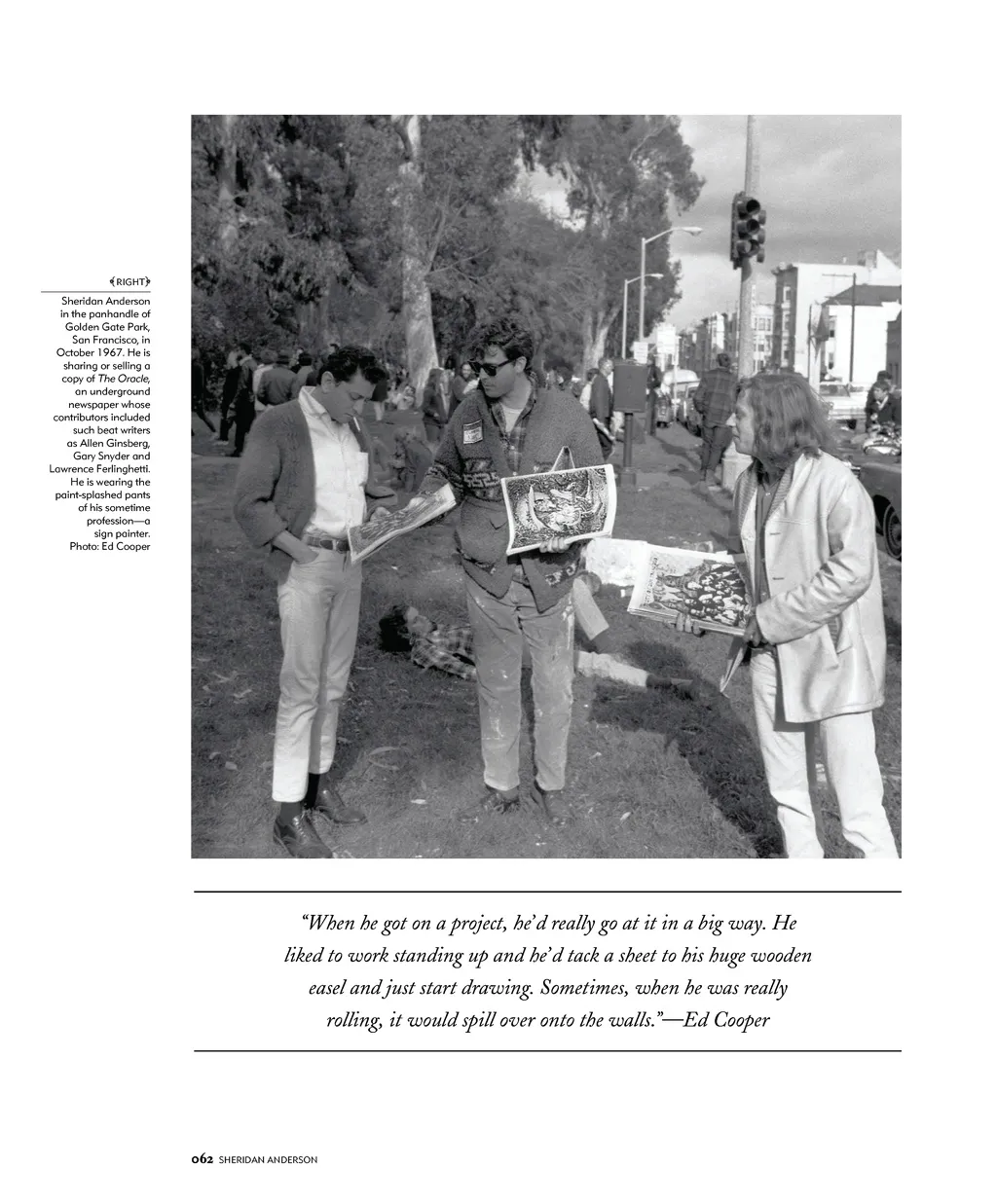
Sheridan wandered into the climbing scene at Yosemite by way of Reno, NV; Bishop, CA; and Salt Lake City. He was born in 1936 outside of Los Angeles, but grew up in Utah, where his two pur-poses in life were to fish and draw. “Sheridan could get right to the heart of a person,” his brother Michael Anderson said. “Even as a kid, he could make the magic strokes that would make a person come out in a drawing.” “I went fishing with him once or twice,” he said. “I spent most of the time untying knots. Sheridan was down low the whole time, crawling around and sneak-ing up on fish—I didn’t get it.” The Andersons were not a fishing family, but Uncle Grant, who married in, changed that. “Sheridan re-ally looked up to him,” Anderson said. “Grant would spin these corrupt stories that couldn’t have been more than half true, but we didn’t care because he told them so well.” And he taught Sheridan to fish. Grant Wooten is the first person listed under The Manifesto’s “Acknowledgements and Thanks,” along-side his photo—the only other photo in the book be-sides the author’s. “Without [his] genius,” Sheridan wrote, “this book would not have been possible.” “I got hold of some correspondence later on,” Anderson said, “and he asked Grant to go in on it with him. Grant told him, no, this is your baby. You can do this.” After high school, Sheridan studied art at the University of Utah, dropped out after a semester or two, and in the early ’60s wandered into Camp Four. Camp Four is a dusty, walk-in campground in Yosemite National Park. But with Half Dome to the east and El Capitan to the west, it was, and, for all I know, still is the heart of American rock climbing. Sheridan took part in at least two first ascents—Andy’s Inferno in 1964, and Aunt Fanny’s Pantry in 1965— but, by all accounts, he was never an elite climber. Yvon Chouinard, founder of Patagonia, was an elite climber. The year Sheridan climbed Andy’s Inferno, Chouinard was part of the first ascent of the North America Wall of El Cap without fixed ropes. The next year he climbed the Muir Wall. But as a teenager Chouinard had spent an inordinate amount of time poaching panfish from the water hazards at private Burbank golf courses. Like the only two fish-ermen in any setting, it was inevitable Chouinard and Sheridan would find each other. “There were a lot of people dirtbagging then,” Chouinard said, “but no-body fished except me and him. We’d fish the Merced and all the little creeks. There’s a series of deep pools below upper and lower Yosemite Falls. It was a pretty easy climb, so we’d fish them from a rappel. We caught some nice 14-inch rainbows that way that must have come over the falls.” Aside from supplying dirtbag climbers with fresh trout, Sheridan was also Camp Four’s artist in resi-dence. The late Royal Robbins would write, in 1984, that Sheridan was, “one of the chief chroniclers of the foibles, vanities and pretensions of the period.” He was friendly, even close with most of the best climbers of the ’60s and, with a knack for reading character and rendering personalities, he wasn’t shy about lampoon-ing them with pencil and paper. “I never met anyone who could do what Sheridan could do,” photographer Ed Cooper said. “He could put a person’s personality right into a sketch.” THE FLYFISH JOURNAL 063
The Flyfish Journal Volume Eight, Issue Four: Page 63