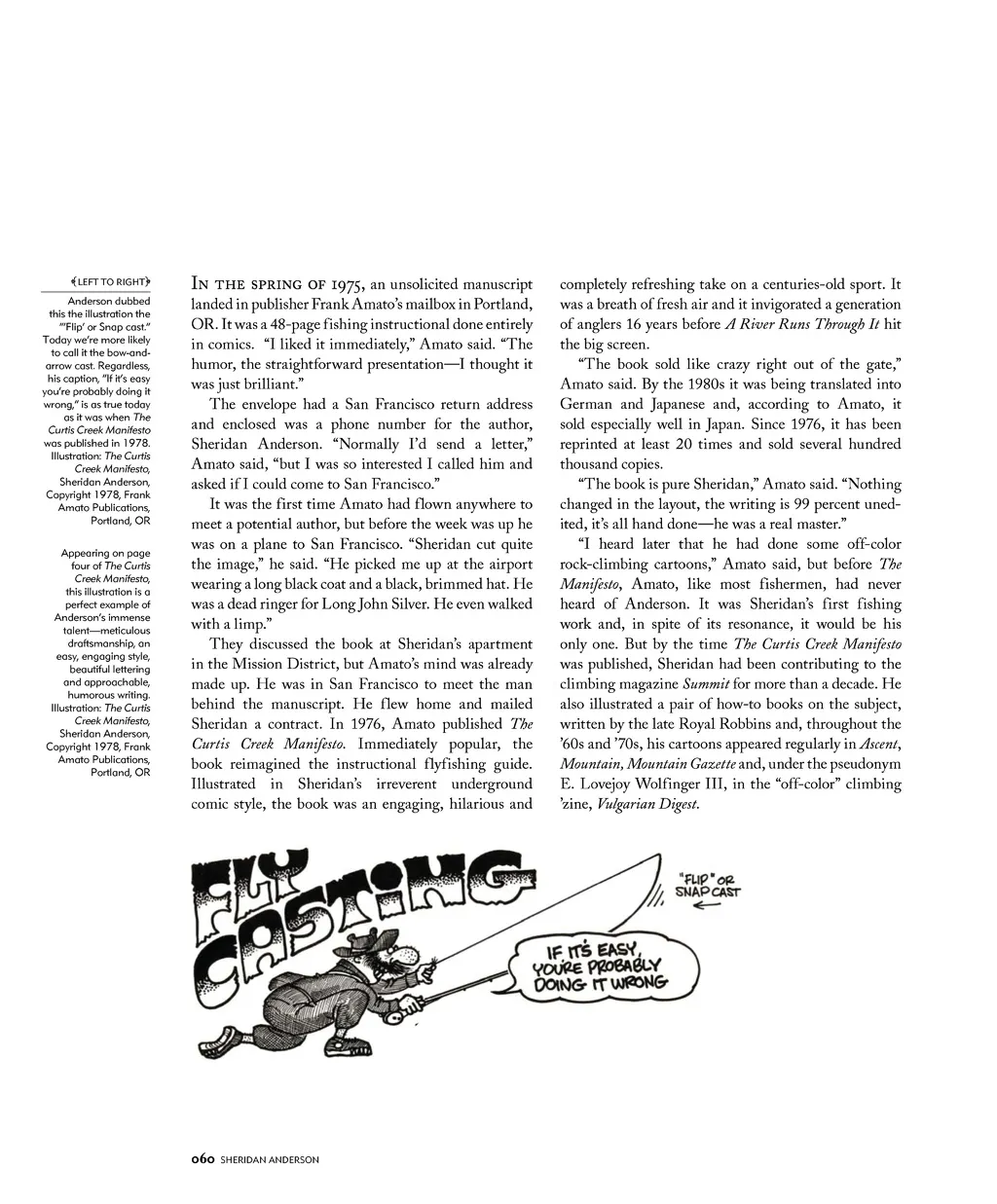
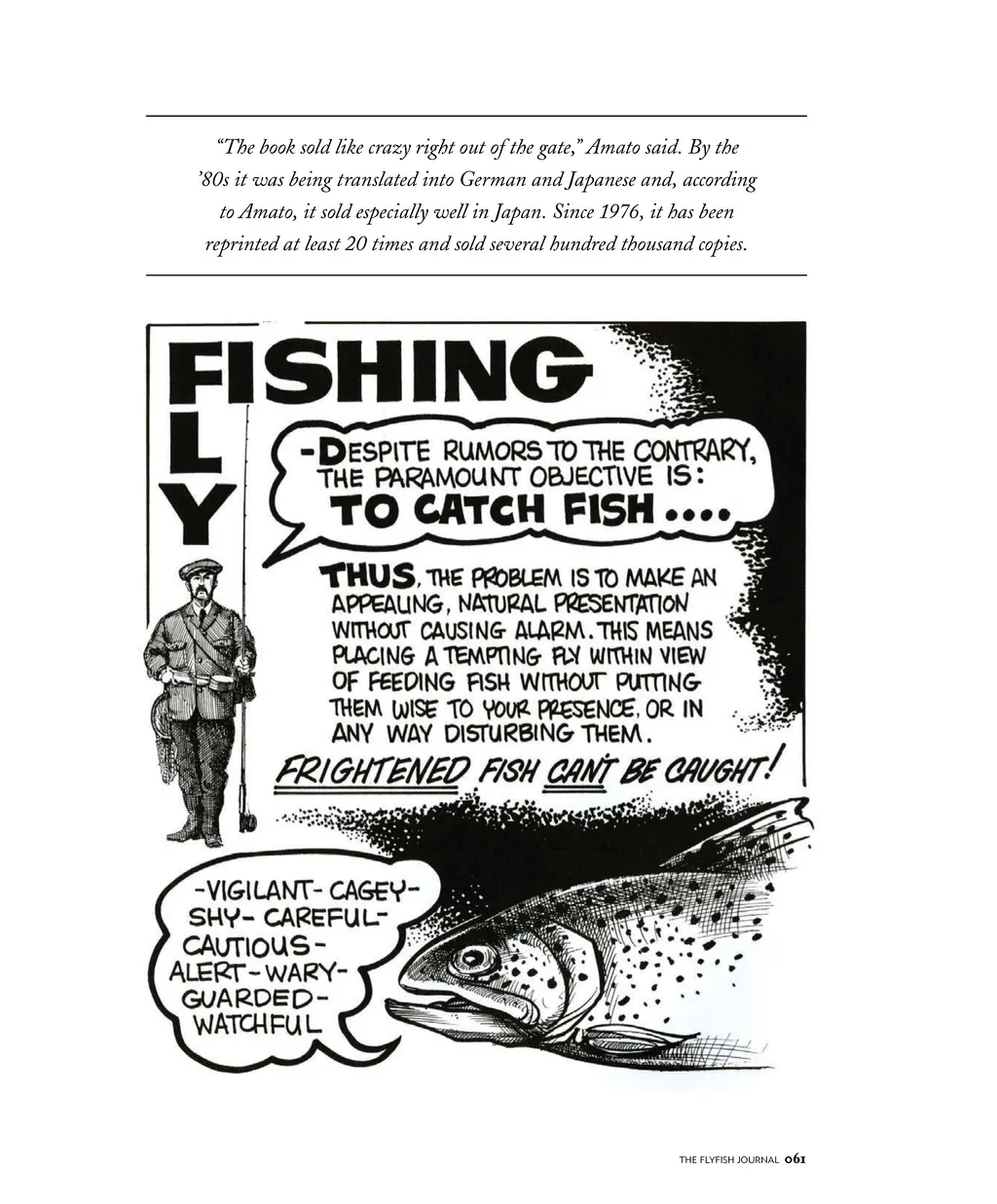
LEFT TO RIGHT In the spring of 1975, an unsolicited manuscript landed in publisher Frank Amato’s mailbox in Portland, OR. It was a 48-page fishing instructional done entirely in comics. “I liked it immediately,” Amato said. “The humor, the straightforward presentation—I thought it was just brilliant.” The envelope had a San Francisco return address and enclosed was a phone number for the author, Sheridan Anderson. “Normally I’d send a letter,” Amato said, “but I was so interested I called him and asked if I could come to San Francisco.” It was the first time Amato had flown anywhere to meet a potential author, but before the week was up he was on a plane to San Francisco. “Sheridan cut quite the image,” he said. “He picked me up at the airport wearing a long black coat and a black, brimmed hat. He was a dead ringer for Long John Silver. He even walked with a limp.” They discussed the book at Sheridan’s apartment in the Mission District, but Amato’s mind was already made up. He was in San Francisco to meet the man behind the manuscript. He flew home and mailed Sheridan a contract. In 1976, Amato published The Curtis Creek Manifesto . Immediately popular, the book reimagined the instructional flyfishing guide. Illustrated in Sheridan’s irreverent underground comic style, the book was an engaging, hilarious and Anderson dubbed this the illustration the “’Flip’ or Snap cast.” Today we’re more likely to call it the bow-and-arrow cast. Regardless, his caption, “If it’s easy you’re probably doing it wrong,” is as true today as it was when The Curtis Creek Manifesto was published in 1978. Illustration: The Curtis Creek Manifesto , Sheridan Anderson, Copyright 1978, Frank Amato Publications, Portland, OR Appearing on page four of The Curtis Creek Manifesto , this illustration is a perfect example of Anderson’s immense talent—meticulous draftsmanship, an easy, engaging style, beautiful lettering and approachable, humorous writing. Illustration: The Curtis Creek Manifesto , Sheridan Anderson, Copyright 1978, Frank Amato Publications, Portland, OR completely refreshing take on a centuries-old sport. It was a breath of fresh air and it invigorated a generation of anglers 16 years before A River Runs Through It hit the big screen. “The book sold like crazy right out of the gate,” Amato said. By the 1980s it was being translated into German and Japanese and, according to Amato, it sold especially well in Japan. Since 1976, it has been reprinted at least 20 times and sold several hundred thousand copies. “The book is pure Sheridan,” Amato said. “Nothing changed in the layout, the writing is 99 percent uned-ited, it’s all hand done—he was a real master.” “I heard later that he had done some off-color rock-climbing cartoons,” Amato said, but before The Manifesto , Amato, like most fishermen, had never heard of Anderson. It was Sheridan’s first fishing work and, in spite of its resonance, it would be his only one. But by the time The Curtis Creek Manifesto was published, Sheridan had been contributing to the climbing magazine Summit for more than a decade. He also illustrated a pair of how-to books on the subject, written by the late Royal Robbins and, throughout the ’60s and ’70s, his cartoons appeared regularly in Ascent , Mountain, Mountain Gazette and, under the pseudonym E. Lovejoy Wolfinger III, in the “off-color” climbing ’zine, Vulgarian Digest . 060 SHERIDAN ANDERSON
The Flyfish Journal Volume Eight, Issue Four: Page 60