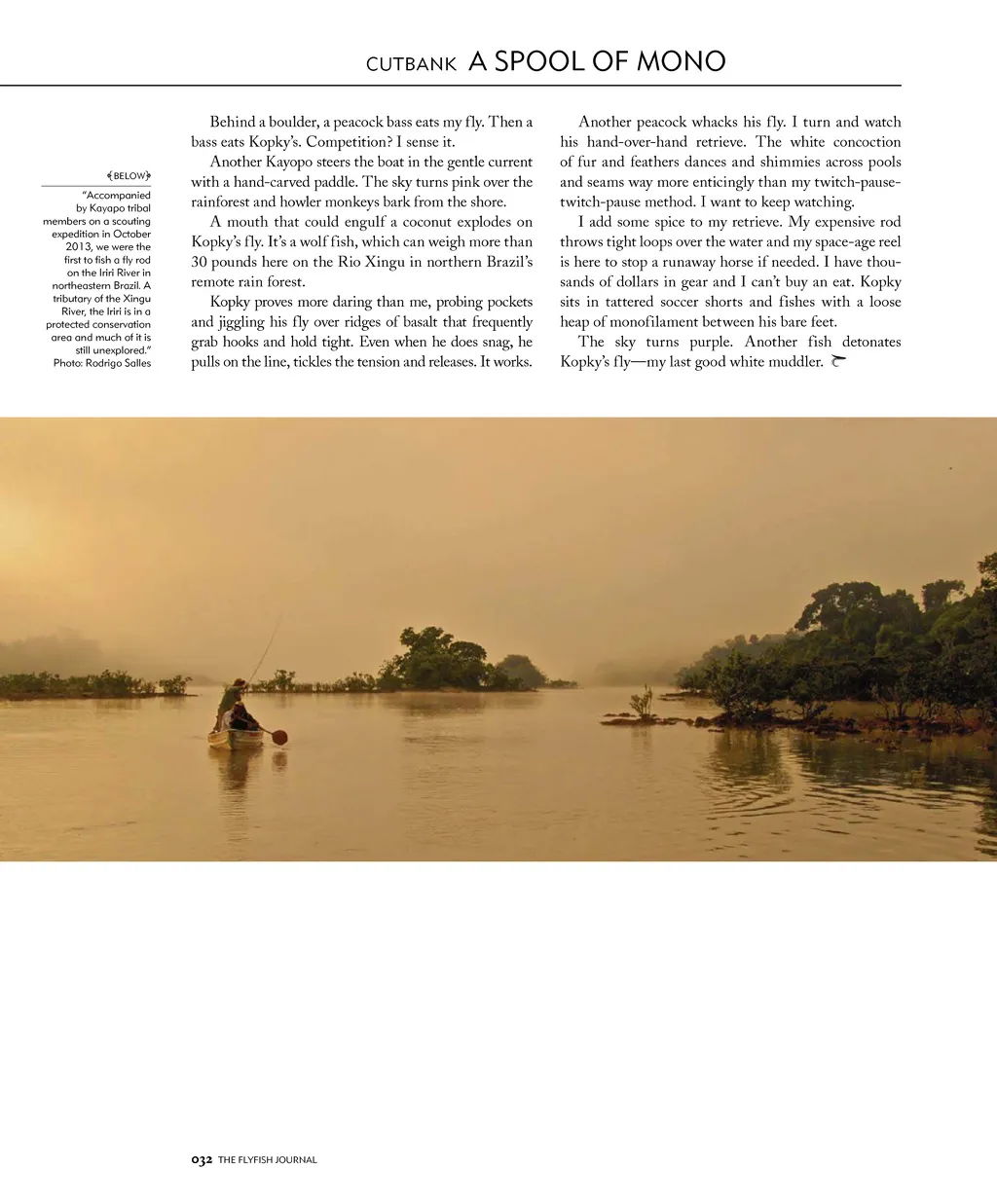
CUTBANK A SPOOL OF MONO Another peacock whacks his fly. I turn and watch his hand-over-hand retrieve. The white concoction of fur and feathers dances and shimmies across pools and seams way more enticingly than my twitch-pause-twitch-pause method. I want to keep watching. I add some spice to my retrieve. My expensive rod throws tight loops over the water and my space-age reel is here to stop a runaway horse if needed. I have thou-sands of dollars in gear and I can’t buy an eat. Kopky sits in tattered soccer shorts and fishes with a loose heap of monofilament between his bare feet. The sky turns purple. Another fish detonates Kopky’s fly—my last good white muddler. BELOW “Accompanied by Kayapo tribal members on a scouting expedition in October 2013, we were the first to fish a fly rod on the Iriri River in northeastern Brazil. A tributary of the Xingu River, the Iriri is in a protected conservation area and much of it is still unexplored.” Photo: Rodrigo Salles Behind a boulder, a peacock bass eats my fly. Then a bass eats Kopky’s. Competition? I sense it. Another Kayopo steers the boat in the gentle current with a hand-carved paddle. The sky turns pink over the rainforest and howler monkeys bark from the shore. A mouth that could engulf a coconut explodes on Kopky’s fly. It’s a wolf fish, which can weigh more than 30 pounds here on the Rio Xingu in northern Brazil’s remote rain forest. Kopky proves more daring than me, probing pockets and jiggling his fly over ridges of basalt that frequently grab hooks and hold tight. Even when he does snag, he pulls on the line, tickles the tension and releases. It works. 032 THE FLYFISH JOURNAL
The Flyfish Journal Volume Eight, Issue Four: Page 32