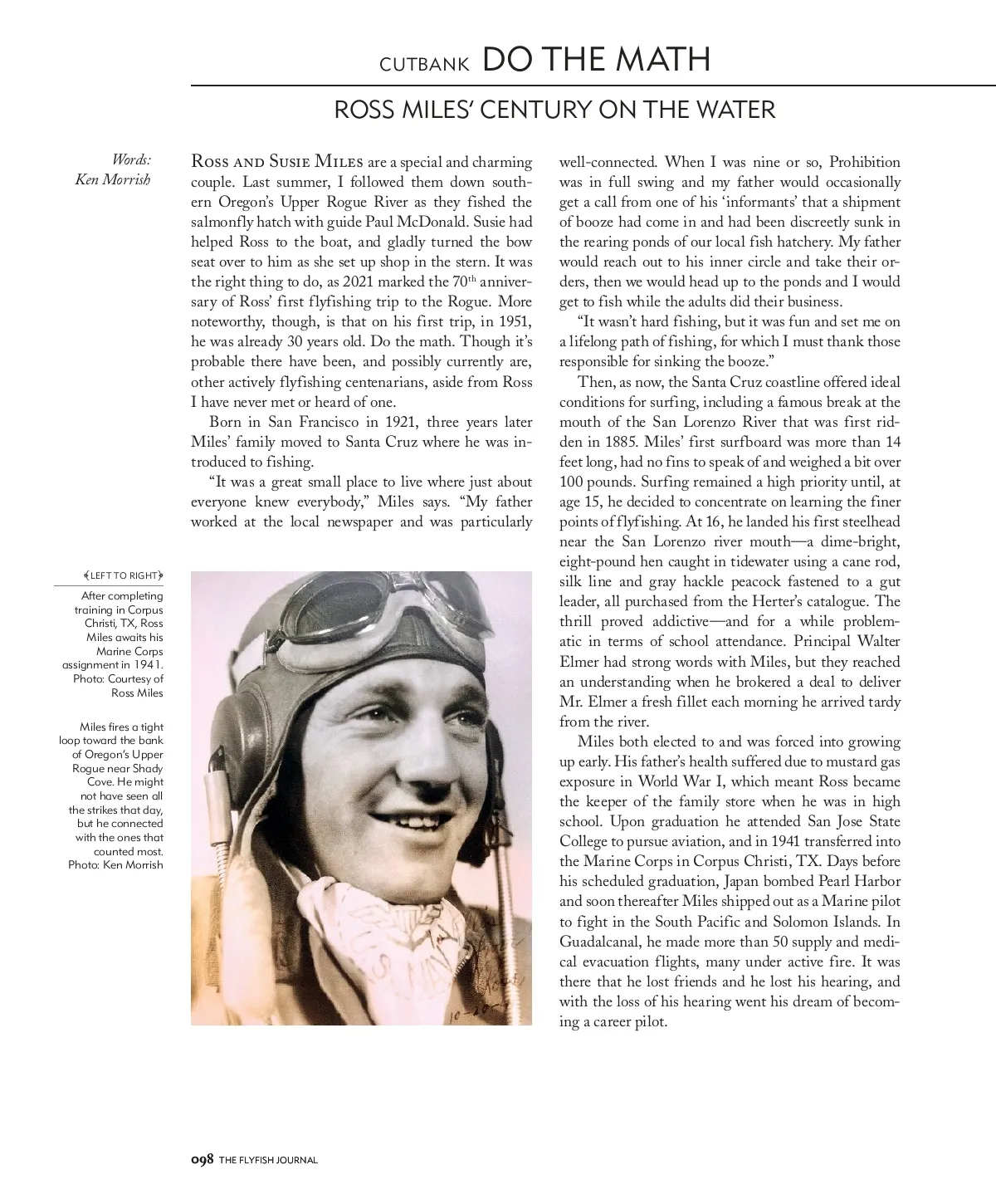
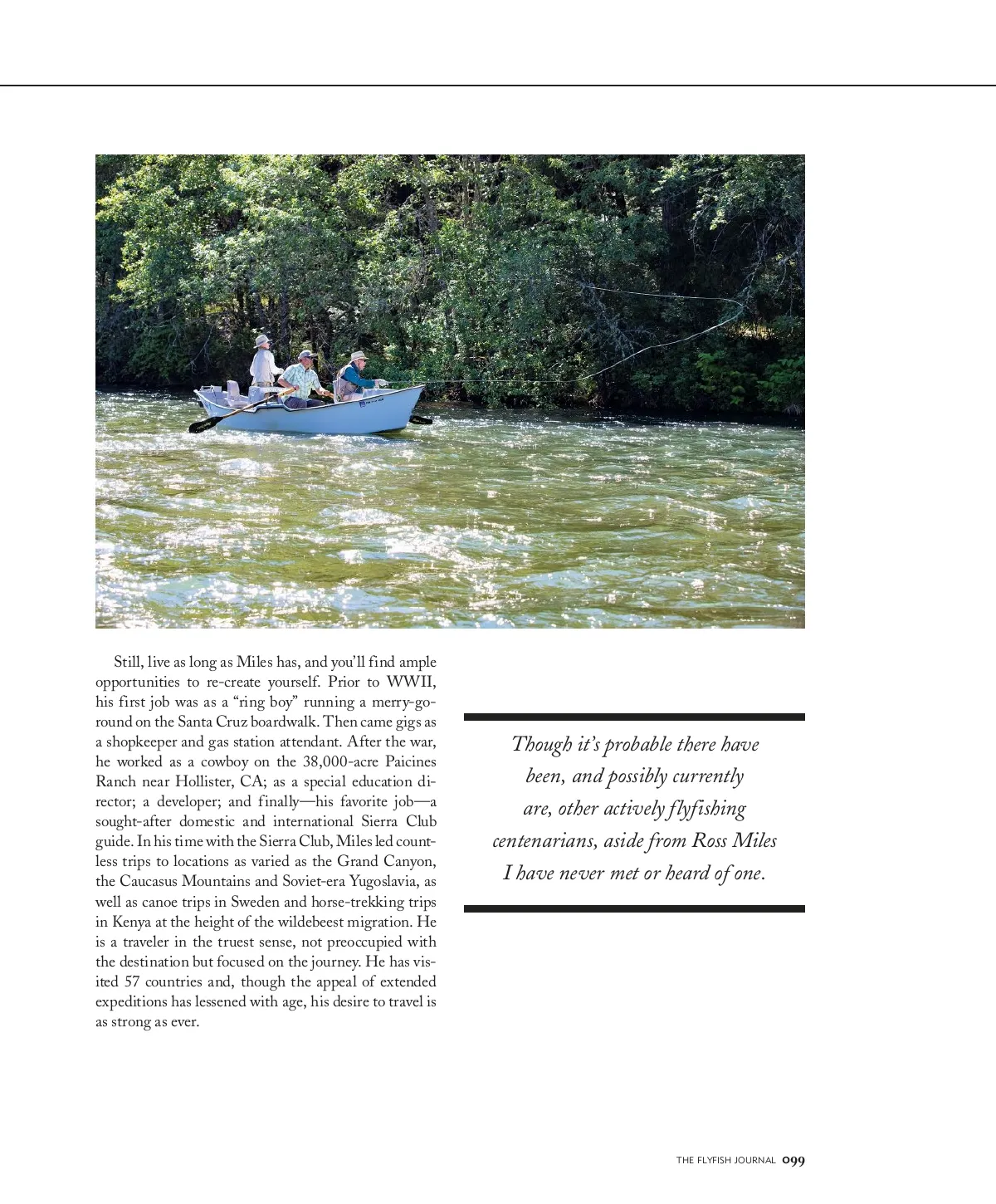
CUTBANK DO THE MATH well-connected. When I was nine or so, Prohibition was in full swing and my father would occasionally get a call from one of his ‘informants’ that a shipment of booze had come in and had been discreetly sunk in the rearing ponds of our local fish hatchery. My father would reach out to his inner circle and take their or-ders, then we would head up to the ponds and I would get to fish while the adults did their business. “It wasn’t hard fishing, but it was fun and set me on a lifelong path of fishing, for which I must thank those responsible for sinking the booze.” Then, as now, the Santa Cruz coastline offered ideal conditions for surfing, including a famous break at the mouth of the San Lorenzo River that was first rid-den in 1885. Miles’ first surfboard was more than 14 feet long, had no fins to speak of and weighed a bit over 100 pounds. Surfing remained a high priority until, at age 15, he decided to concentrate on learning the finer points of flyfishing. At 16, he landed his first steelhead near the San Lorenzo river mouth—a dime-bright, eight-pound hen caught in tidewater using a cane rod, silk line and gray hackle peacock fastened to a gut leader, all purchased from the Herter’s catalogue. The thrill proved addictive—and for a while problem-atic in terms of school attendance. Principal Walter Elmer had strong words with Miles, but they reached an understanding when he brokered a deal to deliver Mr. Elmer a fresh fillet each morning he arrived tardy from the river. Miles both elected to and was forced into growing up early. His father’s health suffered due to mustard gas exposure in World War I, which meant Ross became the keeper of the family store when he was in high school. Upon graduation he attended San Jose State College to pursue aviation, and in 1941 transferred into the Marine Corps in Corpus Christi, TX. Days before his scheduled graduation, Japan bombed Pearl Harbor and soon thereafter Miles shipped out as a Marine pilot to fight in the South Pacific and Solomon Islands. In Guadalcanal, he made more than 50 supply and medi-cal evacuation flights, many under active fire. It was there that he lost friends and he lost his hearing, and with the loss of his hearing went his dream of becom-ing a career pilot. ROSS MILES’ CENTURY ON THE WATER Words: Ken Morrish Ross and Susie Miles are a special and charming couple. Last summer, I followed them down south-ern Oregon’s Upper Rogue River as they fished the salmonfly hatch with guide Paul McDonald. Susie had helped Ross to the boat, and gladly turned the bow seat over to him as she set up shop in the stern. It was the right thing to do, as 2021 marked the 70 th anniver-sary of Ross’ first flyfishing trip to the Rogue. More noteworthy, though, is that on his first trip, in 1951, he was already 30 years old. Do the math. Though it’s probable there have been, and possibly currently are, other actively flyfishing centenarians, aside from Ross I have never met or heard of one. Born in San Francisco in 1921, three years later Miles’ family moved to Santa Cruz where he was in-troduced to fishing. “It was a great small place to live where just about everyone knew everybody,” Miles says. “My father worked at the local newspaper and was particularly LEFT TO RIGHT After completing training in Corpus Christi, TX, Ross Miles awaits his Marine Corps assignment in 1941. Photo: Courtesy of Ross Miles Miles fires a tight loop toward the bank of Oregon’s Upper Rogue near Shady Cove. He might not have seen all the strikes that day, but he connected with the ones that counted most. Photo: Ken Morrish 098 THE FLYFISH JOURNAL
The Flyfish Journal Volume 13, Issue 2: Page 98