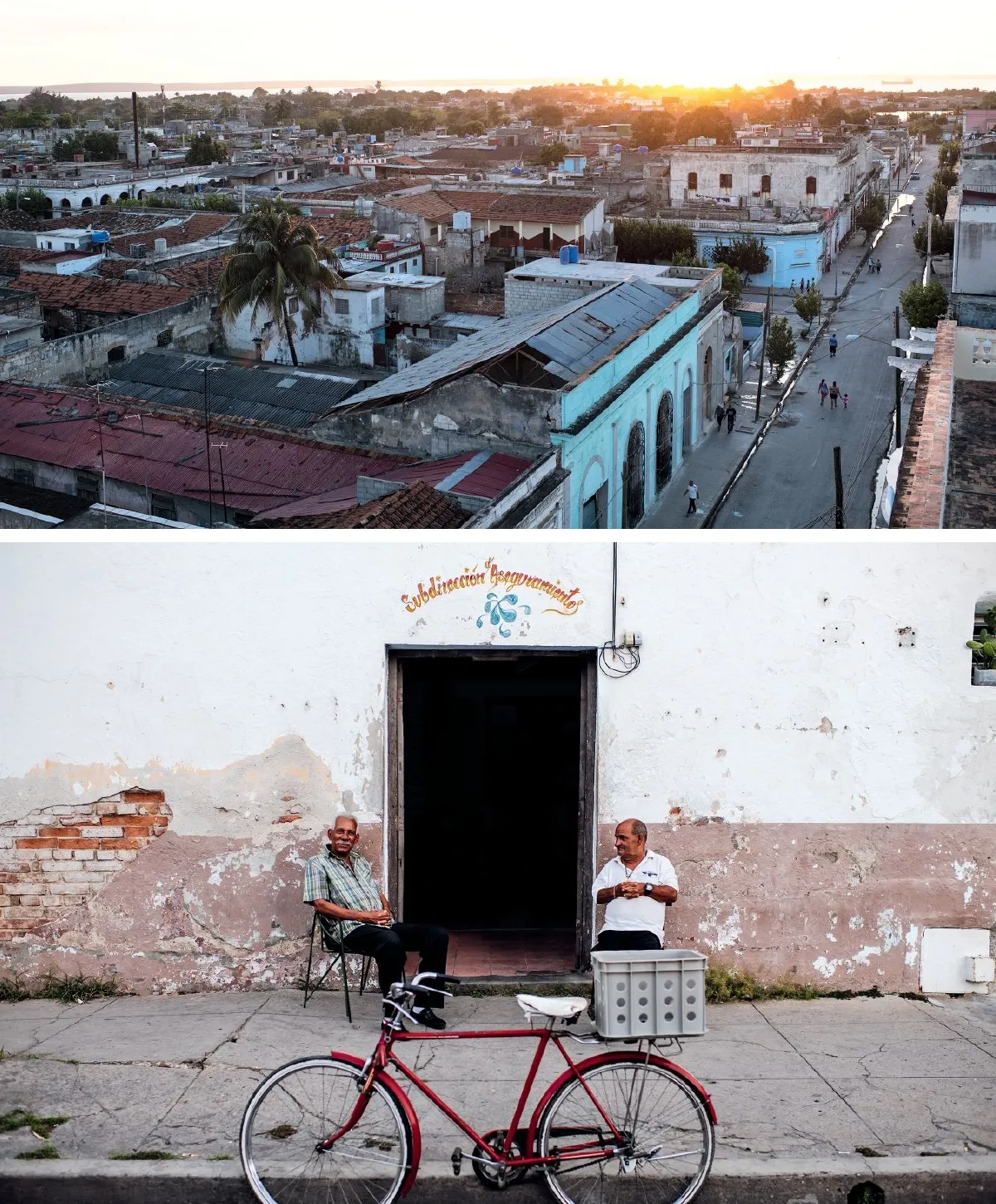
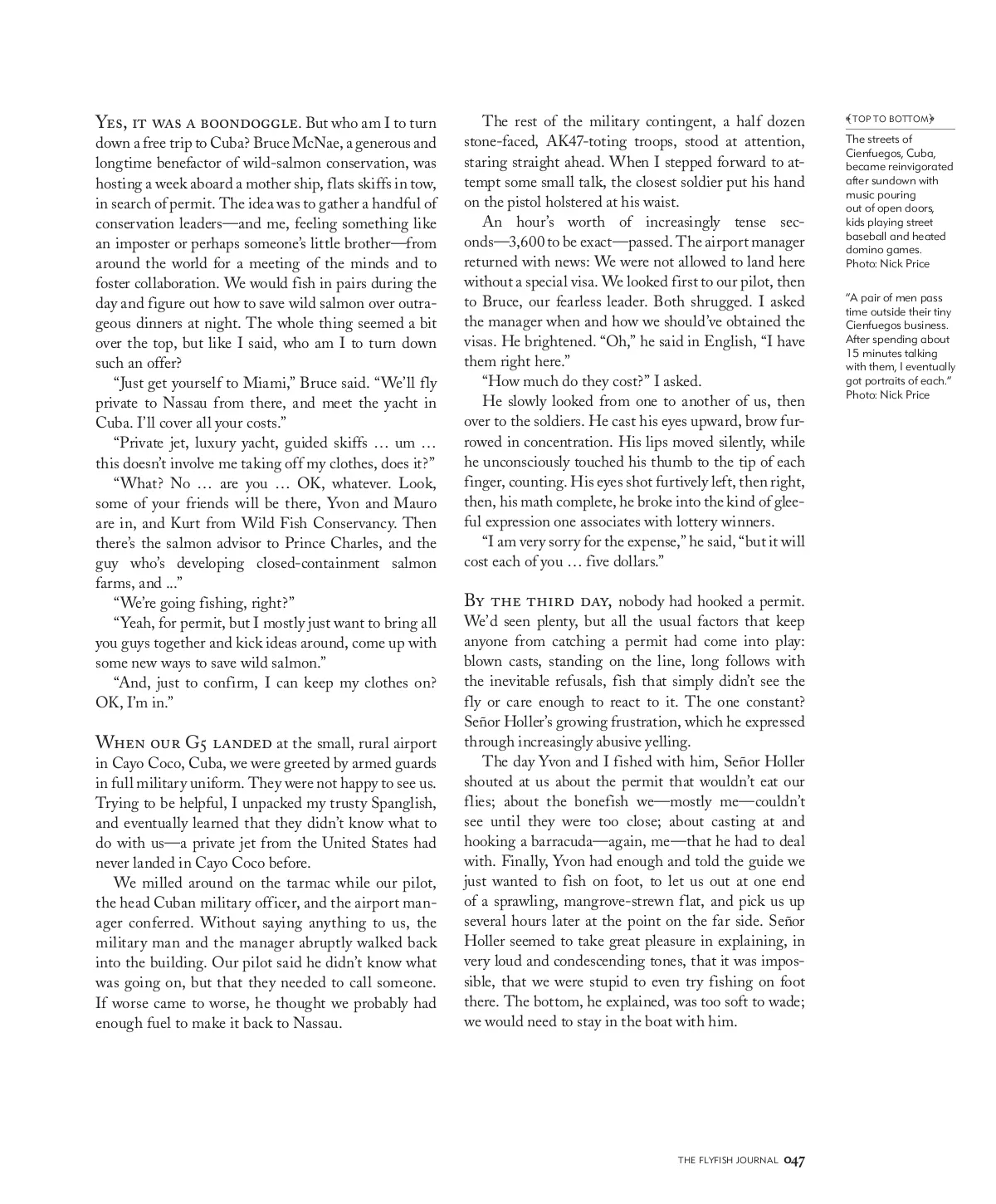
Yes, it was a boondoggle . But who am I to turn down a free trip to Cuba? Bruce McNae, a generous and longtime benefactor of wild-salmon conservation, was hosting a week aboard a mother ship, flats skiffs in tow, in search of permit. The idea was to gather a handful of conservation leaders—and me, feeling something like an imposter or perhaps someone’s little brother—from around the world for a meeting of the minds and to foster collaboration. We would fish in pairs during the day and figure out how to save wild salmon over outra-geous dinners at night. The whole thing seemed a bit over the top, but like I said, who am I to turn down such an offer? “Just get yourself to Miami,” Bruce said. “We’ll fly private to Nassau from there, and meet the yacht in Cuba. I’ll cover all your costs.” “Private jet, luxury yacht, guided skiffs … um … this doesn’t involve me taking off my clothes, does it?” “What? No … are you … OK, whatever. Look, some of your friends will be there, Yvon and Mauro are in, and Kurt from Wild Fish Conservancy. Then there’s the salmon advisor to Prince Charles, and the guy who’s developing closed-containment salmon farms, and ...” “We’re going fishing, right?” “Yeah, for permit, but I mostly just want to bring all you guys together and kick ideas around, come up with some new ways to save wild salmon.” “And, just to confirm, I can keep my clothes on? OK, I’m in.” The rest of the military contingent, a half dozen stone-faced, AK47-toting troops, stood at attention, staring straight ahead. When I stepped forward to at-tempt some small talk, the closest soldier put his hand on the pistol holstered at his waist. A n hour’s wor th of increasingly tense sec-onds—3,600 to be exact—passed. The airport manager returned with news: We were not allowed to land here without a special visa. We looked first to our pilot, then to Bruce, our fearless leader. Both shrugged. I asked the manager when and how we should’ve obtained the visas. He brightened. “Oh,” he said in English, “I have them right here.” “How much do they cost?” I asked. He slowly looked from one to another of us, then over to the soldiers. He cast his eyes upward, brow fur-rowed in concentration. His lips moved silently, while he unconsciously touched his thumb to the tip of each finger, counting. His eyes shot furtively left, then right, then, his math complete, he broke into the kind of glee-ful expression one associates with lottery winners. “I am very sorry for the expense,” he said, “but it will cost each of you … five dollars.” TOP TO BOTTOM The streets of Cienfuegos, Cuba, became reinvigorated after sundown with music pouring out of open doors, kids playing street baseball and heated domino games. Photo: Nick Price “A pair of men pass time outside their tiny Cienfuegos business. After spending about 15 minutes talking with them, I eventually got portraits of each.” Photo: Nick Price By the third day, nobody had hooked a permit. We’d seen plenty, but all the usual factors that keep anyone from catching a permit had come into play: blown casts, standing on the line, long follows with the inevitable refusals, fish that simply didn’t see the fly or care enough to react to it. The one constant? Señor Holler’s growing frustration, which he expressed through increasingly abusive yelling. The day Yvon and I fished with him, Señor Holler shouted at us about the permit that wouldn’t eat our flies; about the bonefish we—mostly me—couldn’t see until they were too close; about casting at and hooking a barracuda—again, me—that he had to deal with. Finally, Yvon had enough and told the guide we just wanted to fish on foot, to let us out at one end of a sprawling, mangrove-strewn flat, and pick us up several hours later at the point on the far side. Señor Holler seemed to take great pleasure in explaining, in very loud and condescending tones, that it was impos-sible, that we were stupid to even try fishing on foot there. The bottom, he explained, was too soft to wade; we would need to stay in the boat with him. When our G5 landed at the small, rural airport in Cayo Coco, Cuba, we were greeted by armed guards in full military uniform. They were not happy to see us. Trying to be helpful, I unpacked my trusty Spanglish, and eventually learned that they didn’t know what to do with us—a private jet from the United States had never landed in Cayo Coco before. We milled around on the tarmac while our pilot, the head Cuban military officer, and the airport man-ager conferred. Without saying anything to us, the military man and the manager abruptly walked back into the building. Our pilot said he didn’t know what was going on, but that they needed to call someone. If worse came to worse, he thought we probably had enough fuel to make it back to Nassau. THE FLYFISH JOURNAL 047
The Flyfish Journal Volume 13, Issue 2: Page 47