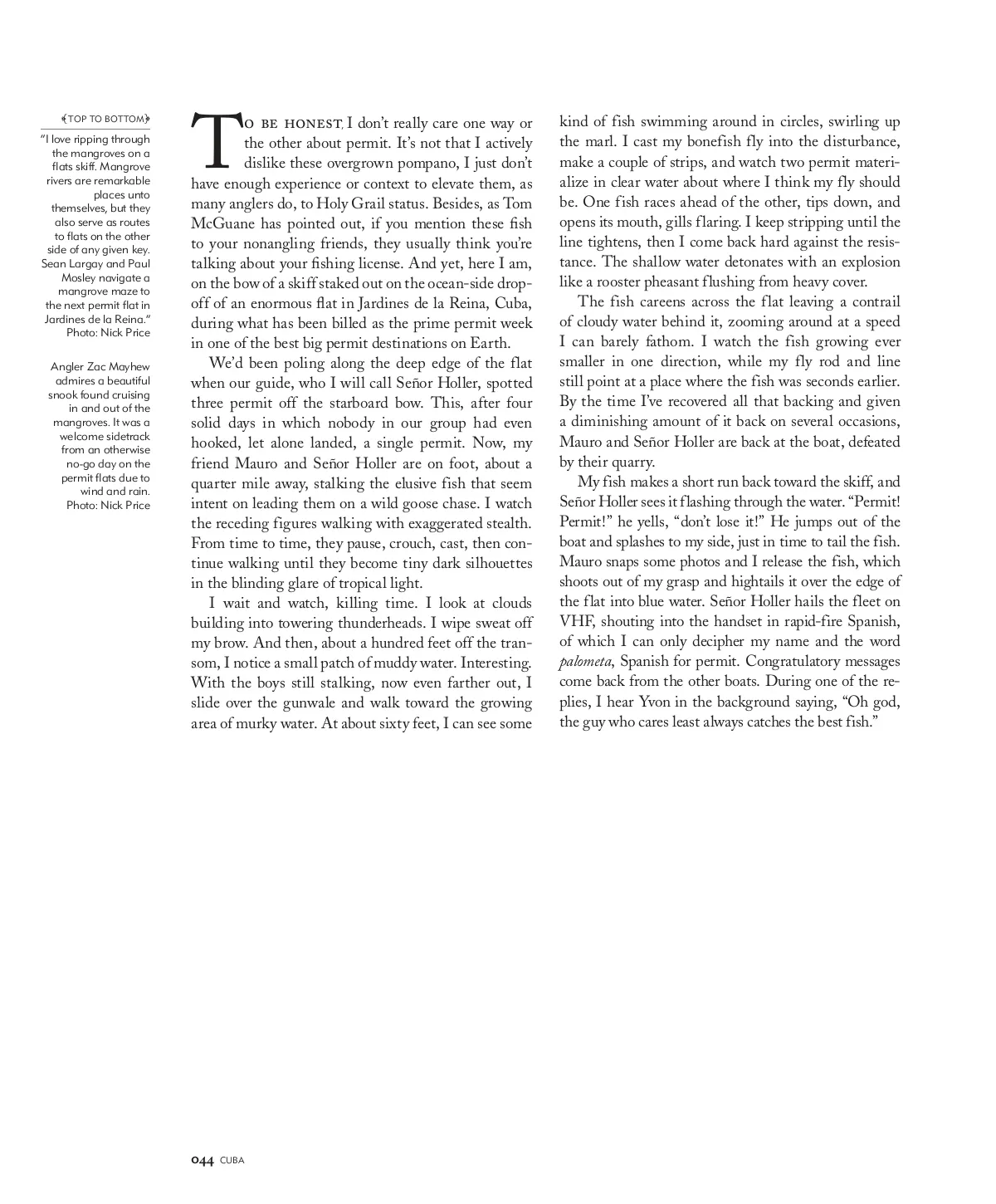
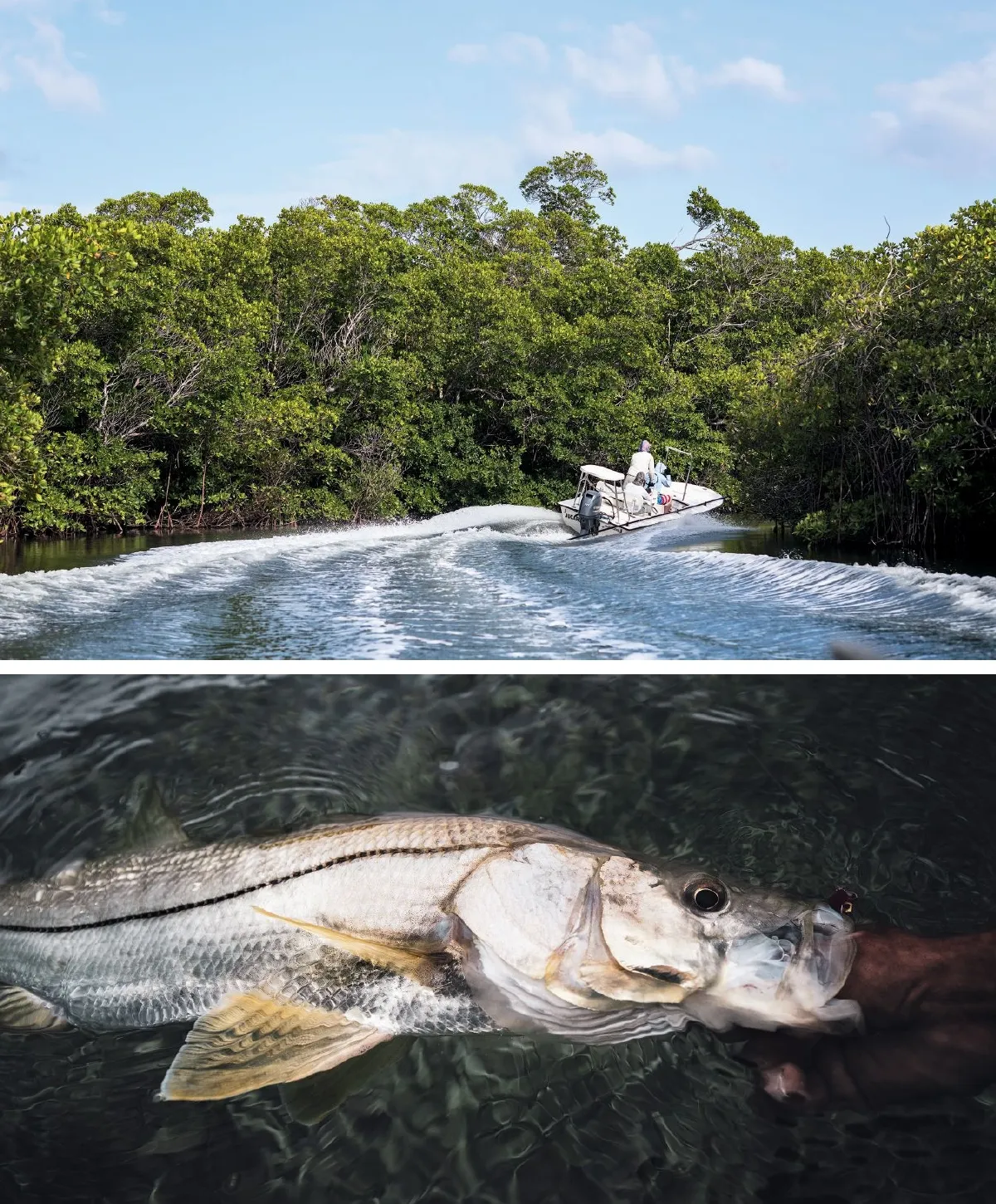
TOP TO BOTTOM “I love ripping through the mangroves on a flats skiff. Mangrove rivers are remarkable places unto themselves, but they also serve as routes to flats on the other side of any given key. Sean Largay and Paul Mosley navigate a mangrove maze to the next permit flat in Jardines de la Reina.” Photo: Nick Price Angler Zac Mayhew admires a beautiful snook found cruising in and out of the mangroves. It was a welcome sidetrack from an otherwise no-go day on the permit flats due to wind and rain. Photo: Nick Price the other about permit. It’s not that I actively dislike these overgrown pompano, I just don’t have enough experience or context to elevate them, as many anglers do, to Holy Grail status. Besides, as Tom McGuane has pointed out, if you mention these fish to your nonangling friends, they usually think you’re talking about your fishing license. And yet, here I am, on the bow of a skiff staked out on the ocean-side drop-off of an enormous flat in Jardines de la Reina, Cuba, during what has been billed as the prime permit week in one of the best big permit destinations on Earth. We’d been poling along the deep edge of the flat when our guide, who I will call Señor Holler, spotted three permit off the starboard bow. This, after four solid days in which nobody in our group had even hooked, let alone landed, a single permit. Now, my friend Mauro and Señor Holler are on foot, about a quarter mile away, stalking the elusive fish that seem intent on leading them on a wild goose chase. I watch the receding figures walking with exaggerated stealth. From time to time, they pause, crouch, cast, then con-tinue walking until they become tiny dark silhouettes in the blinding glare of tropical light. I wait and watch, killing time. I look at clouds building into towering thunderheads. I wipe sweat off my brow. And then, about a hundred feet off the tran-som, I notice a small patch of muddy water. Interesting. With the boys still stalking, now even farther out, I slide over the gunwale and walk toward the growing area of murky water. At about sixty feet, I can see some T o be honest , I don’t really care one way or kind of fish swimming around in circles, swirling up the marl. I cast my bonefish fly into the disturbance, make a couple of strips, and watch two permit materi-alize in clear water about where I think my fly should be. One fish races ahead of the other, tips down, and opens its mouth, gills flaring. I keep stripping until the line tightens, then I come back hard against the resis-tance. The shallow water detonates with an explosion like a rooster pheasant flushing from heavy cover. The fish careens across the flat leaving a contrail of cloudy water behind it, zooming around at a speed I can barely fathom. I watch the fish growing ever smaller in one direction, while my fly rod and line still point at a place where the fish was seconds earlier. By the time I’ve recovered all that backing and given a diminishing amount of it back on several occasions, Mauro and Señor Holler are back at the boat, defeated by their quarry. My fish makes a short run back toward the skiff, and Señor Holler sees it flashing through the water. “Permit! Permit!” he yells, “don’t lose it!” He jumps out of the boat and splashes to my side, just in time to tail the fish. Mauro snaps some photos and I release the fish, which shoots out of my grasp and hightails it over the edge of the flat into blue water. Señor Holler hails the fleet on VHF, shouting into the handset in rapid-fire Spanish, of which I can only decipher my name and the word palometa , Spanish for permit. Congratulatory messages come back from the other boats. During one of the re-plies, I hear Yvon in the background saying, “Oh god, the guy who cares least always catches the best fish.” 044 CUBA
The Flyfish Journal Volume 13, Issue 2: Page 44