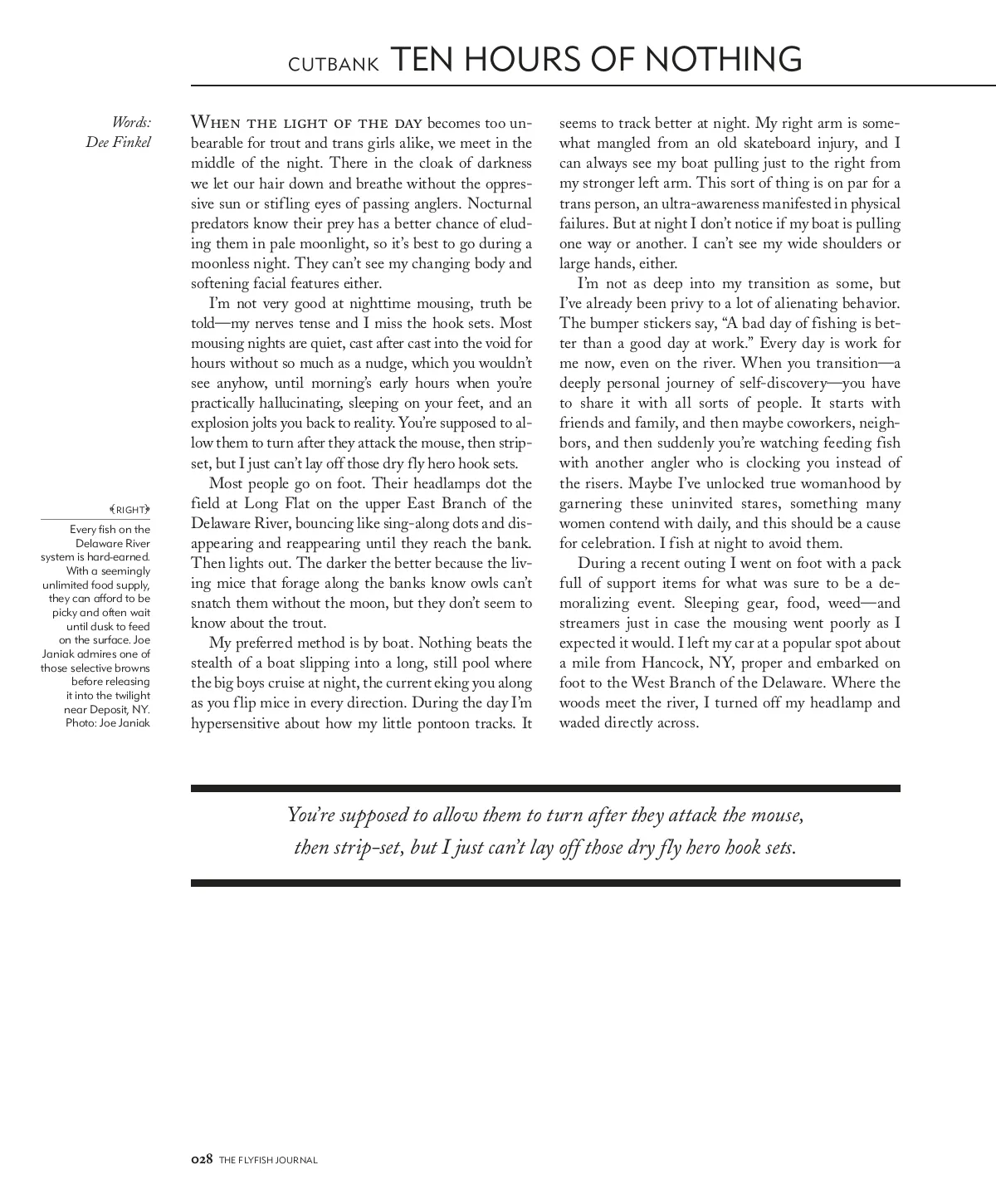
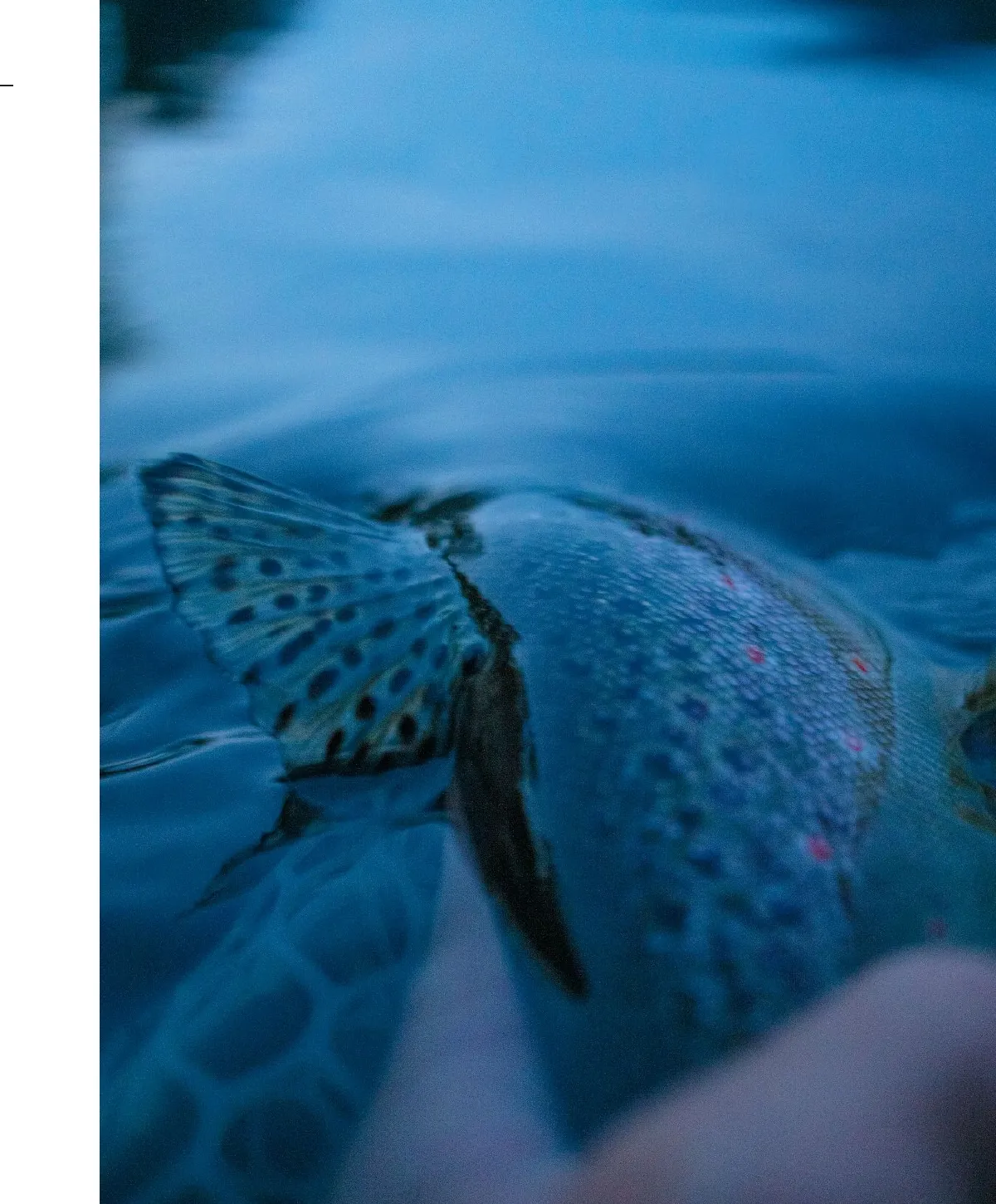
CUTBANK Words: Dee Finkel TEN HOURS OF NOTHING seems to track better at night. My right arm is some-what mangled from an old skateboard injury, and I can always see my boat pulling just to the right from my stronger left arm. This sort of thing is on par for a trans person, an ultra-awareness manifested in physical failures. But at night I don’t notice if my boat is pulling one way or another. I can’t see my wide shoulders or large hands, either. I’m not as deep into my transition as some, but I’ve already been privy to a lot of alienating behavior. The bumper stickers say, “A bad day of fishing is bet-ter than a good day at work.” Every day is work for me now, even on the river. When you transition—a deeply personal journey of self-discovery—you have to share it with all sorts of people. It starts with friends and family, and then maybe coworkers, neigh-bors, and then suddenly you’re watching feeding fish with another angler who is clocking you instead of the risers. Maybe I’ve unlocked true womanhood by garnering these uninvited stares, something many women contend with daily, and this should be a cause for celebration. I fish at night to avoid them. During a recent outing I went on foot with a pack full of support items for what was sure to be a de-moralizing event. Sleeping gear, food, weed—and streamers just in case the mousing went poorly as I expected it would. I left my car at a popular spot about a mile from Hancock, NY, proper and embarked on foot to the West Branch of the Delaware. Where the woods meet the river, I turned off my headlamp and waded directly across. When the light of the day becomes too un-bearable for trout and trans girls alike, we meet in the middle of the night. There in the cloak of darkness we let our hair down and breathe without the oppres-sive sun or stifling eyes of passing anglers. Nocturnal predators know their prey has a better chance of elud-ing them in pale moonlight, so it’s best to go during a moonless night. They can’t see my changing body and softening facial features either. I’m not very good at nighttime mousing, truth be told—my nerves tense and I miss the hook sets. Most mousing nights are quiet, cast after cast into the void for hours without so much as a nudge, which you wouldn’t see anyhow, until morning’s early hours when you’re practically hallucinating, sleeping on your feet, and an explosion jolts you back to reality. You’re supposed to al-low them to turn after they attack the mouse, then strip-set, but I just can’t lay off those dry fly hero hook sets. Most people go on foot. Their headlamps dot the field at Long Flat on the upper East Branch of the Delaware River, bouncing like sing-along dots and dis-appearing and reappearing until they reach the bank. Then lights out. The darker the better because the liv-ing mice that forage along the banks know owls can’t snatch them without the moon, but they don’t seem to know about the trout. My preferred method is by boat. Nothing beats the stealth of a boat slipping into a long, still pool where the big boys cruise at night, the current eking you along as you flip mice in every direction. During the day I’m hypersensitive about how my little pontoon tracks. It RIGHT Every fish on the Delaware River system is hard-earned. With a seemingly unlimited food supply, they can afford to be picky and often wait until dusk to feed on the surface. Joe Janiak admires one of those selective browns before releasing it into the twilight near Deposit, NY. Photo: Joe Janiak You’re supposed to allow them to turn after they attack the mouse, then strip-set, but I just can’t lay off those dry fly hero hook sets. 028 THE FLYFISH JOURNAL
The Flyfish Journal Volume 13, Issue 2: Page 28