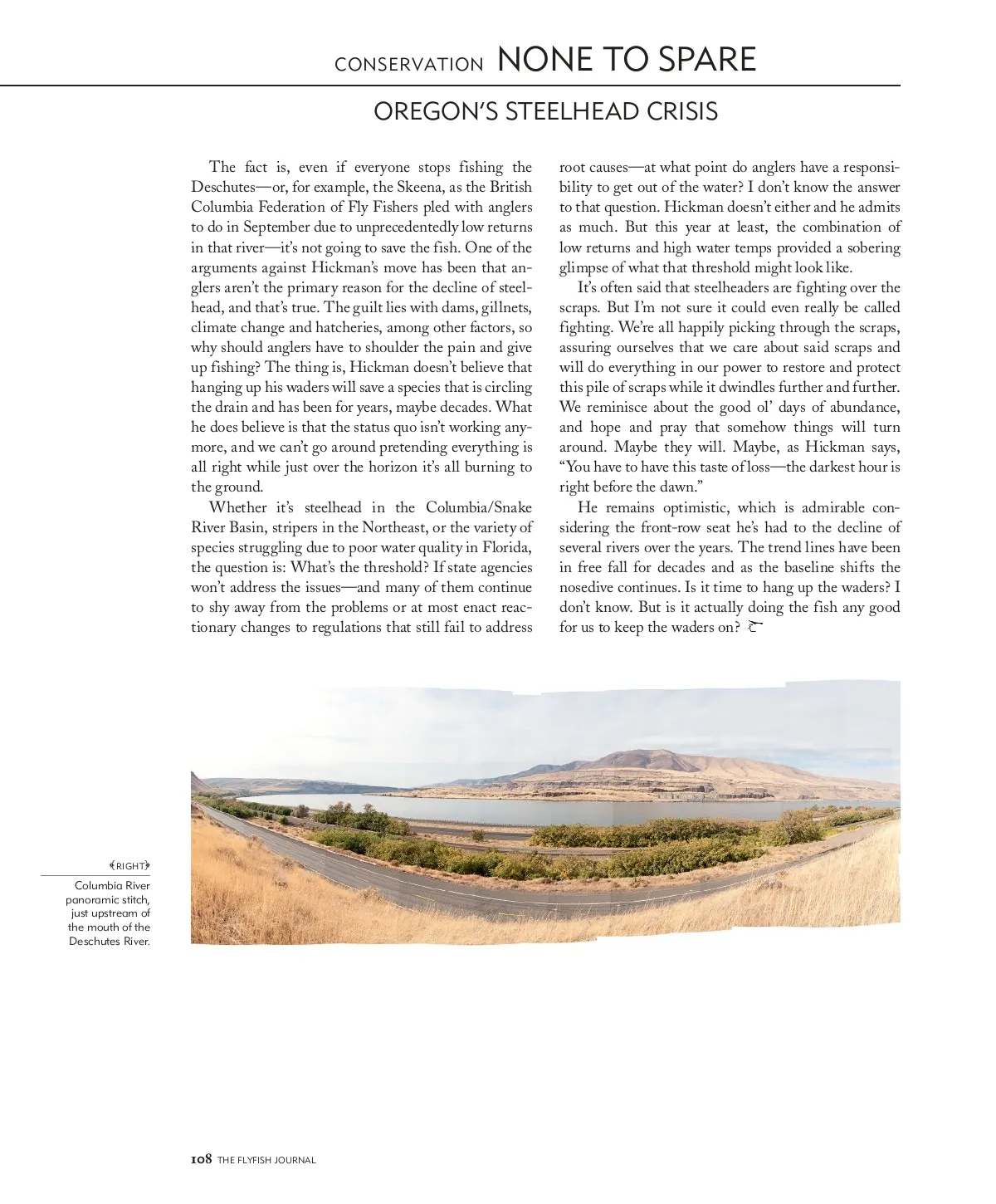
CONSERVATION NONE TO SPARE root causes—at what point do anglers have a responsi-bility to get out of the water? I don’t know the answer to that question. Hickman doesn’t either and he admits as much. But this year at least, the combination of low returns and high water temps provided a sobering glimpse of what that threshold might look like. It’s often said that steelheaders are fighting over the scraps. But I’m not sure it could even really be called fighting. We’re all happily picking through the scraps, assuring ourselves that we care about said scraps and will do everything in our power to restore and protect this pile of scraps while it dwindles further and further. We reminisce about the good ol’ days of abundance, and hope and pray that somehow things will turn around. Maybe they will. Maybe, as Hickman says, “You have to have this taste of loss—the darkest hour is right before the dawn.” He remains optimistic, which is admirable con-sidering the front-row seat he’s had to the decline of several rivers over the years. The trend lines have been in free fall for decades and as the baseline shifts the nosedive continues. Is it time to hang up the waders? I don’t know. But is it actually doing the fish any good for us to keep the waders on? OREGON’S STEELHEAD CRISIS The fact is, even if everyone stops fishing the Deschutes—or, for example, the Skeena, as the British Columbia Federation of Fly Fishers pled with anglers to do in September due to unprecedentedly low returns in that river—it’s not going to save the fish. One of the arguments against Hickman’s move has been that an-glers aren’t the primary reason for the decline of steel-head, and that’s true. The guilt lies with dams, gillnets, climate change and hatcheries, among other factors, so why should anglers have to shoulder the pain and give up fishing? The thing is, Hickman doesn’t believe that hanging up his waders will save a species that is circling the drain and has been for years, maybe decades. What he does believe is that the status quo isn’t working any-more, and we can’t go around pretending everything is all right while just over the horizon it’s all burning to the ground. Whether it’s steelhead in the Columbia/Snake River Basin, stripers in the Northeast, or the variety of species struggling due to poor water quality in Florida, the question is: What’s the threshold? If state agencies won’t address the issues—and many of them continue to shy away from the problems or at most enact reac-tionary changes to regulations that still fail to address RIGHT Columbia River panoramic stitch, just upstream of the mouth of the Deschutes River. 108 THE FLYFISH JOURNAL
The Flyfish Journal Volume 13, Issue 2: Page 108