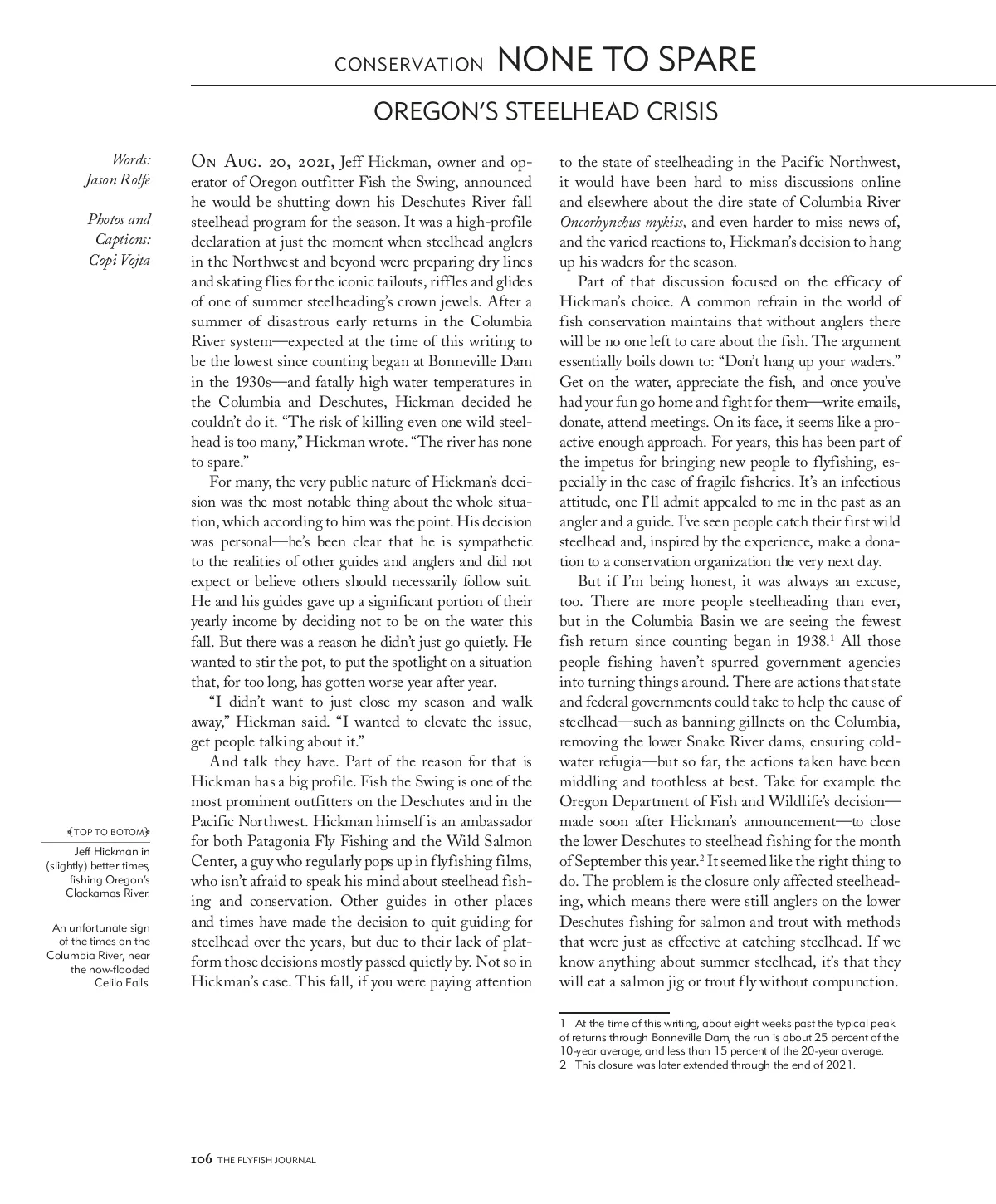
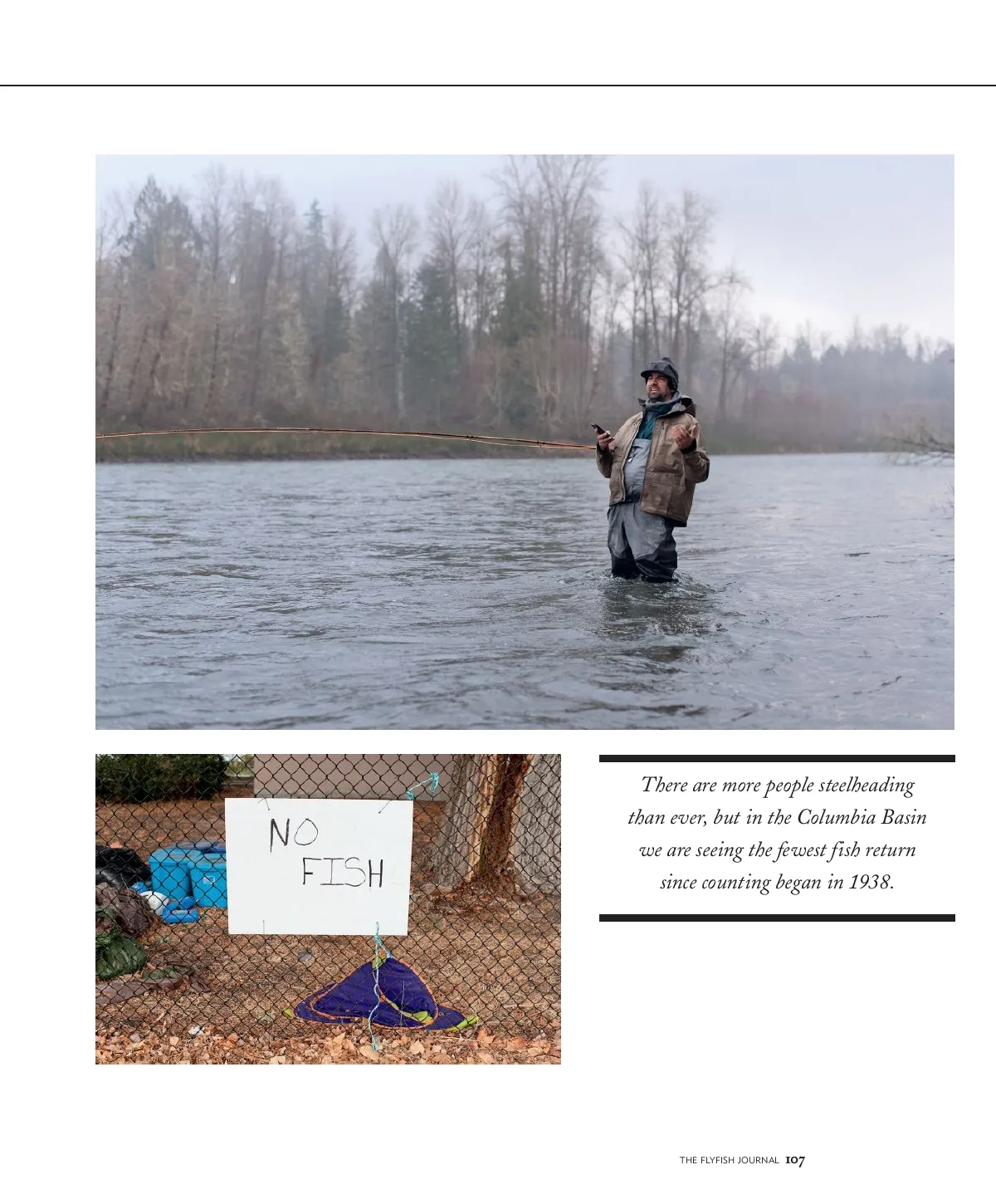
CONSERVATION NONE TO SPARE to the state of steelheading in the Pacific Northwest, it would have been hard to miss discussions online and elsewhere about the dire state of Columbia River Oncorhynchus mykiss, and even harder to miss news of, and the varied reactions to, Hickman’s decision to hang up his waders for the season . Part of that discussion focused on the efficacy of Hickman’s choice. A common refrain in the world of fish conservation maintains that without anglers there will be no one left to care about the fish. The argument essentially boils down to: “Don’t hang up your waders.” Get on the water, appreciate the fish, and once you’ve had your fun go home and fight for them—write emails, donate, attend meetings. On its face, it seems like a pro-active enough approach. For years, this has been part of the impetus for bringing new people to flyfishing, es-pecially in the case of fragile fisheries. It’s an infectious attitude, one I’ll admit appealed to me in the past as an angler and a guide. I’ve seen people catch their first wild steelhead and, inspired by the experience, make a dona-tion to a conservation organization the very next day. But if I’m being honest, it was always an excuse, too. There are more people steelheading than ever, but in the Columbia Basin we are seeing the fewest fish return since counting began in 1938. 1 All those people fishing haven’t spurred government agencies into turning things around. There are actions that state and federal governments could take to help the cause of steelhead—such as banning gillnets on the Columbia, removing the lower Snake River dams, ensuring cold-water refugia—but so far, the actions taken have been middling and toothless at best. Take for example the Oregon Department of Fish and Wildlife’s decision— made soon after Hickman’s announcement—to close the lower Deschutes to steelhead fishing for the month of September this year. 2 It seemed like the right thing to do. The problem is the closure only affected steelhead-ing, which means there were still anglers on the lower Deschutes fishing for salmon and trout with methods that were just as effective at catching steelhead. If we know anything about summer steelhead, it’s that they will eat a salmon jig or trout fly without compunction. 1 At the time of this writing, about eight weeks past the typical peak of returns through Bonneville Dam, the run is about 25 percent of the 10-year average, and less than 15 percent of the 20-year average. 2 This closure was later extended through the end of 2021. OREGON’S STEELHEAD CRISIS Words: Jason Rolfe Photos and Captions: Copi Vojta TOP TO BOTOM Jeff Hickman in (slightly) better times, fishing Oregon’s Clackamas River. An unfortunate sign of the times on the Columbia River, near the now-flooded Celilo Falls. On Aug. 20, 2021, Jeff Hickman, owner and op-erator of Oregon outfitter Fish the Swing, announced he would be shutting down his Deschutes River fall steelhead program for the season. It was a high-profile declaration at just the moment when steelhead anglers in the Northwest and beyond were preparing dry lines and skating flies for the iconic tailouts, riffles and glides of one of summer steelheading’s crown jewels. After a summer of disastrous early returns in the Columbia River system—expected at the time of this writing to be the lowest since counting began at Bonneville Dam in the 1930s—and fatally high water temperatures in the Columbia and Deschutes, Hickman decided he couldn’t do it. “The risk of killing even one wild steel-head is too many,” Hickman wrote. “The river has none to spare.” For many, the very public nature of Hickman’s deci-sion was the most notable thing about the whole situa-tion, which according to him was the point. His decision was personal—he’s been clear that he is sympathetic to the realities of other guides and anglers and did not expect or believe others should necessarily follow suit. He and his guides gave up a significant portion of their yearly income by deciding not to be on the water this fall. But there was a reason he didn’t just go quietly. He wanted to stir the pot, to put the spotlight on a situation that, for too long, has gotten worse year after year. “I didn’t want to just close my season and walk away,” Hickman said. “I wanted to elevate the issue, get people talking about it.” And talk they have. Part of the reason for that is Hickman has a big profile. Fish the Swing is one of the most prominent outfitters on the Deschutes and in the Pacific Northwest. Hickman himself is an ambassador for both Patagonia Fly Fishing and the Wild Salmon Center, a guy who regularly pops up in flyfishing films, who isn’t afraid to speak his mind about steelhead fish-ing and conservation. Other guides in other places and times have made the decision to quit guiding for steelhead over the years, but due to their lack of plat-form those decisions mostly passed quietly by. Not so in Hickman’s case. This fall, if you were paying attention 106 THE FLYFISH JOURNAL
The Flyfish Journal Volume 13, Issue 2: Page 106