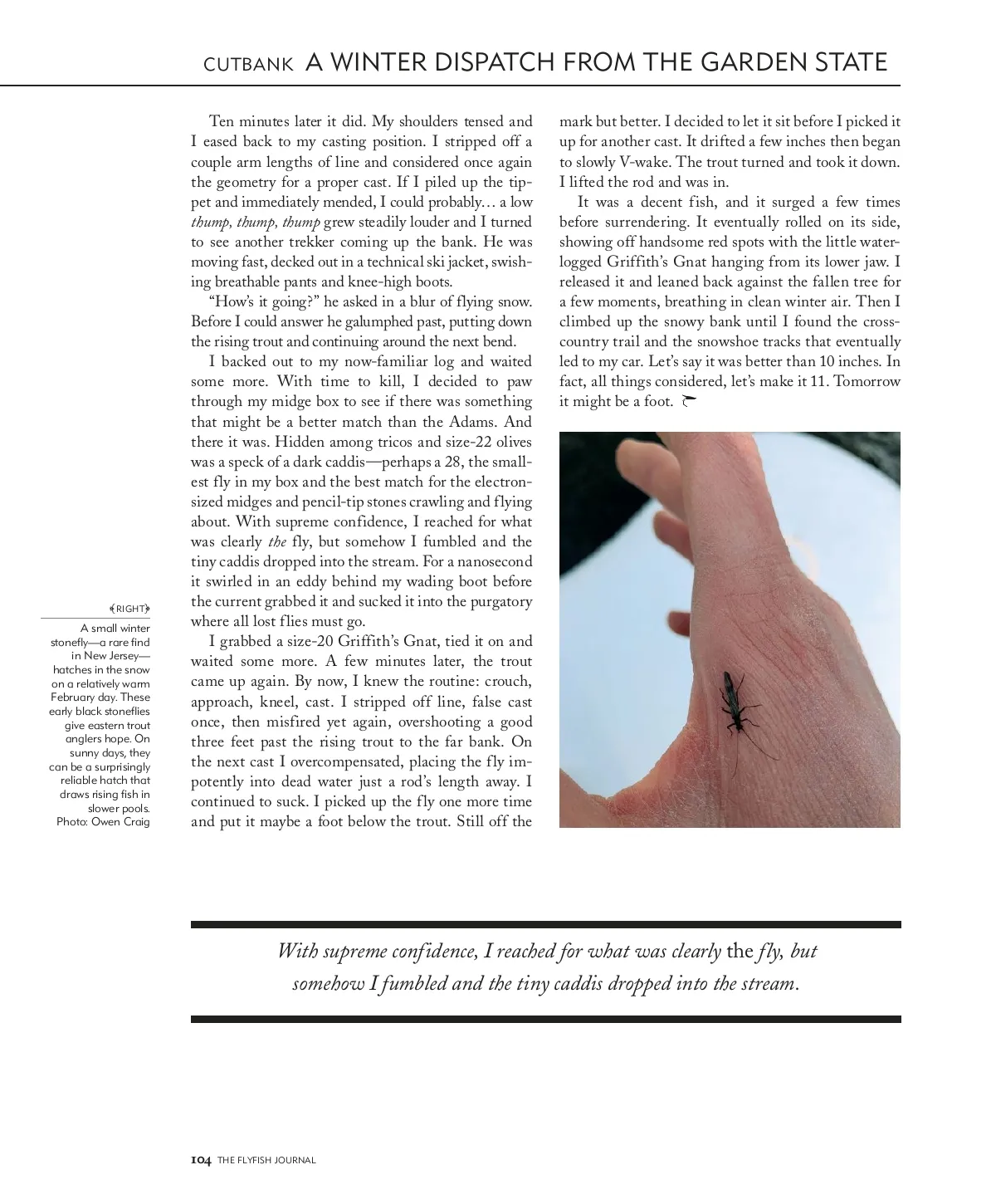
CUTBANK A WINTER DISPATCH FROM THE GARDEN STATE mark but better. I decided to let it sit before I picked it up for another cast. It drifted a few inches then began to slowly V-wake. The trout turned and took it down. I lifted the rod and was in. It was a decent fish, and it surged a few times before surrendering. It eventually rolled on its side, showing off handsome red spots with the little water-logged Griffith’s Gnat hanging from its lower jaw. I released it and leaned back against the fallen tree for a few moments, breathing in clean winter air. Then I climbed up the snowy bank until I found the cross-country trail and the snowshoe tracks that eventually led to my car. Let’s say it was better than 10 inches. In fact, all things considered, let’s make it 11. Tomorrow it might be a foot. RIGHT A small winter stonefly—a rare find in New Jersey— hatches in the snow on a relatively warm February day. These early black stoneflies give eastern trout anglers hope. On sunny days, they can be a surprisingly reliable hatch that draws rising fish in slower pools. Photo: Owen Craig Ten minutes later it did. My shoulders tensed and I eased back to my casting position. I stripped off a couple arm lengths of line and considered once again the geometry for a proper cast. If I piled up the tip-pet and immediately mended, I could probably… a low thump, thump, thump grew steadily louder and I turned to see another trekker coming up the bank. He was moving fast, decked out in a technical ski jacket, swish-ing breathable pants and knee-high boots. “How’s it going?” he asked in a blur of flying snow. Before I could answer he galumphed past, putting down the rising trout and continuing around the next bend. I backed out to my now-familiar log and waited some more. With time to kill, I decided to paw through my midge box to see if there was something that might be a better match than the Adams. And there it was. Hidden among tricos and size-22 olives was a speck of a dark caddis—perhaps a 28, the small-est fly in my box and the best match for the electron-sized midges and pencil-tip stones crawling and flying about. With supreme confidence, I reached for what was clearly the fly, but somehow I fumbled and the tiny caddis dropped into the stream. For a nanosecond it swirled in an eddy behind my wading boot before the current grabbed it and sucked it into the purgatory where all lost flies must go. I grabbed a size-20 Griffith’s Gnat, tied it on and waited some more. A few minutes later, the trout came up again. By now, I knew the routine: crouch, approach, kneel, cast. I stripped off line, false cast once, then misfired yet again, overshooting a good three feet past the rising trout to the far bank. On the next cast I overcompensated, placing the fly im-potently into dead water just a rod’s length away. I continued to suck. I picked up the fly one more time and put it maybe a foot below the trout. Still off the With supreme confidence, I reached for what was clearly the fly, but somehow I fumbled and the tiny caddis dropped into the stream. 104 THE FLYFISH JOURNAL
The Flyfish Journal Volume 13, Issue 2: Page 104