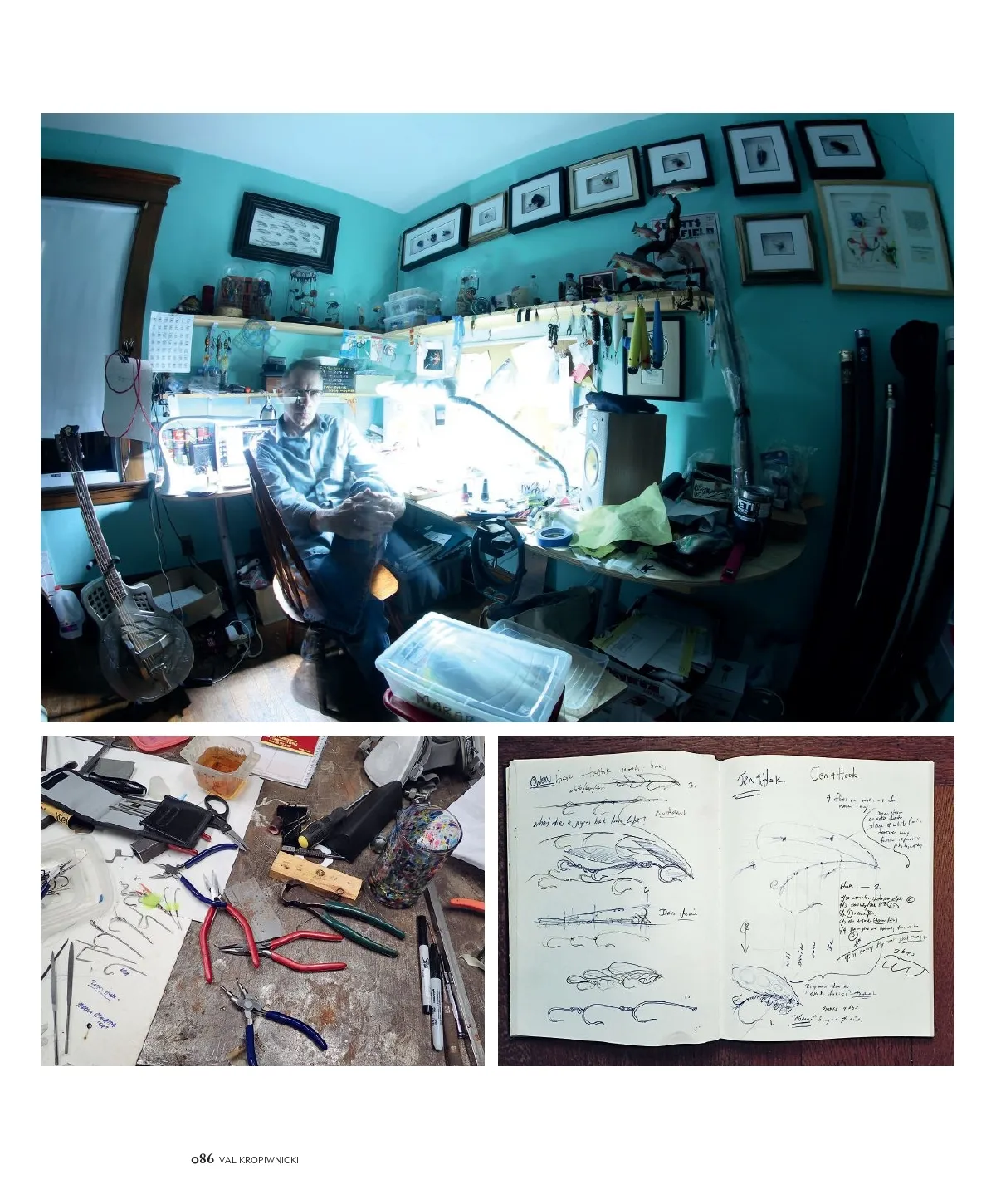
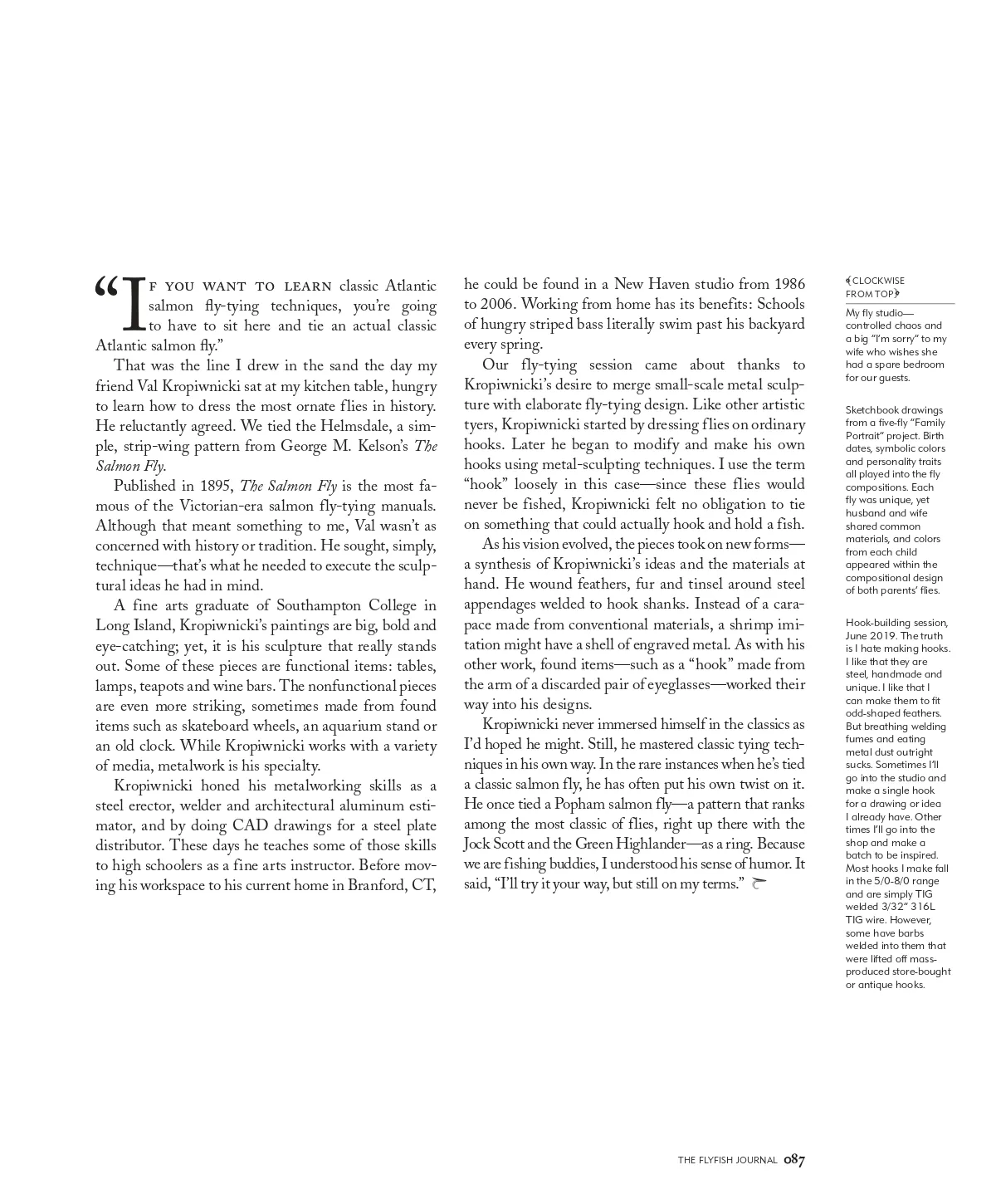
“I f you want to learn classic Atlantic salmon fly-tying techniques, you’re going to have to sit here and tie an actual classic Atlantic salmon fly.” That was the line I drew in the sand the day my friend Val Kropiwnicki sat at my kitchen table, hungry to learn how to dress the most ornate flies in history. He reluctantly agreed. We tied the Helmsdale, a sim-ple, strip-wing pattern from George M. Kelson’s The Salmon Fly . Published in 1895, The Salmon Fly is the most fa-mous of the Victorian-era salmon fly-tying manuals. Although that meant something to me, Val wasn’t as concerned with history or tradition. He sought, simply, technique—that’s what he needed to execute the sculp-tural ideas he had in mind. A fine arts graduate of Southampton College in Long Island, Kropiwnicki’s paintings are big, bold and eye-catching; yet, it is his sculpture that really stands out. Some of these pieces are functional items: tables, lamps, teapots and wine bars. The nonfunctional pieces are even more striking, sometimes made from found items such as skateboard wheels, an aquarium stand or an old clock. While Kropiwnicki works with a variety of media, metalwork is his specialty. Kropiwnicki honed his metalworking skills as a steel erector, welder and architectural aluminum esti-mator, and by doing CAD drawings for a steel plate distributor. These days he teaches some of those skills to high schoolers as a fine arts instructor. Before mov-ing his workspace to his current home in Branford, CT, he could be found in a New Haven studio from 1986 to 2006. Working from home has its benefits: Schools of hungry striped bass literally swim past his backyard every spring. Our fly-tying session came about thanks to Kropiwnicki’s desire to merge small-scale metal sculp-ture with elaborate fly-tying design. Like other artistic tyers, Kropiwnicki started by dressing flies on ordinary hooks. Later he began to modify and make his own hooks using metal-sculpting techniques. I use the term “hook” loosely in this case—since these flies would never be fished, Kropiwnicki felt no obligation to tie on something that could actually hook and hold a fish. As his vision evolved, the pieces took on new forms— a synthesis of Kropiwnicki’s ideas and the materials at hand. He wound feathers, fur and tinsel around steel appendages welded to hook shanks. Instead of a cara-pace made from conventional materials, a shrimp imi-tation might have a shell of engraved metal. As with his other work, found items—such as a “hook” made from the arm of a discarded pair of eyeglasses—worked their way into his designs. Kropiwnicki never immersed himself in the classics as I’d hoped he might. Still, he mastered classic tying tech-niques in his own way. In the rare instances when he’s tied a classic salmon fly, he has often put his own twist on it. He once tied a Popham salmon fly—a pattern that ranks among the most classic of flies, right up there with the Jock Scott and the Green Highlander—as a ring. Because we are fishing buddies, I understood his sense of humor. It said, “I’ll try it your way, but still on my terms.” CLOCKWISE FROM TOP My fly studio— controlled chaos and a big ”I’m sorry” to my wife who wishes she had a spare bedroom for our guests. Sketchbook drawings from a five-fly “Family Portrait” project. Birth dates, symbolic colors and personality traits all played into the fly compositions. Each fly was unique, yet husband and wife shared common materials, and colors from each child appeared within the compositional design of both parents’ flies. Hook-building session, June 2019. The truth is I hate making hooks. I like that they are steel, handmade and unique. I like that I can make them to fit odd-shaped feathers. But breathing welding fumes and eating metal dust outright sucks. Sometimes I’ll go into the studio and make a single hook for a drawing or idea I already have. Other times I’ll go into the shop and make a batch to be inspired. Most hooks I make fall in the 5/0-8/0 range and are simply TIG welded 3/32” 316L TIG wire. However, some have barbs welded into them that were lifted off mass-produced store-bought or antique hooks. THE FLYFISH JOURNAL 087
The Flyfish Journal Volume 11, Issue 1: Page 87