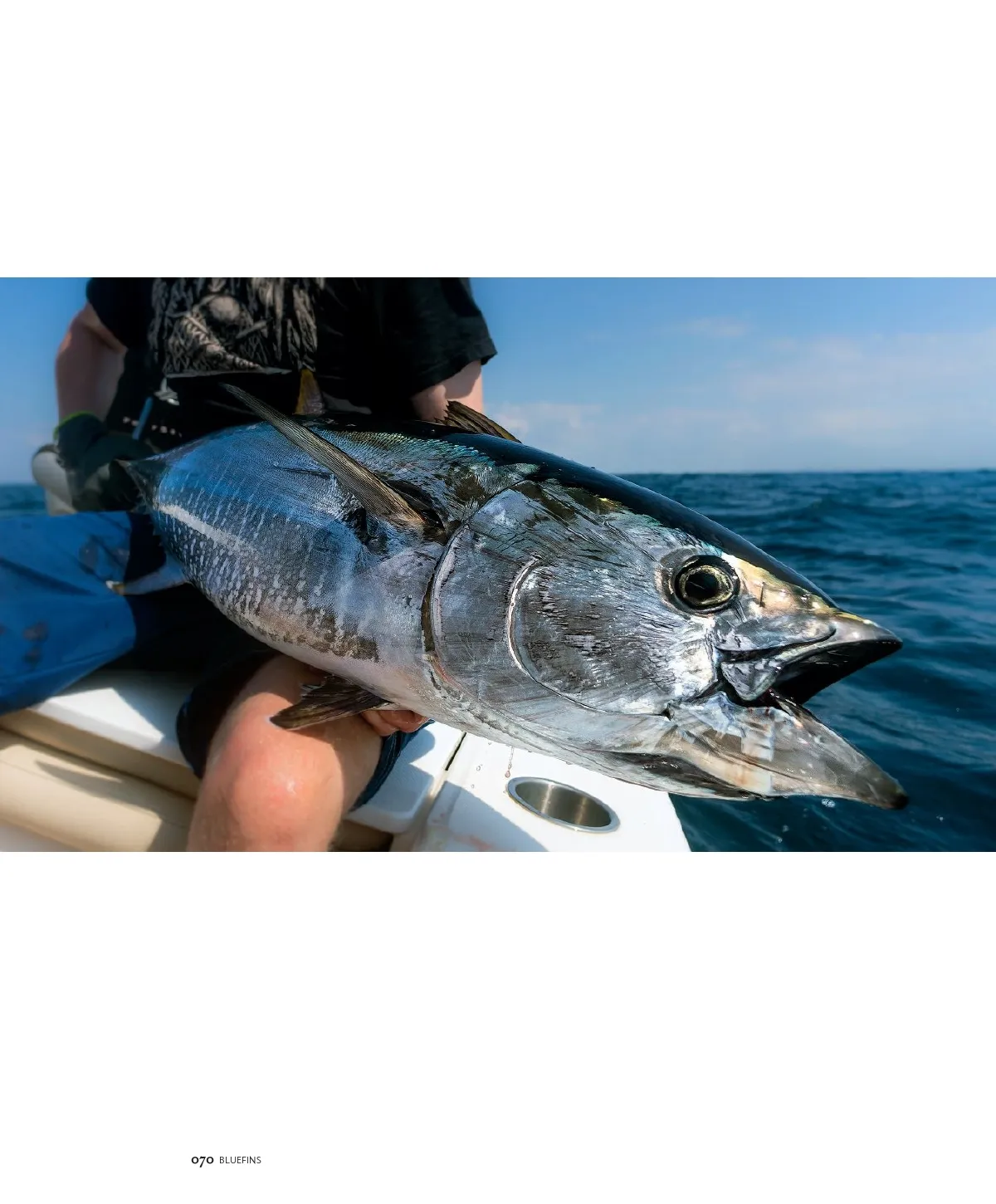
The rest of the battle was the typical slog of a fish that’s exhausted but unwilling to give in. Every time I put pressure on the fish I winced, but it was soon under the boat. I dreaded the death dance tuna make when they sound directly under the boat. It’s hard to put the wood to a fish directly beneath the boat without break-ing a rod; it requires short pumps of the rod and min-iscule gains of line after each, while never bringing the rod above the horizontal. I’ve had yellowfin tuna dive straight down into my backing. Luckily, being near shore we were only in 50 feet of water. The fish couldn’t go too deep and after a short time I had it close to the surface, vibrating in circles, and after a few passes at its tail Mike had my first bluefin firmly in hand. It was small for a bluefin. Probably a yearling. But it was my first, with all the satisfaction of catching the first of any species, whether it be a brook trout or a carp. This spring I spent a week with my family on Cape Cod. I pestered large schoolie stripers every morning, hitting the beach before dawn and returning to our rental house before my wife and son rolled out of bed. One achingly clear morning at our breakfast table overlooking Nauset Beach, I thought I saw a tiny splash on the horizon and grabbed my binoculars. The 10x50s quickly brought a large pod of whales into view, humpbacks blowing bubble trails to disorient baitfish, probably large sand lance, and above the cavorting whales intense and frantic waves of gulls and shearwa-ters, plucking from the surface the wounded baitfish the whales didn’t inhale. Although they were a couple miles off, I could almost smell the torn-up baitfish and whale breath and hear the shrieks of the plunging birds. And from past experiences out there, I knew tuna would be in the mix. I couldn’t resolve the binoculars close enough to see the plumes of feeding bluefin, but I am certain they were in the melee. There was nothing I could do about it. They were closer to shore than usual, but all my charter boat captain buddies were booked, and these days no one wants to burn a lot of gas chasing bluefin for the remote chance of a hookup and probably a broken leader—or worse. The word from the offshore fisher-men is that most of the tuna these days are about 100 pounds, doable on a fly rod but not easy, and back-breaking work if you are fortunate to hold on to one. But every now and then I hear reports of people seeing small footballs in the mix—15-to-40 pounders—and if someone were to invite me on a trip to chase them, I would drop everything. Don Quixote had his wind-mills; I’ve got my bluefin. LEFT “Ilkka Neva holds one of two fish brought to the boat during a day of fishing in France’s Bay of Biscay. We had plenty of bluefin feeding on top just on the edge of the deep water. Aside from the two fish landed, there were plenty of others that didn’t stick or broke off during the fight. All fish were taken on small, two-inch Surf Candies; the fish ignored anything bigger.” Photo: Jari Koski THE FLYFISH JOURNAL 071
The Flyfish Journal Volume 11, Issue 1: Page 71